
Wheat streak mosaic
Tenuivirus persotritici
Description
Symptoms
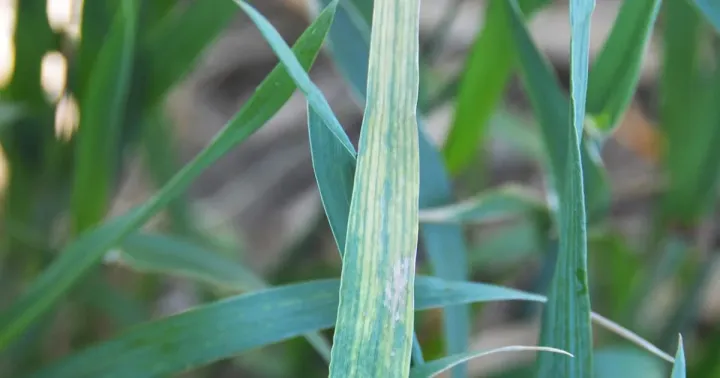
The most distinctive symptom is a mosaic-like pattern of yellow, discontinuous streaks or dashes that run parallel to the leaf veins, giving the plant a mottled appearance.
Infected plants exhibit stunted growth and reduced vigor. They often appear chlorotic and, in severe cases, may show leaf curling and necrosis of leaf tissue.
Plants infected early in the season often show signs of severe dwarfing and may fail to produce viable tillers, leading to a thin and patchy crop stand.
Reproductive organs are frequently impacted: heads may be small, malformed, or sterile, resulting in shriveled or absent grain, which causes massive yield reduction.
- Discontinuous yellow streaks on leaves.
- Overall plant stunting and dwarfing.
- Reduced number of productive tillers.
- Malformed or sterile grain heads.
Pathogen
The pathogen responsible for this disease is the Wheat streak mosaic virus (WSMV), a member of the Tritimovirus genus within the Potyviridae family.
The virus consists of flexuous, filamentous particles. It is a systemic pathogen that invades the vascular tissues, effectively hijacking the host plant's metabolic pathways.
The primary vector for the transmission of WSMV is the wheat curl mite (Aceria tosichella). Mites acquire the virus while feeding on infected plant tissues and subsequently transmit it to healthy wheat plants.
The virus is not soil-borne in the traditional sense; rather, it persists in living plant tissues, including volunteer wheat, winter cereals, and various wild grassy weeds.
Understanding the biology of the wheat curl mite is crucial, as the disease cycle is inextricably linked to the mite's migration patterns and population dynamics.
Conditions for development
Disease development is heavily influenced by a "green bridge," where volunteer wheat or early-planted winter wheat serves as an inoculum source for emerging fall crops.
Warm, extended autumn weather is highly favorable for the multiplication and rapid spread of the wheat curl mite, increasing the risk of widespread infection.
Wind plays a critical role in the dissemination of the virus, as it carries infected mites from senescing wheat fields to newly emerged seedlings.
The survival of the mite during the summer months is dependent on the availability of green hosts, which directly dictates the initial level of viral pressure on the next season's crop.
Temperatures between 20°C and 25°C are optimal for both viral replication and mite reproduction, creating high-risk windows for agricultural producers.
Why it matters
The economic impact of Wheat streak mosaic is significant, often resulting in devastating yield losses that can range from minor reductions to total crop failure.
In addition to lower grain volume, the disease negatively affects the quality of the harvested produce, resulting in low test weights and poor milling characteristics.
The physiological stress caused by the virus makes the crop more susceptible to environmental stressors such as drought and extreme cold, as well as secondary fungal infections.
Because the disease spreads from infected fields, the damage is typically patchy, creating irregular areas of unproductive crops that are difficult to manage.
The inability to treat the virus itself makes prevention the only viable way to mitigate the substantial economic losses associated with this disease.
Protection
Management focuses on breaking the "green bridge" by eliminating all volunteer wheat and grass hosts at least two weeks before planting new winter wheat.
Strategic planting dates are essential; delaying planting until temperatures cool down can significantly reduce the activity of the wheat curl mite and decrease infection rates.
Implementing proper field spacing and choosing resistant or tolerant wheat varieties are the most effective strategies for long-term disease management.
While chemical control of the mite vector exists, it is generally ineffective for large-scale wheat production due to the mite's behavior and the systemic nature of the virus.
Monitoring local mite populations and avoiding the planting of susceptible winter wheat near fields with active infestations is a critical scouting practice.
Discussion
No discussions yet — be the first.