
Description
Symptoms
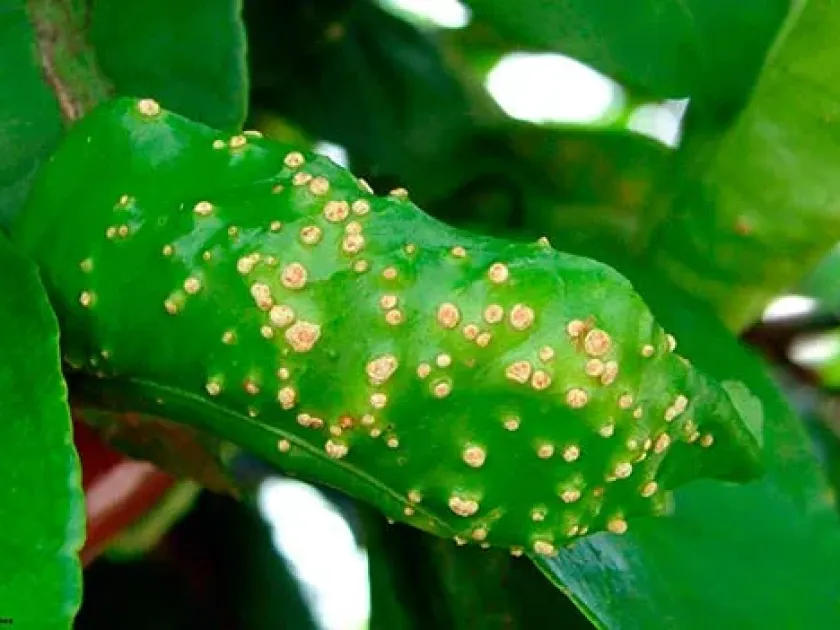
The initial signs of citrus scab appear as small, semi-translucent, yellowish spots on the undersides of young leaves. These spots gradually develop into raised, grayish or tan, corky pustules.
On the fruit surface, the disease manifests as rough, brown, wart-like scabs. These lesions can be isolated or coalesced, causing significant deformation and making the fruit appear unappealing.
Leaves that are heavily infected often become distorted and stunted. The reduction in healthy leaf area significantly impacts the plant's ability to undergo photosynthesis, thereby weakening the tree over time.
Twigs and young shoots also show severe lesions, leading to twisting, curling, and eventually dieback. The texture of the infected areas is distinctly rough and dry, which makes identification quite simple for experienced growers.
Severe infections can lead to premature abscission of fruit and leaves, resulting in visible thinning of the canopy and reduced overall vigor of the citrus tree.
Pathogen
The causative agent of citrus scab is the fungus Elsinoë fawcettii (anamorph Sphaceloma fawcettii). This fungal pathogen primarily targets young, actively growing tissues of citrus plants, causing significant cosmetic and physiological damage.
The fungus survives during unfavorable periods as mycelium or spores within infected lesions on twigs, leaves, and fruit. Once environmental conditions become favorable, it initiates primary infections on new flushes.
Dissemination of the pathogen occurs through the movement of conidia, which are easily transported by splashing rain, dew, or irrigation water. Strong winds can also carry the fungal spores over short distances to healthy leaves.
Elsinoë fawcettii acts by penetrating the leaf epidermis and stimulating abnormal cell growth. This results in the characteristic tissue hyperplasia, forming the bumpy, wart-like lesions that define the disease.
The life cycle of the pathogen is intricately linked to host development. As long as young, succulent citrus tissue is present, the fungus remains active and continues its infection cycle throughout the growing season.
Conditions for development
Citrus scab thrives in conditions characterized by high humidity and moderate temperatures. The fungus requires free moisture, such as rain or heavy dew, to germinate and infect host tissues successfully.
The optimal temperature range for the development of Elsinoë fawcettii is between 20°C and 25°C. In these conditions, the fungal incubation period is short, allowing for rapid disease spread.
Poor airflow within the orchard or in home gardens creates micro-environments that remain moist for extended periods. This persistence of moisture on foliage is a primary driver of scab epidemics.
Dense, unpruned tree canopies provide shaded, humid environments that favor the fungus. Proper canopy management is essential to prevent the accumulation of moisture that the pathogen requires for colonization.
Young flushes occurring during rainy spring periods are particularly vulnerable. When wet weather persists during the fruit set phase, the risk of infection to developing fruit is extremely high.
Why it matters
The primary economic impact of citrus scab is the devaluation of fruit due to unsightly lesions. This makes the citrus unsuitable for the fresh market, leading to significant financial losses for growers.
In addition to cosmetic issues, the disease affects tree vigor. Constant stress from fungal infection reduces the overall yield potential and can eventually lead to a decline in the tree's health.
Nurseries are particularly vulnerable, as the disease can lead to the rejection of entire batches of saplings. Ensuring clean nursery stock is critical to preventing the spread of the disease to new orchards.
Damaged fruit skins provide entry points for opportunistic decay fungi, which can cause internal rot during transit and storage, further increasing post-harvest losses.
Young trees with heavy infections may suffer from stunted growth, requiring a longer time to reach maturity and start producing economically viable yields.
Protection
Effective management begins with the use of certified, disease-free planting material. Avoiding the introduction of infected nursery stock is the most important step in prevention.
Sanitation is key; pruning and destroying infected twigs and fruit will significantly reduce the primary inoculum load in the orchard. This practice should be followed by proper canopy management to improve airflow.
Chemical control usually involves the application of copper-based fungicides. These should be applied preventively during critical growth stages, especially during the bloom and fruit set period.
Irrigation methods that avoid wetting the foliage, such as drip irrigation, help in keeping the leaves dry and reducing the risk of fungal infection compared to overhead sprinkler systems.
- Regular monitoring of the orchard during flush growth.
- Disinfecting pruning tools between trees to stop the spread.
- Planting resistant citrus varieties if available in your region.
- Strategic fungicide sprays during high-risk rainy weather.
Pathogens and affected parts
Affects crops · 1
Discussion
No discussions yet — be the first.