
Powdery scab of potato
Spongospora
Description
Symptoms
Initial symptoms on tubers appear as small, raised, light-colored pustules that gradually expand as the disease progresses.
These pustules eventually rupture, releasing a dark, powdery mass of spores and necrotic skin debris, exposing the tuber tissue.
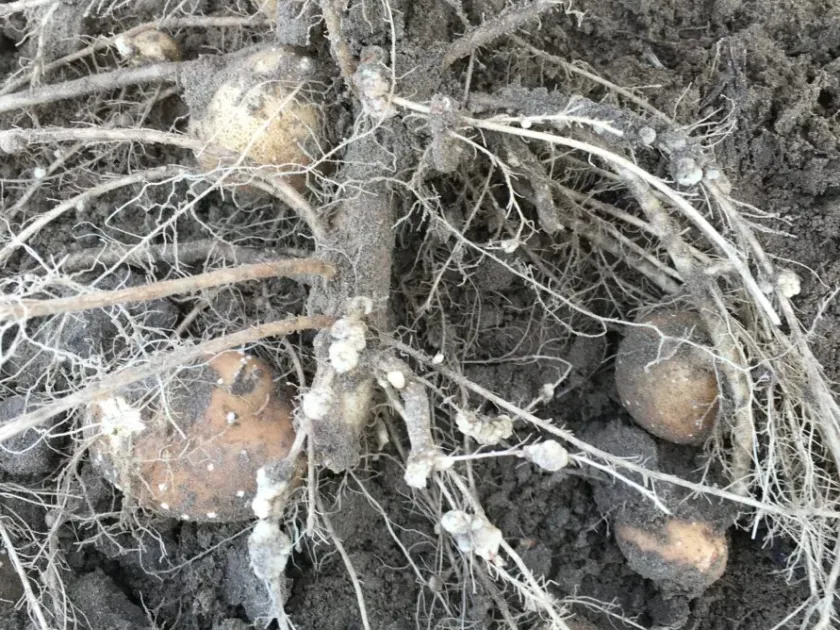
On root systems, the pathogen induces the formation of galls, which are knobby, irregular growths that impair nutrient uptake.
Severe infestations render tubers unmarketable and serve as entry points for various secondary rot-causing bacteria and fungi.
- small, raised pustules on the tuber surface;
- dark, powdery spore mass visible after skin rupture;
- knobby galls on roots and stolons;
- overall stunting and wilting of the potato plants.
Pathogen
The disease is caused by the obligate parasite Spongospora subterranea, an organism belonging to the Plasmodiophorales order.
This pathogen specifically targets the roots, stolons, and tubers of the potato plant throughout the growing season.
Its life cycle involves the formation of biflagellate zoospores that swim through soil water films to infect the plant tissues.
The organism persists in the soil for many years as clusters of resting spores, which are highly resistant to environmental stressors.
Furthermore, this pathogen is recognized as the primary vector for the Potato Mop-Top Virus, causing severe systemic issues in infected crops.
Conditions for development
Powdery scab development is strongly correlated with cool temperatures, typically between 12°C and 18°C, and high soil moisture levels.
Poorly drained soils or waterlogged areas significantly increase the risk and severity of the disease spreading within a field.
Acidic soil conditions favor the germination of resting spores, making the pathogen more aggressive in such environments.
The disease is often introduced to clean fields through contaminated seed potatoes or soil attached to agricultural machinery.
Irrigation practices that maintain constant soil saturation during tuber formation exacerbate the spread of the fungal zoospores.
Why it matters
The primary economic impact of powdery scab is the significant reduction in tuber quality, making potatoes unsuitable for premium markets.
Infected tubers lose weight more rapidly during storage due to the damage to their skin, which allows for increased water loss.
The presence of root galls limits the plant's ability to extract moisture, leading to decreased yields and smaller tuber size.
Since the pathogen is soilborne and extremely persistent, affected fields often require long rotations before potatoes can be grown again safely.
Transmission of virus diseases via the parasite complicates the management of potato production, often resulting in significant financial losses.
Protection
The most effective strategy is to plant only certified, disease-free seed tubers in fields with no history of the pathogen.
Implementing long-term crop rotation schemes, ideally for 4–5 years, helps to reduce the inoculum density in the soil.
Improving field drainage and ensuring proper soil aeration are essential to minimize the wet conditions required by the parasite.
Fungicidal seed treatments are available and can help protect the developing tubers from early-season infections.
Managing soil pH through liming can create an environment that is less conducive to the survival and spread of Spongospora subterranea.
Discussion
No discussions yet — be the first.