
Rugulopteryx okamurae
Rugulopteryx okamurae
Description
Symptoms
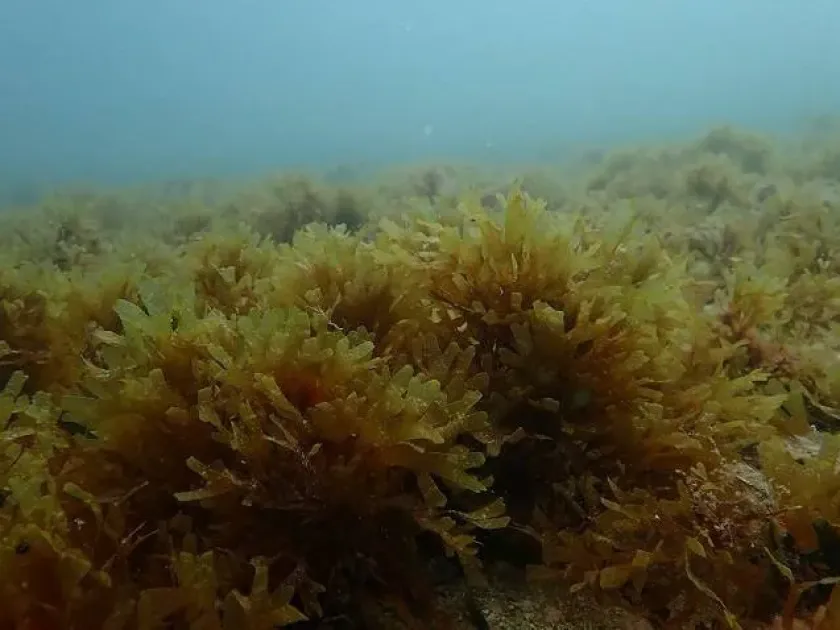
The most prominent sign of infestation is the appearance of dark brown or olive-green seaweed masses covering rocky substrates and sea bottoms.
It is distinguished by its characteristic wrinkled or "rugose" surface texture, which gives the species its specific name and identifies it from local flora.
A mass invasion leads to the complete displacement of native seaweed communities, resulting in an underwater monoculture of this invasive species.
Early colonization stages can be identified by isolated thalli anchoring onto rock formations, which then begin to proliferate in multiple directions.
Accumulation of decaying seaweed on coastal beaches, producing foul odors and attracting insects, serves as a major sign of high biomass levels in the water.
Pathogen
Rugulopteryx okamurae is a species of brown seaweed within the Dictyotaceae family that has become a globally recognized invasive threat to marine environments.
While not a traditional agricultural crop pathogen, it acts as an aggressive ecological invader that disrupts native marine flora and biological balance.
The species is native to the northwestern Pacific Ocean, but human-mediated dispersal, particularly through ballast water, has facilitated its global expansion.
It exhibits high biological plasticity, allowing it to adapt to diverse coastal conditions and propagate through rapid vegetative growth.
The structure consists of dichotomously branched blades that quickly develop into extensive, dense mats, effectively carpeting the seafloor.
Conditions for development
Rugulopteryx okamurae thrives in water temperatures ranging from 10 to 25 degrees Celsius, making it suitable for both temperate and subtropical environments.
It prefers nutrient-rich waters where sunlight penetration is sufficient, allowing for high rates of photosynthesis and biomass accumulation.
The species demonstrates significant tolerance to varying salinity levels, which supports its spread into estuaries and harbors frequented by ships.
Human transport via maritime shipping lanes acts as the primary vector for spreading fragments, which easily reattach to new surfaces if conditions are met.
A lack of natural herbivores in invaded regions allows this species to occupy ecological niches without the usual biological checks and balances.
Why it matters
The primary impact is a severe reduction in marine biodiversity, as it outcompetes and smothers native seaweeds and small invertebrates.
Commercial fishing is impacted by the species clogging nets and fishing gear, which increases operating costs and reduces the efficiency of local fleets.
Coastal tourism and recreational areas suffer from the heavy accumulation of rotten seaweed on beaches, which requires costly and repeated clean-up efforts.
The alteration of the seafloor structure disrupts the breeding grounds for local fish populations, negatively affecting the entire marine food chain.
In ports, massive accumulations of the algae can obstruct maritime infrastructure and interfere with water intake systems for various industrial applications.
Protection
Currently, there is no reliable method to completely eradicate Rugulopteryx okamurae from the open sea, making prevention the highest priority.
Strict regulation of ballast water discharge for vessels arriving from invaded regions is the most effective way to prevent further introduction.
Mechanical removal from harbors and high-value ecosystem areas provides temporary relief and protects essential infrastructure from immediate clogging.
Biological control research is ongoing, but the potential risks of introducing natural predators into new environments must be carefully evaluated first.
Continuous monitoring programs in coastal zones allow for the early detection of the algae, which is crucial for managing its spread in protected regions.
Discussion
No discussions yet — be the first.