
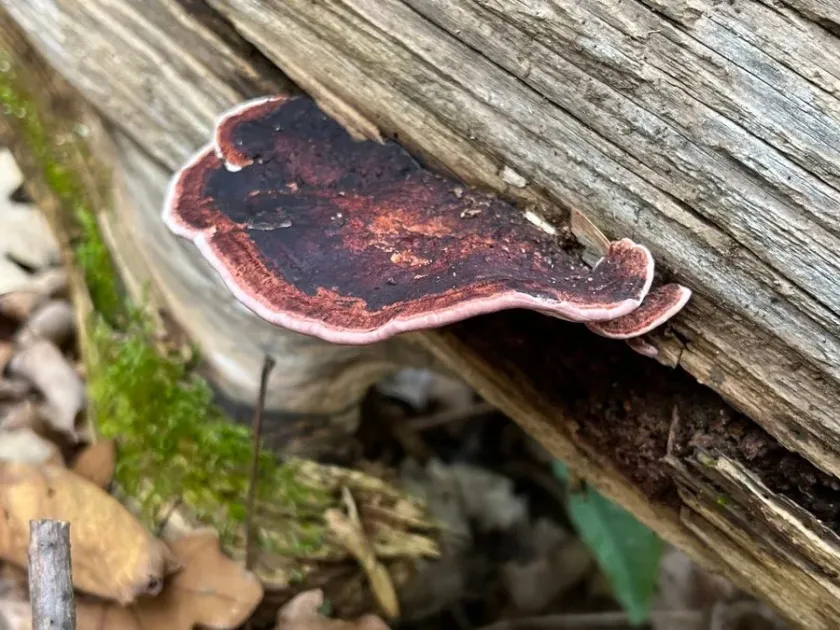
Description
Symptoms
The main sign of infection is the appearance of characteristic fungal fruiting bodies on tree trunks. They are often found in clusters and have a cushion-like or hoof-like shape.
Internal changes in the wood manifest as intense darkening of the affected areas. The wood turns brown and eventually becomes brittle, breaking into small cubes.
As the disease progresses, cracking of the wood occurs both along and across the grain, with white fungal mats or mycelial cords often visible within the cracks.
In infected Douglas-fir trees, overall vitality declines: premature needle yellowing, crown thinning, and the gradual death of individual branches are frequently observed.
In the final stages of decay, the trunk loses structural integrity, which leads to windthrow and stem breakage even under moderate wind conditions.
Pathogen
The causative agent of this disease is the wood-decaying fungus Fomitopsis cajanderi, which belongs to the Basidiomycota division. This fungus causes active destruction of wood, attacking both dead and weakened living trees.
Biologically, this pathogen is classified as a facultative parasite capable of existing for long periods as a saprotroph on woody debris or stumps. The fungal mycelium penetrates the tree trunk, secreting enzymes that break down lignin and cellulose.
The type of disease is defined as brown wood rot. During its development, the fungus forms perennial fruiting bodies, which serve as the primary source for spore dispersal.
The fruiting bodies of this fungus are characterized by colors ranging from pink to reddish-brown. It is this visual appearance of these structures that gave the disease its common name.
The pathogen's life cycle is closely linked to environmental humidity and temperature, making forest stands in temperate climates the most vulnerable zones for its development.
Conditions for development
The development of Fomitopsis cajanderi is favored by high humidity conditions, particularly in dense stands with poor air circulation. The pathogen prefers moderate temperatures.
An important factor in its spread is mechanical damage to the bark, through which fungal spores easily penetrate into the trunk, bypassing the tree's natural defensive barriers.
The disease is more common in overmature or improperly managed forests where significant amounts of dead woody material have accumulated, serving as a substrate.
Weakening of trees due to drought, insect pest infestations, or exposure to industrial emissions significantly increases the likelihood of infection.
Spore dispersal occurs via air currents over long distances, making the complete isolation of infection centers in natural conditions virtually impossible.
Why it matters
The primary damage lies in the qualitative deterioration of the wood, rendering it entirely unsuitable for industrial use in construction or timber manufacturing.
From a forestry perspective, Fomitopsis cajanderi is a dangerous pest of Douglas-fir and other coniferous species, causing premature mortality in forest stands.
Infection leads to reduced forest productivity and disruption of ecological balance in areas with a high incidence of diseased trees.
Economic losses include costs for sanitation logging, disposal of affected timber, and reforestation efforts in the damaged areas.
The risk of infection spreading to adjacent healthy trees necessitates regular monitoring of forest stand health by forest managers.
Protection
The primary control measure is strict adherence to forest sanitation rules, including the timely removal of infected trees and the clearance of logging residues.
It is essential to avoid mechanical damage to the bark during forestry operations, as wounds serve as entry points for the infection.
The formation of mixed-species stands is recommended, as they typically exhibit higher resistance to the spread of fungal pathogens compared to pure monocultures.
- Implementation of regular sanitation harvesting.
- Use of biological wood preservatives in high-value areas.
- Maintaining optimal planting density to prevent moisture stagnation.
In cases where infection centers are identified, quarantine measures should be implemented to prevent further spore dispersal to nearby territories.
Pathogens and affected parts
Affects crops · 1
Discussion
No discussions yet — be the first.