
Description
Symptoms
The first visual symptoms of the infection often manifest only when the fungus has already significantly damaged the root system. Trees exhibit noticeable thinning and chlorosis (yellowing) of needles, which indicates a disruption in nutrient uptake.
A characteristic sign is the reduction of shoot growth and a general decline in the tree's vitality. Gradually, the crown becomes sparse, needles fall off, often accompanied by the premature shedding of lower branches.
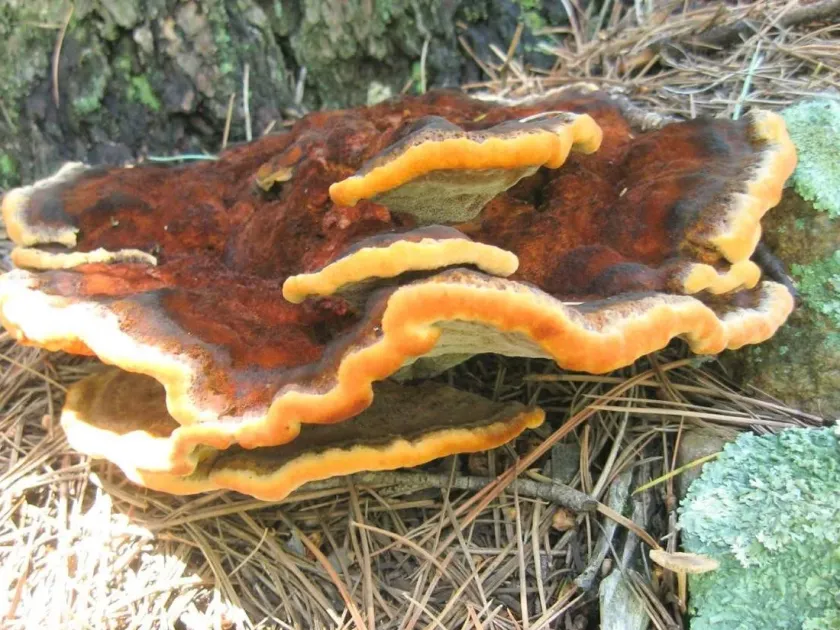
Fruiting bodies of Phaeolus schweinitzii can be found on roots and at the base of the trunk. They have a velvety surface, initially golden-yellow or orange, and acquire a brown hue as they mature.
Upon inspection of the root system, severe wood decay is observed, where the wood becomes brittle and crumbles easily in the hands. In areas of infection, the wood acquires a specific turpentine-like odor, typical for many fungal diseases of conifers.
In the final stage of the disease, the tree loses stability and is often subject to windthrow. Due to root rot, even minor gusts of wind can lead to the fall of trees that appear externally healthy.
Pathogen
The causative agent of this disease is the fungus Phaeolus schweinitzii, belonging to the class of Basidiomycetes. This parasite primarily leads a soil-borne lifestyle and is classified as a facultative parasite, capable of surviving both on living tree tissues and dead wood.
The fungus attacks the root system and the butt (base) of conifer trunks. During its biological cycle, it produces characteristic fruiting bodies in the form of rosettes or funnels, which often appear at the base of infected trees or directly on the roots.
The infection spreads both through spores carried by air currents and by root contact through root grafts. The fungal mycelium can survive in soil and stumps for a long time, awaiting contact with new susceptible roots of healthy plants.
The type of disease is defined as brown cubical rot. The fungus intensively decomposes wood cellulose, leading to a change in its structure, loss of strength, and a characteristic color change to dark brown, followed by cracking into cubical fragments.
The primary hosts in forest stands are Douglas fir, as well as pine, spruce, and larch. Mature trees are most susceptible to infection, as the fungus prefers the already formed heartwood of roots and the lower part of the trunk.
Conditions for development
The development of the fungus is favored by high soil moisture and poor aeration of the root zone. Waterlogging creates ideal conditions for basidiospore germination and active mycelial growth in the soil substrate.
The infection most often attacks stands weakened by other factors, such as drought, mechanical root damage, or unfavorable soil conditions. Healthy and vigorous trees have better immunity against pathogen entry.
A temperature range from +15 to +25 degrees Celsius is optimal for the growth of Phaeolus schweinitzii mycelium. During this period, the fungus most aggressively colonizes host tissues.
The spread of the pathogen is significantly accelerated in stands with a high density of same-aged trees. The close proximity of root systems facilitates the rapid transfer of mycelium from an infected plant to neighboring healthy ones.
The presence of stumps and decaying wood in the forest creates an "infectious background" that sustains the fungal population for many years. Fresh stumps after harvesting become entry points for spores, which then spread the infection to the roots of nearby trees.
Why it matters
The main danger lies in the fact that the disease is hidden and leads to the total destruction of the root system. This makes nutrient intake impossible, which inevitably leads to the slow death of the tree.
The damage manifests in significant losses of timber, as the affected part of the trunk becomes unsuitable for construction or woodworking due to deep rot.
Infection of Douglas fir and pines leads to the formation of windthrow patches. Such forest areas require immediate sanitary logging, which disrupts the integrity of the stands and requires significant expenditure on reforestation.
The fungus seriously reduces the quality of wood by attacking the most valuable butt section of the trunk. This results in direct economic losses for forestry due to the devaluation of timber products.
In the long term, the presence of Phaeolus schweinitzii in a stand makes normal forest management on that site impossible. The infectious agent persists in the soil for decades, which hinders the successful planting of new conifer cultures.
Protection
The key control method is adherence to forest hygiene rules. It is necessary to promptly remove infected trees and fresh stumps from stands to minimize the spread of mycelium through roots.
During reforestation, it is recommended to avoid planting monocultures in areas where disease outbreaks have previously been noted. Mixing conifers with broadleaved species can significantly slow the spread of fungal mycelium in the soil.
It is important to avoid mechanical damage to roots and trunk bases during thinning or other forestry operations. Any wound is an open gate for infection entry.
To prevent the spread of the fungus in outbreak areas, isolation trenches are used to break contact between the root systems of healthy and infected trees. This is a labor-intensive but effective method for localizing the disease.
In nurseries, fungicidal treatments of soil and planting material should be used to protect young seedlings. Regular monitoring of root system health allows for early detection of the disease when the outbreak can still be contained.
Pathogens and affected parts
Affects crops · 1
Discussion
No discussions yet — be the first.