
Description
Symptoms
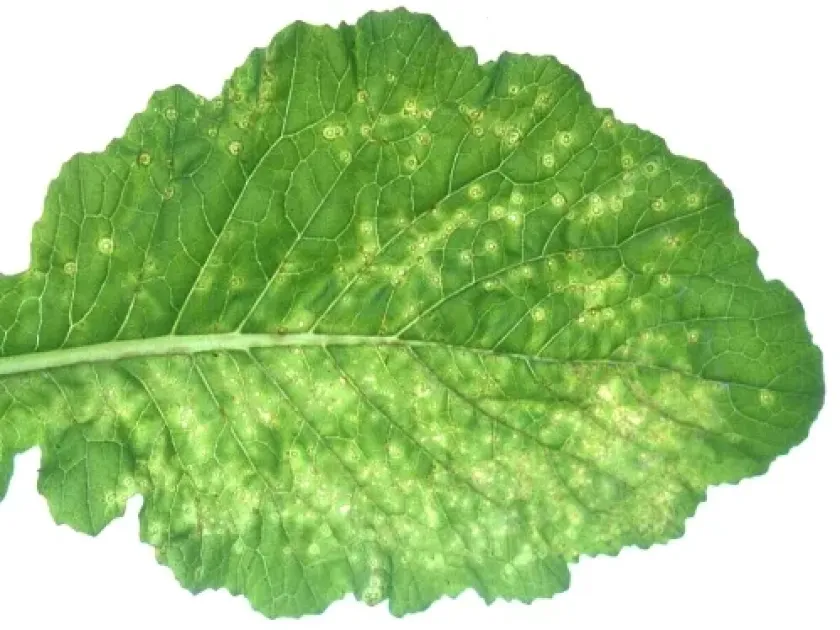
The disease typically begins with the appearance of chlorotic spots and light green mottling on younger leaves. As the disease progresses, these spots develop into a characteristic mosaic pattern with alternating light and dark areas.
Leaf deformation is a hallmark sign of infection. Affected leaves often become curled, wavy, or asymmetrical, with significant reductions in overall leaf surface area in severe cases.
Plants infected at an early growth stage show significant stunting and poor development. For radishes, the storage roots often become malformed, woody, or undersized, making them unmarketable.
In winter oilseed rape, the infection leads to reduced cold tolerance and suppressed growth of the vegetative mass. Shoots may be stunted, and the flowering process often becomes erratic or completely inhibited.
- Initial vein clearing on young leaf tissues.
- Mottled yellow spots and rings appearing on leaves.
- Severe stunting of the entire plant.
- Significant curling and distortion of leaf blades.
Pathogen
Radish mosaic disease is caused by the Radish mosaic virus (RMV), a member of the Comoviridae family. This pathogen is a significant threat to crops within the Brassicaceae family.
The virus exhibits high persistence in infected plant debris and seeds of specific host weeds, which serves as a primary inoculum source for subsequent growing seasons.
Transmission occurs primarily through insect vectors, specifically various species of aphids and flea beetles. These insects acquire the virus while feeding on infected plant tissue and transmit it to healthy plants during subsequent feeding sessions.
Mechanical transmission is also possible. The virus can spread through contaminated tools during pruning, weeding, or other routine agricultural practices that cause damage to plant tissues.
A broad host range includes radish, winter oilseed rape, turnip, and various wild cruciferous weeds, which act as reservoirs, maintaining the virus in the environment throughout the year.
Conditions for development
The spread of the virus is heavily dependent on the population dynamics of its insect vectors. Warm and dry weather conditions typically trigger mass migrations of aphids and beetles to crop fields.
The presence of wild cruciferous weeds near fields creates a green bridge, allowing the virus to persist and accumulate until the main crop is planted and begins to emerge.
Agricultural practices that promote high plant density can create favorable microclimatic conditions for vectors to thrive, increasing the frequency of virus transmission events.
Improper field hygiene, such as leaving volunteer plants or weeds in the field after harvest, provides an ideal environment for the virus to survive the winter months.
Consecutive planting of cruciferous crops on the same site prevents the disruption of the virus cycle, leading to an increased infectious load in the soil and surrounding area.
Why it matters
Radish mosaic virus causes substantial economic losses, particularly in farms specializing in vegetables and oilseed production. The damage is largely irreversible once a plant is infected.
For radish growers, the loss of aesthetic and taste qualities of the roots renders the harvest unfit for commercial distribution, leading to direct financial losses.
In winter oilseed rape, the virus significantly reduces crop yield and potential. Plants weakened by the virus are less able to survive winter stress and are more susceptible to secondary pathogenic infections.
The virus disrupts normal physiological processes, leading to weakened immune responses. This makes crops more susceptible to secondary fungal or bacterial pathogens, which further exacerbate the decline.
Overall, the economic burden increases due to the need for frequent pesticide applications to manage vector populations and potential yield losses of up to 50% in heavily infested areas.
Protection
Effective management requires a multi-faceted approach centered on strict field sanitation and the control of insect vectors like aphids and flea beetles using appropriate insecticides.
Implementing spatial isolation is crucial. Fields should be located at a significant distance from areas where cruciferous crops were grown the previous year or where weed reservoirs are abundant.
Agricultural hygiene, including the thorough destruction of plant residues and weeds immediately after harvest, is vital to eliminate potential overwintering sites for the virus.
Selecting certified, virus-free seeds and utilizing resistant cultivars, when available, are the most reliable methods for mitigating the risk of viral infection.
Strict crop rotation with non-host species is essential to break the disease cycle and reduce the inoculum pressure in the field over time.
Pathogens and affected parts
Affects crops · 2
Discussion
No discussions yet — be the first.