
Pseudocochliobolus
Pseudocochliobolus
Description
Symptoms
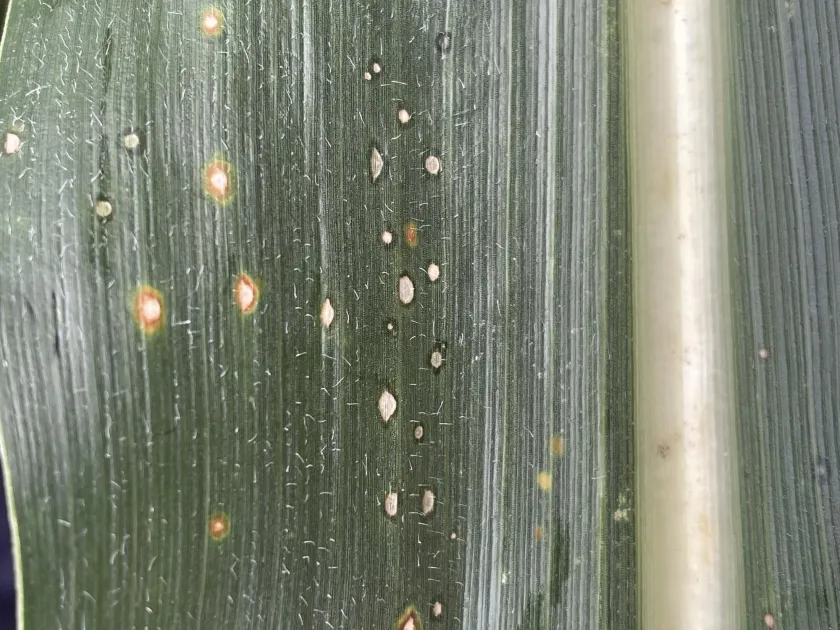
Initial symptoms typically appear as small chlorotic spots on the foliage that gradually enlarge, often taking on an elliptical or elongated shape characteristic of the infection.
As the disease progresses, these spots develop brown or dark gray centers, often surrounded by a distinct yellow chlorotic halo caused by fungal toxins diffusing into healthy tissue.
Under humid conditions, a dark olive-colored velvet-like layer of conidial spores appears on the surface of the lesions, which is a key diagnostic feature for field identification.
The infection can spread to leaf sheaths, stems, and heads. In severe cases, significant necrosis occurs, leading to the yellowing and wilting of the entire leaf structure.
- Chlorotic spots on leaves
- Necrotic patches with dark centers
- Dark velvety spore growth
- Premature leaf senescence
- Reduced vigor of the entire plant
Pathogen
The disease is caused by fungi of the genus Pseudocochliobolus, which belong to the Ascomycota division. This pathogen is often the teleomorphic stage of various imperfect fungi.
The fungus survives primarily as mycelium or conidia within crop residues, soil, and occasionally within infected seeds, serving as a primary source of inoculum for new seasons.
The life cycle of the pathogen is highly adaptable, involving both asexual production of conidia for rapid spread and sexual reproduction through ascospores to increase genetic diversity.
The pathogen utilizes complex enzymatic mechanisms to degrade plant tissues, allowing it to penetrate cell walls and absorb nutrients, which ultimately leads to tissue death.
Environmental plasticity allows these fungi to maintain viability under a wide range of temperatures and moisture conditions, making them resilient in various agricultural ecosystems.
Conditions for development
Optimal development of Pseudocochliobolus requires high humidity, specifically periods of prolonged leaf wetness, which are essential for spore germination and infection.
The fungus thrives in moderate temperature ranges, typically between 20°C and 30°C. Fluctuations in these ranges can trigger faster sporulation and spread across the field.
High-density planting configurations create a stagnant microclimate within the canopy, trapping moisture and promoting the rapid secondary spread of the fungal disease.
Continuous cropping without proper rotation allows the accumulation of pathogenic spores in the upper layers of the soil, significantly increasing the probability of outbreaks.
Imbalanced soil fertility, particularly low levels of potassium or micronutrients like copper, weakens plant defense systems and facilitates easier entry for the pathogen.
Why it matters
The primary impact of the disease is the substantial reduction of the photosynthetic leaf area, which directly correlates to a decrease in biomass and final grain yield.
The infection results in grain shriveling and reduced test weight, which significantly impacts the marketability and grade of the harvested agricultural product.
Yield losses due to Pseudocochliobolus can vary, but in conducive epidemic years, they can range from 15 to 40 percent of total production potential.
Plants affected by the disease are often more susceptible to secondary pathogens and abiotic stresses, such as drought, which further exacerbates the economic damage.
The financial burden is compounded by the necessity for multiple fungicide applications and the potential rejection of crops that do not meet quality standards.
Protection
Effective management starts with a robust crop rotation strategy, which interrupts the life cycle of the pathogen by removing suitable hosts from the field for several seasons.
Deep plowing or incorporating crop residues into the soil helps to accelerate the decomposition process and reduces the survival rate of the fungal inoculum.
Using certified, fungicide-treated seed is a critical preventative measure that protects seedlings during the most vulnerable early growth stages of the plant.
Integrated pest management (IPM) practices, including balanced fertilization and timely weed control, help maintain high plant immunity and reduce canopy moisture.
Strategic application of systemic fungicides should be prioritized based on field monitoring, targeting the disease during its early stages to achieve maximum efficacy.
Discussion
No discussions yet — be the first.