
Description
Symptoms
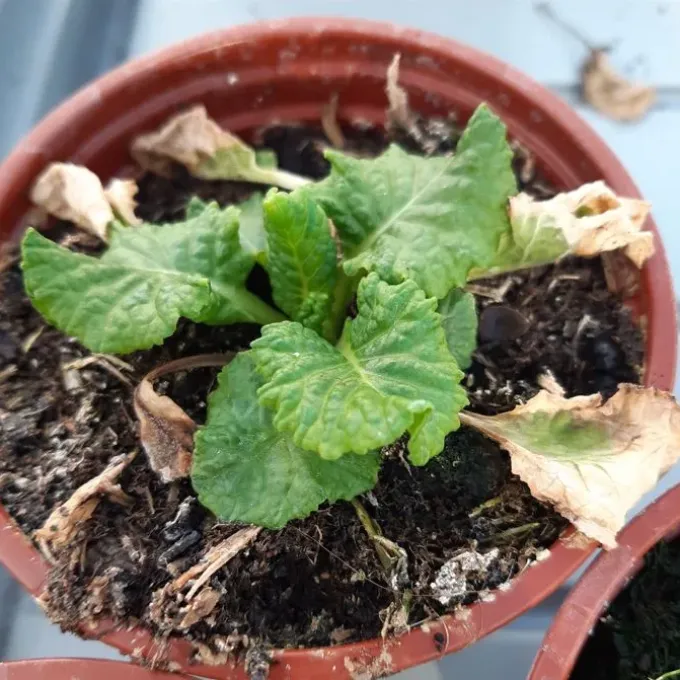
The primary symptom of the disease is the appearance of a characteristic mosaic pattern on primula leaves, consisting of alternating light green, yellowish, and dark green patches.
In severe cases, the leaf blades become deformed, curled, or wrinkled, which significantly ruins the ornamental appearance of the plant.
In the early stages of infection, chlorotic spots or ring patterns may appear on young leaves, becoming more pronounced over time.
The disease is often accompanied by general growth stunting: the primula significantly lags in development compared to healthy specimens.
Flower stalks in virus-infected plants are often shortened, and the flowers may display variegated coloring, losing their varietal uniformity, or fail to form entirely.
Pathogen
The disease is caused by various viruses, most commonly identified as Cucumber mosaic virus and Tobacco mosaic virus.
These are obligate parasites that lack cellular structure and can only replicate inside the living tissues of the host plant, utilizing its biochemical resources.
Viral particles affect various species of the Primula genus, including Primula malacoides, Primula obconica, and Primula vulgaris.
Inside the plant, the virus spreads rapidly through the phloem, systemically infecting all organs, including roots, shoots, and flower stalks, making control extremely difficult.
The vectors of infection are most often sap-sucking pests, such as aphids, thrips, and whiteflies, which transmit the virus while feeding on the juices of diseased plants.
Conditions for development
Viral infection development is favored by conditions that promote the mass reproduction of insect vectors, especially in greenhouse environments or in dense plantings.
The spread of the disease accelerates rapidly under conditions of high humidity and moderate temperatures when the activity of aphids and other pests peaks.
An important transmission factor is mechanical transfer: infection can spread through garden tools if they are not disinfected after working with an infected plant.
Lack of light and poor agricultural practices that weaken the primula's immunity make the plants more susceptible to systemic viral invasion.
The virus can persist in overwintering perennial weeds or plant debris, which become reservoirs of infection at the beginning of the next growing season.
Why it matters
Primula mosaic causes significant economic losses to flower nurseries, as infected plants lose their market appeal and are unsuitable for sale.
Severe infection leads to premature leaf drop and the death of individual shoots, which eventually leads to the complete death of the plant.
Due to the disruption of photosynthetic processes, diseased primulas rarely set flower buds, rendering further cultivation of the specimen pointless.
Virus-infected plants are a constant source of infection, posing a threat to the entire collection in a garden or greenhouse.
Viral diseases cannot be cured with chemical agents, so the only solution upon detecting symptoms is the radical destruction of infected specimens.
Protection
The main method of control is strict adherence to phytosanitary standards: regular inspection of plantings and the immediate culling of plants showing signs of mosaic.
Active control of insect pests is necessary, using broad-spectrum insecticides to prevent the transmission of the virus by aphids and thrips.
All tools used for primula care must be thoroughly disinfected with alcohol or bleach solution after each operation involving a plant.
Regular weeding in the area is recommended, as weeds can serve as intermediate hosts for both viruses and insect vectors.
- Use healthy planting material.
- Maintain spatial isolation between seedlings and mature plants.
- Provide timely fertilization to strengthen the general immunity of primulas.
Pathogens and affected parts
Affects crops · 4
Discussion
No discussions yet — be the first.