
Potato virus Y
Potyvirus vetuberosi
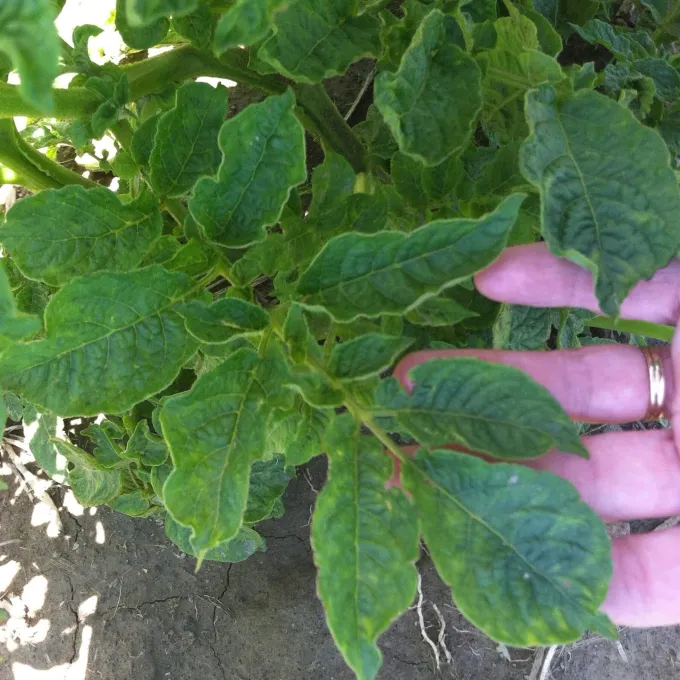
Description
Symptoms
The symptoms of Potato virus Y are highly diverse and depend on the virus strain, potato variety, and environmental conditions at the time of infection.
Typical signs include leaf mosaic, various forms of mottling, vein necrosis, and the curling of leaf blades.
In cases of primary infection (during the current season), symptoms may appear as mild vein clearing, which later progresses into more distinct leaf variegation.
Secondary infection (from infected tubers) usually manifests in more severe forms: plant stunting, significant leaf deformation, and premature senescence of the foliage.
- Mosaic and mottling patterns
- Necrosis on the underside of veins
- Leaf deformation and curling
- Overall plant stunting
- Premature yellowing and drying of the canopy
Pathogen
The causal agent of this disease is Potato virus Y (PVY), which belongs to the genus Potyvirus. It is one of the most significant and widespread pathogens affecting solanaceous crops globally.
The virus consists of filamentous particles containing single-stranded RNA. Its primary biological characteristic is high genetic variability, resulting in numerous strains that differ in virulence and symptom expression.
The main reservoir of infection during the off-season is infected potato tubers used for propagation. Additionally, the virus can persist in perennial weed hosts within the Solanaceae family.
Aphids serve as the primary vectors, transmitting the virus in a non-persistent manner. This means the insect picks up the virus during a brief probing puncture on an infected plant and immediately transmits it to healthy tissues.
Transmission occurs extremely rapidly, as only a few seconds of aphid feeding are sufficient to successfully infect a healthy potato plant.
Conditions for development
The development of the virus is favored by weather conditions that promote the active reproduction and migration of aphid populations, the primary vectors.
Warm and dry weather during the early stages of the growing season accelerates the life cycle of insect vectors, leading to a surge in the number of infection foci in fields.
The presence of infection sources nearby, such as infested seed potato plots or poorly managed fields with weeds, significantly facilitates the spread of the virus.
Poor agricultural practices, particularly the use of non-certified or saved seed material, are critical factors in the long-term accumulation of the virus within an agro-ecosystem.
Dense planting and the lack of proper spatial isolation between potato fields of different generations create ideal conditions for rapid pathogen transmission.
Why it matters
Potato virus Y is considered one of the most economically damaging diseases, capable of reducing yield by up to 80% during major outbreaks.
Infection leads to a significant decrease in photosynthetic activity, which directly results in smaller tuber sizes and a reduction in the total number of tubers per plant.
The major hazard is the rapid degeneration of potato varieties; with each subsequent generation grown from infected tubers, productivity declines exponentially.
The market quality of the tubers deteriorates significantly, as they become malformed and small, rendering them unsuitable for retail and storage purposes.
High viral loads in seed stocks eventually make the use of home-saved seeds impossible, necessitating total replacement of the seed material.
Protection
The primary control strategy is the use of high-quality, certified virus-free seed material, such as elite or super-elite categories, obtained through meristem culture techniques.
Strict spatial isolation (at least 500-1000 meters) between seed potato plots and commercial potato production fields is essential.
It is vital to implement comprehensive insect control programs, utilizing systematic insecticide applications during periods of peak aphid flight and migration.
Regular phytosanitary inspections and roguing (the removal and destruction of symptomatic plants) are necessary to limit the spread of the virus within the field.
Timely haulm killing (desiccation) helps restrict the translocation of the virus from the foliage to the daughter tubers, which is crucial for preserving the quality of the seed stock.
Discussion
No discussions yet — be the first.