
Porina adflata
Porina adflata
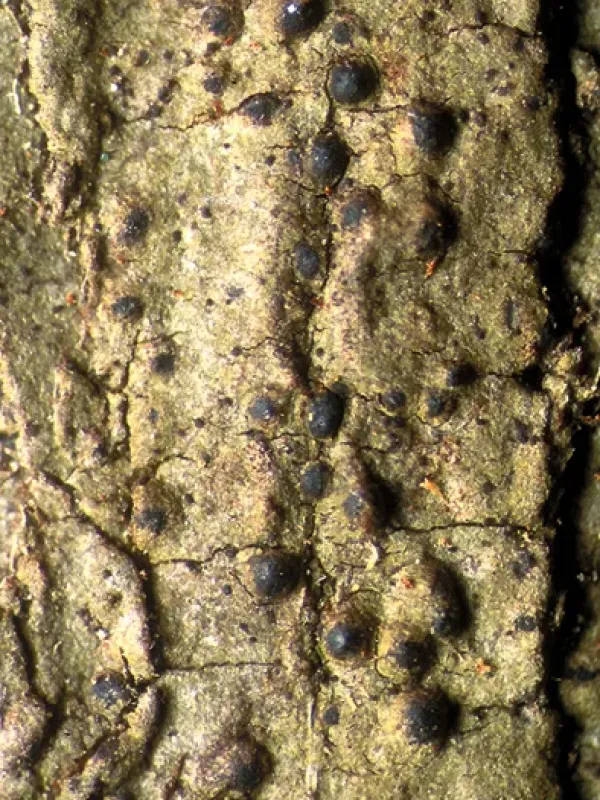
Description
Symptoms
The primary symptom of infection is the appearance of patchy, crust-like growths on the bark, typically exhibiting grey, olive, or greenish hues.
These patches often have a rough or grainy texture, which is caused by the presence of numerous small fruiting bodies known as perithecia.
In cases of advanced colonization, the bark may show signs of minor cracking or peeling, particularly in the older, outer layers of the corky tissue.
Colonies usually start on the shaded or moisture-retaining sides of trunks and branches, making them more visible during the dormant season.
Unlike rapid-onset wilting diseases, the signs of Porina adflata are cumulative and develop steadily over multiple growing seasons.
Pathogen
Porina adflata is identified as a lichenized fungus that colonizes the bark of trees and shrubs. It functions as an epiphyte, deriving its structural support from the host plant's surface while obtaining nutrients and moisture from the environment.
The biology of this organism involves a symbiotic relationship where the fungal component provides protection and structure, and the algal component performs photosynthesis.
While often considered harmless in natural ecosystems, in agricultural or orchard settings, it can reach densities that affect the physiology of the tree bark.
The reproduction and dispersal of Porina adflata are achieved through the production of spores, which are disseminated by wind or splash dispersal during high-humidity events.
The development of the colony is slow, requiring stable environmental conditions over several years to form mature, visible structures on the host surface.
Conditions for development
High relative humidity and frequent rainfall are the most critical factors favoring the establishment and expansion of this fungus.
Orchards with dense planting patterns or lack of proper canopy management suffer from poor air circulation, which creates an ideal environment for colonization.
Limited light exposure on trunks, often caused by overcrowded canopies, increases the susceptibility of the tree to surface-dwelling organisms like this one.
The texture and age of the bark influence colonization, with older, rougher bark providing more attachment points for the fungal spores.
Lack of sanitary maintenance in the orchard allows for the buildup of inoculum, leading to a wider distribution of the disease across neighboring trees.
Why it matters
The major impact of Porina adflata is the physical obstruction of gas exchange through the lenticels of the bark, which can stress the tree's metabolic functions.
Dense colonies create micro-habitats that attract various insect pests, providing them with shelter from predators and environmental extremes.
Chronic infestation can lead to a general decline in tree vigor, resulting in reduced seasonal growth and lowered overall productivity of fruit-bearing trees.
The constant moisture trapped beneath the fungal growth can predispose the bark to secondary infections, including soft rot pathogens.
Ultimately, persistent heavy colonization reduces the resilience of the tree, making it more vulnerable to secondary environmental stressors like drought or frost.
Protection
Cultural management, such as thinning the canopy to increase light penetration and air movement, is the most effective long-term strategy for prevention.
Mechanical cleaning of the trunks using stiff brushes during the dormant season can remove established colonies and prevent further spread.
Early spring applications of copper-based fungicides are highly effective in reducing the density of fungal colonies on the bark surfaces.
Maintaining optimal tree health through balanced nutrition ensures that the plant has the resources to resist unwanted surface colonization.
- Thin out branches to improve air circulation.
- Mechanically remove heavy lichen growth from trunks.
- Apply copper-based sprays during the dormant phase.
- Remove and destroy heavily infested branches.
Discussion
No discussions yet — be the first.