
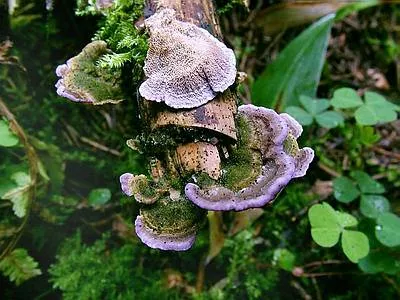
Description
Symptoms
The primary symptom of infection is the emergence of fungal fruiting bodies on the bark of stressed, dying, or dead tree trunks and branches.
These fruiting bodies appear as small, rigid, shelving brackets. Their upper surfaces are usually grayish or brownish, while the lower hymenial surface displays a distinct violet or purplish color when fresh.
Internally, the infected wood undergoes significant degradation, characterized by white stringy rot. The tissue loses its structural integrity and becomes soft and fibrous.
Diagnostic dark lines often appear within the decaying wood, demarcating areas of fungal activity and causing the wood to look bleached compared to healthy tissue.
In advanced stages, the structural weakness becomes so severe that trees are prone to breaking during high winds or heavy snowfall.
Pathogen
The causal agent is the basidiomycete fungus Trichaptum abietinum, which is highly specialized in decomposing coniferous wood in forest ecosystems.
While primarily a saprotroph that feeds on dead material, it functions as a facultative parasite, taking advantage of wounds and reduced tree vigor to colonize living tissue.
The fungus secretes enzymes that break down cellulose and lignin, effectively dissolving the woody structure of the host tree.
It reproduces through the dispersal of basidiospores, which travel via wind currents to find new hosts, landing on bark crevices or open lesions.
This fungus is a common forest pathogen that targets various conifers, with a particular impact on species like spruce, pine, and Douglas fir (Pseudotsuga).
Conditions for development
Development is favored by high humidity and moderate temperatures, which are essential for spore germination and mycelial growth.
Forest stands with high density, poor air circulation, and accumulation of logging debris provide ideal conditions for the pathogen to thrive and spread.
Trees suffering from environmental stress, such as drought, nutrient deficiency, or insect damage, show lower resistance to fungal invasion.
Persistent wet weather or foggy seasons significantly accelerate the production of fruiting bodies, leading to massive spore dispersal events.
Conversely, extremely dry conditions or harsh winter frosts can temporarily inhibit the growth of the fungus, though the internal mycelium remains dormant.
Why it matters
The most severe impact is the mass mortality of infected trees, leading to substantial economic and ecological losses in timber production.
Douglas fir, a crucial species for reforestation and timber, is highly susceptible to this decay, which compromises its wood quality and mechanical properties.
Infected wood becomes structurally unstable, making it unfit for commercial use in construction or manufacturing processes.
The presence of the fungus creates a hazardous environment in forests and parks, as decaying trees become potential safety risks for workers and visitors.
By causing widespread decay, the pathogen disrupts local forest ecosystems, affecting biodiversity and increasing fire hazards due to accumulated deadwood.
Protection
Effective management relies on strict sanitation practices, including the timely removal of dead, dying, and downed trees from the forest stand.
Clearing logging slash and other woody debris is essential to minimize the substrates available for the fungus to establish and produce spores.
Promoting forest health through balanced silvicultural practices, such as proper thinning and insect control, helps maintain trees in a state of high vitality.
For ornamental trees, surgical removal of infected branches and sealing of pruning wounds can help limit the spread of the pathogen.
Regular forest pathology monitoring and early intervention are necessary to prevent localized outbreaks from becoming regional infestations.
Pathogens and affected parts
Affects crops · 1
Discussion
No discussions yet — be the first.