
Tobacco black shank
Phytophthora nicotianae
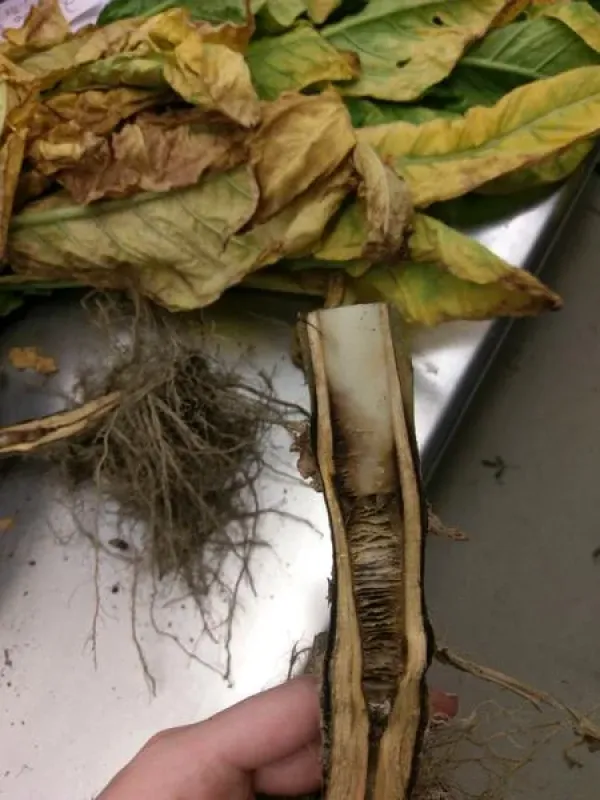
Description
Symptoms
Symptoms typically begin with wilting, which often starts with the lower leaves and becomes more pronounced during the heat of the day. Eventually, the entire plant may collapse and die.
Examining the root system reveals characteristic browning and decay of the roots. In advanced stages, the roots appear black and necrotic, which is where the name "black shank" originates.
A dark, sunken lesion often develops on the stem near the soil line. This lesion can expand and girdle the stem, effectively cutting off the plant from its root system.
Internal symptoms include a dark brown discoloration of the stem pith and vascular tissue, which can be seen when the stem is split longitudinally. This internal rot is diagnostic of the disease.
- Lower leaf wilting
- Sunken stem lesions
- Root system necrosis
- Blackened pith tissue
- Sudden plant death
Pathogen
The causative agent of this disease is the oomycete Phytophthora nicotianae, a soil-borne pathogen. It is a highly persistent organism capable of surviving in the soil for years by producing thick-walled oospores.
The pathogen life cycle involves the formation of zoospores that swim through water films to reach plant roots. These zoospores are chemotactic, meaning they actively move toward root exudates.
While primarily affecting tobacco, this pathogen has a broad host range, including various solanaceous crops. The ability to infect different species complicates disease management in diverse cropping systems.
Once inside the host, the pathogen colonizes the cortex and vascular tissues, causing systemic infection. This leads to the disruption of water and nutrient transport throughout the plant.
Spread is largely facilitated by contaminated irrigation water, movement of infested soil by machinery, and infected transplants. The pathogen is notoriously difficult to eradicate once established in a field.
Conditions for development
The disease thrives in warm, moist conditions. Soil temperatures between 20°C and 30°C, combined with high soil moisture, are optimal for the infection and rapid multiplication of the pathogen.
Poorly drained or waterlogged soils significantly increase the severity of the disease. Standing water acts as a medium for zoospore movement, facilitating rapid spread across the field.
Fields with a history of intensive tobacco cultivation or short crop rotations are at a higher risk of infestation. Continuous cropping practices allow the pathogen population to build up over time.
Mechanical injuries to the root system during cultivation or transplanting increase susceptibility to infection. Providing clean growing environments for seedlings is a critical preventative measure.
Environmental stress, such as drought followed by heavy irrigation, can exacerbate disease symptoms. Consistent management of water inputs is essential for healthy plant development.
Why it matters
Tobacco black shank is considered one of the most destructive diseases for tobacco worldwide. It can lead to complete yield loss in heavily infested fields if conditions are favorable for the pathogen.
The disease causes significant economic losses by killing plants in all stages of growth, from the transplant stage to maturity. This necessitates replanting and increases production costs.
Quality reduction is a major issue, as affected plants produce leaves that lack the necessary chemical composition and physical properties for high-quality tobacco processing.
Soil infestation is long-lasting, forcing growers to abandon prime tobacco lands or switch to non-host crops for many years. This severely limits land-use options for farmers.
The difficulty in controlling the pathogen once it has infected a crop makes it a constant threat that requires long-term integrated pest management strategies.
Protection
The most effective strategy is the use of resistant tobacco cultivars. Breeding programs focus on incorporating genetic resistance to manage the disease economically.
Long crop rotations, preferably 3-4 years between tobacco crops with non-host species, are fundamental for reducing soilborne pathogen populations and maintaining soil health.
Implementing proper soil drainage and avoiding over-irrigation are vital measures to inhibit zoospore activity. Ensuring that fields are well-drained reduces the risk of waterlogging.
Chemical control involving fungicides specifically targeting oomycetes can be applied as a preventative measure. Applications must be timed correctly according to local extension recommendations.
Strict sanitation practices, such as cleaning equipment between fields and using only disease-free transplants, are crucial to prevent the introduction and spread of the pathogen.
Discussion
No discussions yet — be the first.