
Phaeosphaeria leaf spot
Phaeosphaeriaceae
Description
Symptoms
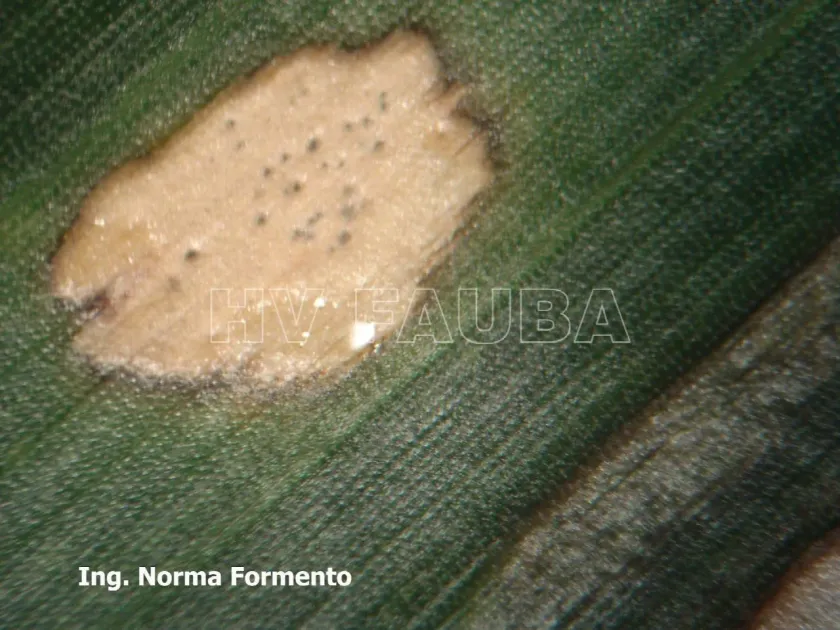
Symptoms of the disease manifest as circular or oval spots on leaves, leaf sheaths, and occasionally on the glumes of infected plants.
Over time, a light-colored center or necrotic zone forms in the middle of the spots, often surrounded by a darker, yellowish or brownish halo.
Small black dots, representing the fungal fruiting bodies (pseudothecia), appear clearly within the epidermis on the dead plant tissues as the fungus sporulates.
Under high humidity conditions, these spots may coalesce, causing premature yellowing and withering of the leaf blade, typical of late-stage disease development.
Diagnosis is often complicated by visual similarities to other leaf spot diseases, necessitating laboratory analysis for accurate pathogen identification.
Pathogen
The disease is caused by ascomycete fungi within the family Phaeosphaeriaceae, with Phaeosphaeria nodorum being one of the most prominent representatives.
This pathogen is a highly specialized parasite that primarily infects cereals, including wheat, barley, rye, and various wild grass species.
The fungus can survive in the soil on plant debris, in seed material, and on winter crops throughout the autumn-winter period.
The development cycle involves the formation of ascospores, which are wind-dispersed over long distances, and pycnospores, which spread via rain splashes within the crop canopy.
The pathogen exhibits high genetic variability, allowing it to adapt to diverse climatic zones and overcome partial resistance in commercial cultivars.
Conditions for development
The development of Phaeosphaeria leaf spot is favored by warm, humid weather conditions with frequent rainfall during the active growth stages of cereals.
The optimal temperature for spore germination ranges from 15 to 25 degrees Celsius, provided there is high relative air humidity.
Dense crop stands and excessive nitrogen fertilization create a favorable microclimate that promotes the rapid spread of the infection.
The presence of free moisture (dew or rain) on leaves for extended periods is a critical factor for the fungal mycelium to penetrate plant tissues.
Early sowing of winter crops and lack of crop rotation lead to the accumulation of inoculum in the fields, significantly increasing the risk of epiphytotics.
Why it matters
The primary impact of the disease is a significant reduction in the photosynthetic leaf area, which directly impairs the plant's overall productivity.
Infection disrupts the grain-filling process, leading to a decrease in the thousand-kernel weight and lower grain plumpness.
Heavy infection during early vegetative stages can cause premature leaf senescence and significant thinning of the crop stand.
The disease negatively affects grain quality, reducing protein and gluten content, and impairing the milling and baking properties of the harvest.
When the ears are infected, the fungus can cause shriveled kernels, potentially reducing total yields by 10–30% or more depending on seasonal conditions.
Protection
The most fundamental control measure is strict crop rotation, ensuring that cereals are not planted in the same field more frequently than every 2–3 years.
Effective management includes the thorough incorporation of crop residues into the soil and deep plowing to promote rapid mineralization of infected material.
Using resistant or tolerant cereal cultivars is an essential strategy to limit the spread and impact of the pathogen in agricultural ecosystems.
Fungicide application during the stem elongation and flag leaf stages effectively suppresses infection and protects the plant's upper, photosynthetically active leaves.
Seed treatment with high-quality fungicides prior to sowing is necessary to prevent the introduction and spread of the pathogen through seed material.
Discussion
No discussions yet — be the first.