
Phacus acuminatus
Phacus acuminatus
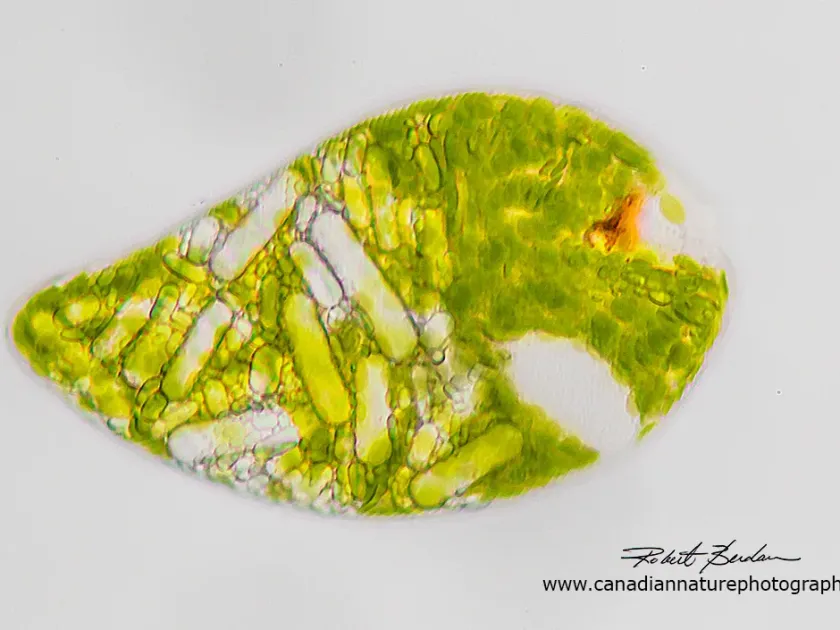
Description
Pathogen
Phacus acuminatus is a unicellular microorganism belonging to the group of euglenoid algae. It is a free-living flagellate that does not act as a classic pathogen or parasite of higher plants, thus not causing infectious diseases in plant tissues.
Biologically, this species is part of the phytoplankton inhabiting freshwater bodies with stagnant or slow-moving water rich in organic matter. Its presence often serves as an ecological indicator of the trophic state of the aquatic environment.
In an agronomic context, this organism is viewed primarily as a factor affecting the quality of irrigation water. Its mass proliferation can indirectly impact plant metabolic processes by altering the chemical and biological properties of the water supply.
The organism possesses a rigid pellicle and a characteristic flattened, pointed shape. It is capable of mixotrophic nutrition, combining photosynthesis with the ingestion of dissolved organic compounds present in the environment.
Although Phacus acuminatus does not invade plant tissues, its excessive concentration in irrigation systems can lead to disruptions in the biological and technical balance of agricultural water management systems.
Conditions for development
The development of Phacus acuminatus populations depends directly on the concentration of nutrients, specifically nitrogen and phosphorus, within the water. Optimal conditions include high light intensity and an abundance of organic matter.
Water temperature is a critical factor, with the most intensive cell division occurring during warm summer periods. Stagnant water in irrigation channels or storage tanks significantly accelerates population growth.
Bottom sediments rich in decomposing plant residues provide the necessary nutrient base for this species. Fluctuations in water pH can also influence the dynamics of colony expansion, depending on the specific strain and environmental adaptation.
In closed hydroponic systems, the introduction of these organisms leads to the clogging of filters and emitters. Intensive aeration of the water in such systems is typically effective in suppressing the growth of euglenoid algae.
The lack of water movement is the primary factor promoting spread. Minimizing the storage time of water in open reservoirs significantly reduces the risk of reaching high concentrations of this microorganism.
Why it matters
The main issue caused by this organism is the clogging of micro-irrigation systems, leading to uneven water distribution across the fields. Algal biomass forms slimy layers that block fine nozzles and emitters, disrupting irrigation uniformity.
When water heavily populated with Phacus acuminatus is used for overhead spraying, a thin film may form on leaves, potentially hindering normal respiration. This disturbs gas exchange through stomata and may reduce the efficiency of photosynthesis.
The decomposition of dead algae within closed tanks alters water pH and increases the concentration of toxic metabolic by-products, which can negatively affect the root systems of sensitive plant species.
Organic residues create a favorable environment for the proliferation of secondary microflora, including bacteria that can cause root rot. In hydroponics, this can lead to nutrient solution "blooming" and a reduction in dissolved oxygen levels.
Economic damage is associated with the increased need for cleaning and disinfection of irrigation infrastructure, as well as potential crop yield losses due to decreased irrigation water quality and efficiency.
Protection
To prevent the spread, regular mechanical cleaning and disinfection of water storage tanks are necessary. Using light-blocking materials for reservoirs effectively inhibits algal photosynthesis.
The application of efficient filtration systems, such as sand or disc filters, allows for the physical removal of cells from the water. It is essential to perform regular backwashing and maintenance of filter elements according to the operational manual.
Chemical disinfection using hydrogen peroxide or specialized algaecides is an effective measure, though it requires precise dosage control to avoid phytotoxicity to crops. Such treatments must be strictly regulated.
Biological control involves maintaining water circulation, for example, through forced aeration. Active water movement and high dissolved oxygen levels create an environment that is unfavorable for the development of Phacus acuminatus.
- Regular monitoring of water composition in storage reservoirs.
- Timely maintenance and replacement of filter elements.
- Ensuring proper water circulation in irrigation ponds.
- Utilization of closed-loop water supply systems.
Discussion
No discussions yet — be the first.