
Peanut bud necrosis
Peanut bud necrosis virus
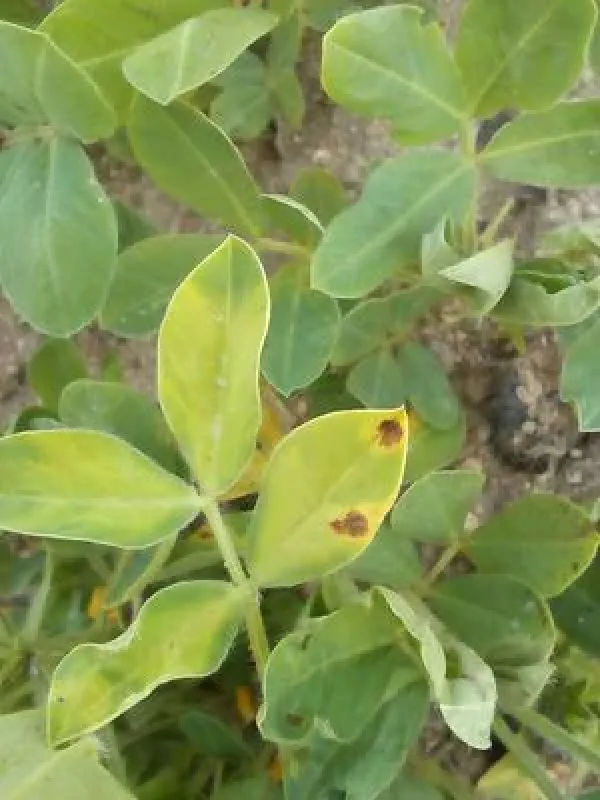
Description
Symptoms
Initial symptoms include chlorotic spots, rings, or stripes on young leaves. Over time, these areas undergo necrosis, turning dark brown or black, leading to the characteristic "bud necrosis" appearance.
A classic sign is the stunting of the main growing point and severe deformation of the apical buds. The plant often exhibits a bushy or "witches' broom" appearance due to severely shortened internodes and profuse lateral branching.
Stems may become brittle and display distinct longitudinal necrotic streaks. In severe cases, the entire plant structure is compromised, leading to premature leaf drop and the death of individual branches.
Reproductive organs are significantly affected; flowers become deformed and fail to develop properly. If pods do form, they are often shriveled, malformed, and exhibit poor filling, significantly reducing crop yield.
- Chlorotic and necrotic rings on foliage.
- Stunting of the main apical bud.
- Bushy growth habit with shortened internodes.
- Deformed flowers and pods.
Pathogen
The disease is caused by the Peanut bud necrosis virus (PBNV), which belongs to the genus Orthotospovirus, family Tospoviridae. It is a single-stranded RNA virus known for its high level of pathogenicity and genetic variability.
Transmission occurs exclusively through insect vectors, primarily thrips such as Thrips palmi. The virus is acquired by larvae during feeding, and the insects remain persistent vectors throughout their adult lives.
Once ingested, the virus replicates within the thrips' tissues, ensuring that the insect can infect new plants for weeks. This efficiency makes even small thrips populations highly dangerous in agricultural settings.
The virus also persists in various host weeds, which act as reservoirs during the off-season. These weeds maintain the viral load in the environment, creating a continuous threat to newly planted fields.
After entering the host plant, PBNV moves systemically through the phloem, eventually colonizing the meristematic tissues and causing the characteristic symptoms of necrosis and growth arrest.
Conditions for development
The severity of the disease is directly linked to thrips population dynamics. Hot, dry weather conditions significantly accelerate thrips reproduction and facilitate rapid virus transmission across the field.
Weed infestation serves as a major contributing factor to epidemics. Many common weeds act as symptomless hosts, providing the virus with a continuous survival bridge until the next peanut crop is planted.
Sowing dates play a crucial role in disease management. Early-season plantings in areas with high thrips activity often suffer the most damage because the young, tender plants are highly attractive to migratory insects.
Ambient temperatures between 25°C and 30°C are optimal for both the biological processes of the virus and the lifecycle of its thrips vector, leading to peak disease pressure during these periods.
Agricultural practices that maintain high field humidity, such as proper irrigation, may reduce the attraction of thrips to the crop, although this rarely offers complete protection against established viral vectors.
Why it matters
Peanut bud necrosis is a major economic threat, capable of causing yield losses ranging from 30% up to 80% in severe outbreak years. The disease impacts both the quantity and quality of the harvest.
Direct losses manifest as reduced kernel weight and a significantly lower number of marketable pods per plant. Infected crops often produce poor-quality seeds that are unsuitable for processing or commercial sale.
The systemic nature of the infection leaves plants weakened, making them susceptible to secondary infections by various opportunistic fungal and bacterial pathogens that further damage the plant tissue.
Because there is no curative treatment once a plant is infected, the economic impact is permanent. This necessitates large investments in preventive measures and insecticides to maintain a viable crop.
Furthermore, the reduction in oil content and altered seed chemistry significantly decreases the market value of the produce, negatively affecting the profitability of peanut farming.
Protection
The primary control strategy involves managing thrips populations. The application of systemic insecticides at early growth stages is vital to prevent the initial virus inoculation by adult thrips.
Maintaining proper spatial isolation between peanut fields and other susceptible crops, such as tomatoes or peppers, helps interrupt the transmission cycle and reduces the influx of infected vectors.
Rigorous weed management is essential. Eliminating reservoir hosts inside and surrounding the field removes the source of the virus, significantly lowering the overall inoculum pressure during the growing season.
The development and deployment of resistant or tolerant peanut cultivars remain the most effective long-term solution for managing the disease in regions where the virus is endemic.
Adjusting planting schedules to avoid peak periods of thrips migration can provide a significant advantage, allowing the peanut plants to establish a robust immune state before heavy insect pressure occurs.
Discussion
No discussions yet — be the first.