
Peach leaf curl
Peach seedling chlorosis disease
Description
Symptoms
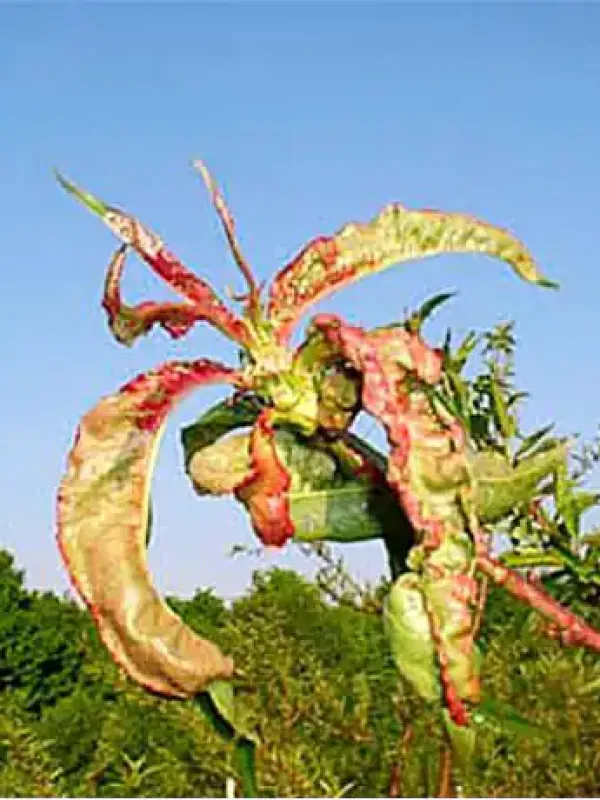
The primary symptom of peach leaf curl is the severe curling, thickening, and puckering of leaves. As the infection progresses, affected leaves often develop an abnormal, distorted shape and irregular texture.
Color changes are significant; initial symptoms appear as light green or yellowish areas. These soon develop into vibrant red or pinkish blisters across the leaf surface, which is a hallmark of the disease.
Over time, a powdery white or gray coating—the fungal spores—appears on the leaf surface. Affected leaves become brittle, lose their luster, and eventually turn brown and fall off prematurely.
Infected young shoots become stunted, twisted, and thickened. If the infection is severe, the shoot tips may die back, severely affecting the overall architectural development of the peach tree canopy.
Defoliation often occurs by early summer. This leaves the tree vulnerable, reduces its ability to produce energy, and makes it susceptible to winter injury and environmental stress.
Pathogen
The causative agent of this disease is the fungus Taphrina deformans, an obligate parasite that specifically infects members of the Prunus genus, especially peaches and nectarines.
The fungus survives the winter as dormant spores (ascospores) or mycelium, hiding deep within the tree bark crevices, bud scales, and twig junctions, waiting for optimal spring conditions.
In early spring, when buds begin to swell and open, the spores are activated by moisture and infiltrate the tender tissues of the developing leaves and blossoms.
The fungus releases substances that interfere with the plant's hormonal regulation, causing unnatural cell division and hypertrophy, which leads to the characteristic leaf deformation.
As the season progresses toward summer, the fungus produces new conidia (spores) on the leaf surface. These spores are dispersed by wind and rain, settling on the bark to restart the infection cycle for the following year.
Conditions for development
The disease thrives in cool and wet spring weather. Specifically, temperatures between 10°C and 16°C combined with high humidity are optimal for fungal germination.
Prolonged spring rains, mist, and fog are the most critical factors for spreading the disease. If the weather is dry and sunny during the bud-break phase, the risk of infection decreases significantly.
Poor orchard site selection, such as planting in low-lying areas with stagnant air or high soil moisture, creates a microclimate that strongly favors the development of Taphrina deformans.
Crowded planting or lack of proper pruning reduces airflow within the canopy, allowing moisture to persist on the tree surfaces longer, thus facilitating easier fungal penetration.
Trees that are already under stress due to poor nutrition or lack of care are more susceptible to severe outbreaks compared to well-maintained trees that possess natural vigor.
Why it matters
The economic impact of peach leaf curl is severe, as early defoliation drastically reduces the tree's photosynthetic capacity, leading to a complete loss of the current year's fruit yield.
Because the tree must expend significant energy to sprout a second set of leaves, it becomes severely weakened and nutrient-depleted, which impairs fruit quality and size.
Repeated yearly infections lead to branch dieback, a thinning canopy, and overall decline in tree health, eventually shortening the productive life of the orchard.
The lack of winter hardiness is a major consequence; trees depleted by defoliation are much more likely to suffer damage or death during colder winter months.
For commercial growers, an uncontrolled outbreak can lead to the total loss of marketable fruit, necessitating high costs for remediation and long-term orchard recovery.
Protection
The most effective strategy is the application of copper-based fungicides while the tree is still dormant, specifically just before the buds start to swell in late winter or early spring.
A second application in late autumn, after leaf fall, is highly recommended to kill the overwintering spores, significantly reducing the fungal inoculum for the next growing season.
Sanitation is essential; all curled, distorted leaves and infected twigs should be pruned and destroyed immediately to prevent the build-up of spores within the orchard environment.
Good cultural practices, including balanced fertilization (phosphorus and potassium) and proper irrigation, help keep trees robust, improving their natural ability to recover from stress.
Choosing resistant cultivars and ensuring that trees are planted in sites with excellent drainage and sun exposure will naturally limit the conditions required for the disease to flourish.
Discussion
No discussions yet — be the first.