
Description
Symptoms
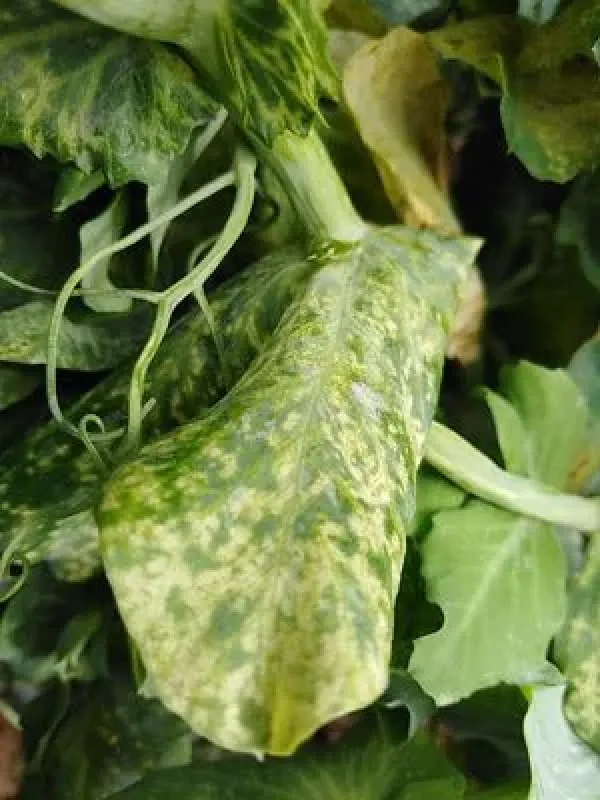
The first signs of Pea enation mosaic involve the development of chlorotic spots and translucent flecks on young, developing leaves.
A hallmark symptom is the formation of enations — distinct, ridge-like outgrowths on the underside of leaves, often accompanied by leaf curling.
Plants infected with the virus exhibit severe stunting, with shortened internodes that create a bushy or rosetted appearance in the canopy.
Pods show characteristic malformations, swellings, and a reduced number of seeds, rendering the crop unmarketable and of poor quality.
The virus causes systemic changes, with the entire plant often turning a pale yellow or light green as the disease progresses through the tissue.
Pathogen
The causative agent is the Pea enation mosaic virus (PEMV), an Enamovirus that causes significant losses in pulse crops globally.
The virus is primarily transmitted by aphids, most notably the pea aphid, which retains the virus in a persistent, circulative manner.
Transmission occurs when aphids feed on infected plants, acquire the virus, and then move to healthy pea plants to feed, injecting the virus.
The virus has a wide host range among the Fabaceae family, which allows it to persist in various wild legumes and weeds throughout the year.
Research indicates that the virus can remain viable in vectors for several days, facilitating its spread across large agricultural landscapes.
Conditions for development
The incidence of PEMV is heavily influenced by the seasonal timing and population size of aphid vectors in the surrounding ecosystem.
Warm spring temperatures followed by mild, moist conditions provide an ideal environment for the rapid reproduction of aphid colonies.
Fields located near perennial legume pastures act as primary sources of the virus, making them higher risk areas for initial infection.
Wind patterns are critical in the spread of the disease, as they carry viruliferous winged aphids over long distances to young pea crops.
Delayed planting often exposes younger plants to higher densities of migrating aphids, increasing the probability and severity of early infection.
Why it matters
Pea enation mosaic can cause devastating yield losses, sometimes reducing total production by over 50% in heavily infested fields.
Seed quality is severely compromised, leading to smaller, shriveled grains that possess lower germination rates and poor vigor.
The reduction in foliage health and deformation limits the plant's photosynthetic capacity, resulting in weak and unhealthy crop stands.
Economic losses are compounded by the high cost of insecticidal control measures and the potential for total loss of harvest value.
Increased vulnerability to secondary fungal or bacterial pathogens further weakens the plants, making the infection cycle harder to manage.
Protection
Effective management begins with the use of systemic insecticides to control aphid populations before the virus can be transmitted.
Planting resistant or tolerant cultivars is the most sustainable and efficient strategy to mitigate the impact of the viral disease.
Spatial isolation of new pea plantings from old forage legumes or perennial fields is highly recommended to break the infection cycle.
Integrated pest management (IPM) practices, including the removal of weeds that host both the virus and the aphids, are essential components.
- Use of resistant cultivars.
- Systemic aphid control.
- Spatial separation from forage.
- Weed management.
- Strategic planting dates.
Pathogens and affected parts
Affects crops · 1
Discussion
No discussions yet — be the first.