
Peanut ringspot virus
Orthotospovirus arachianuli
Description
Symptoms
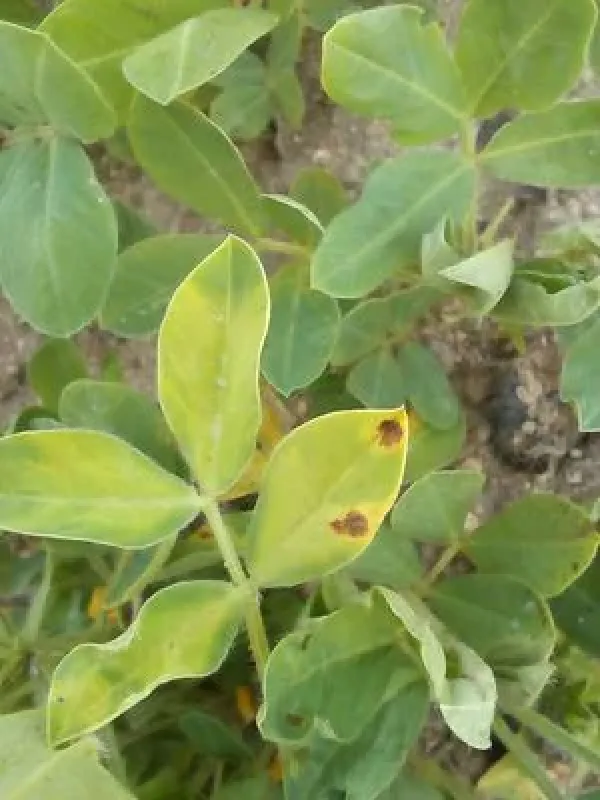
Symptoms of Peanut ringspot virus typically manifest as chlorotic spots that develop into distinct rings or concentric patterns on the leaves, giving the disease its characteristic name.
As the infection advances, necrosis often occurs within the centers of these rings. Over time, these necrotic areas may coalesce, causing the leaf tissue to wither and eventually fall off.
Infected plants exhibit stunted growth, with shortened internodes leading to a bushy or rosette-like appearance. The overall vigor of the plant is significantly compromised.
Reproductive parts are also heavily affected, often resulting in deformed pods and shriveled or discolored seeds, which severely impacts the commercial value of the harvest.
- Chlorotic ring-like patterns on leaves.
- Progressive necrosis of foliar tissues.
- Stunting and shortened plant internodes.
- Deformed pods and poor seed development.
- Mosaic discoloration in younger leaves.
Pathogen
The Peanut ringspot virus (PResV) is a plant pathogenic virus belonging to the genus Orthotospovirus. It is a highly specialized parasite that relies on its host's cellular machinery to replicate.
The virus particle consists of a segmented, single-stranded RNA genome enclosed in a membrane envelope. This structural configuration is typical for viruses transmitted by insect vectors.
Transmission of the virus is primarily mediated by thrips, particularly species that acquire the virus during their larval stage. The virus remains within the insect for its entire lifespan, facilitating efficient dispersal.
The pathogen is known for its wide host range, which includes various legumes and other crop species, making it a persistent challenge in agricultural environments where multiple hosts coexist.
Because the virus cannot survive for long periods outside of a living host or its vector, disease management is focused on breaking the cycle between the insect population and the susceptible plants.
Conditions for development
The development and spread of the virus are heavily influenced by the presence and activity of thrips populations, which thrive in hot and dry weather conditions.
High temperatures accelerate the life cycle of the vector, leading to rapid population surges that can result in widespread viral outbreaks in a short period of time.
The presence of wild hosts or reservoir weeds around the perimeter of the farm serves as a consistent source of the virus, allowing it to persist even during fallow periods.
Agricultural practices that promote high plant density or late-season planting may increase the likelihood of virus transmission if vector populations are concurrently high.
Environmental stress on the host plant, such as drought or nutritional deficiency, can lower the plant's natural defense mechanisms, making it more susceptible to viral invasion.
Why it matters
Peanut ringspot virus causes severe economic harm, with yield losses often reaching substantial percentages, making it a primary limiting factor in peanut production areas.
The reduction in quality—deformed pods and low-quality seeds—means that even if a harvest is obtained, it may be unsuitable for the premium food or export markets.
Early-stage infection can result in the total failure of individual plants, leading to irregular stands and inefficient use of land and agricultural resources.
The systemic nature of the infection means that once a plant is infected, there is no curative treatment, making prevention the only viable management strategy.
Increased dependency on repeated insecticide applications to manage thrips vectors contributes to higher production costs and potential resistance issues in the insect population.
Protection
The most effective strategy for managing the virus is the use of high-quality, virus-free certified seeds to prevent the introduction of the pathogen into new fields.
Strategic control of thrips populations using systemic insecticides is essential during the early stages of plant growth when the crop is most vulnerable to primary infection.
Implementing a rigorous weed control program around fields helps to remove alternative hosts, thereby reducing the reservoir of both the virus and its insect vectors.
Cultural practices, such as crop rotation and isolation from fields with high-risk host plants, help to break the transmission cycle and limit the spread of the virus.
Early detection through regular field monitoring allows for the removal of symptomatic plants, which helps to contain the infection within a localized area before it becomes an epidemic.
Discussion
No discussions yet — be the first.