
Okra yellow vein mosaic
Okra yellow vein mosaic agent
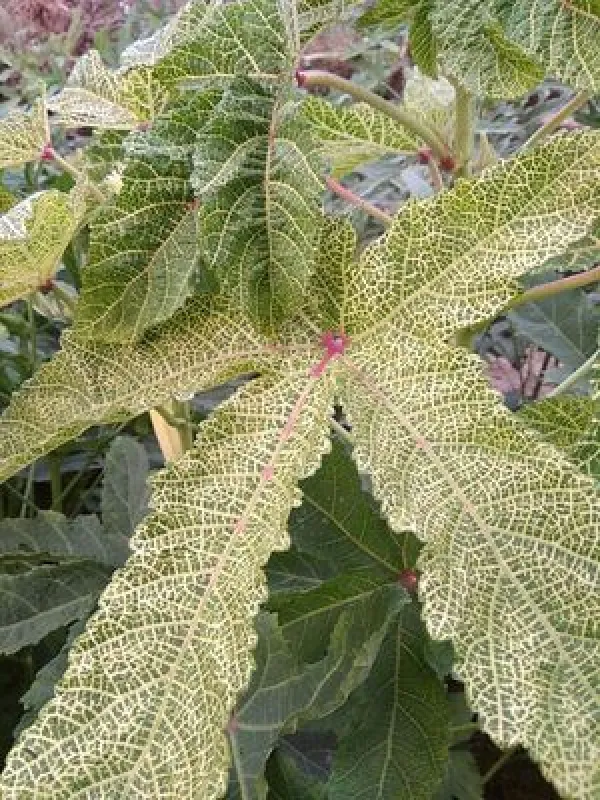
Description
Symptoms
The hallmark symptom of this disease is a distinct yellowing of the leaf veins, which often progresses into a mosaic pattern covering the entire leaf blade. In advanced stages, leaves appear almost completely yellow or creamy white, with very little green tissue remaining.
Stunting of the entire plant is a common characteristic. The infected plants fail to reach their full height, and the internodes become significantly shortened, giving the plant a bushy or dwarf appearance that is clearly visible compared to healthy crops.
Leaves exhibit severe malformation, including curling, wrinkling, and a reduction in size. This distortion is caused by the virus disrupting normal cellular division and growth within the developing leaf tissue.
Flowering is severely hampered by the viral infection. Infected plants produce fewer flowers, and those that do emerge are often small, misshapen, and may fail to produce viable fruit, leading to significant yield losses.
Fruit set on diseased plants is poor, and the pods that manage to form are usually small, tough, and deformed. These pods lack the typical commercial quality required for fresh market sales, effectively rendering the harvest worthless.
Pathogen
The disease is caused by the Okra yellow vein mosaic virus (OYVMV), a begomovirus belonging to the Geminiviridae family. It is a persistent circulative virus, meaning it circulates within the body of the insect vector.
Conditions for development
The primary vector for the transmission of OYVMV is the whitefly, Bemisia tabaci. The insect acquires the virus while feeding on infected sap and carries it for its entire lifespan, transmitting it to healthy plants during subsequent feedings.
The spread of the disease is highly temperature-dependent, as whitefly populations thrive in hot, dry weather conditions. During these periods, the frequency of vector-mediated transmission increases, leading to rapid disease expansion.
Weed hosts, particularly those within the Malvaceae family, serve as essential reservoirs for both the virus and the whitefly population during the off-season. These weeds allow the virus to persist in the environment even when no okra is being grown.
High-density planting and poor ventilation within the crop canopy create microclimates that are favorable for whitefly colonization. These conditions accelerate the movement of the vector between plants, increasing the rate of secondary spread.
The movement of the virus is also facilitated by agricultural activities, as farm workers and tools can inadvertently disturb whiteflies, causing them to move from infected areas to healthy sections of the field.
Why it matters
Okra yellow vein mosaic is considered the most limiting biotic factor in okra production in many regions. It can lead to a total crop failure if the infection occurs early in the vegetative stage, causing massive economic losses for farmers.
Protection
The most crucial step in management is the eradication of alternative weed hosts from the field boundaries. By eliminating reservoirs of the virus, the initial source of inoculum available to the whitefly vector is significantly reduced.
Implementing an effective insecticide program targeting the whitefly is essential. Farmers should prioritize systemic insecticides and ensure they are applied in a rotation to prevent the development of pesticide resistance in the whitefly population.
Cultivation of resistant or tolerant okra varieties is the most sustainable management strategy. Breeders continuously work to develop lines that can withstand OYVMV infection without substantial reduction in fruit quality or yield.
Utilizing physical barriers like fine-mesh row covers during the early growth stages can protect young okra plants from whitefly colonization. This simple technique can delay or prevent the primary infection, allowing the crop to mature.
Sanitation practices, such as the immediate removal and destruction of symptomatic plants, are vital to preventing the spread of the virus within the plantation. Ensuring a clean field environment is key to minimizing the impact of the disease.
Discussion
No discussions yet — be the first.