
Okra yellow vein mosaic
Okra leaf curl begomovirus
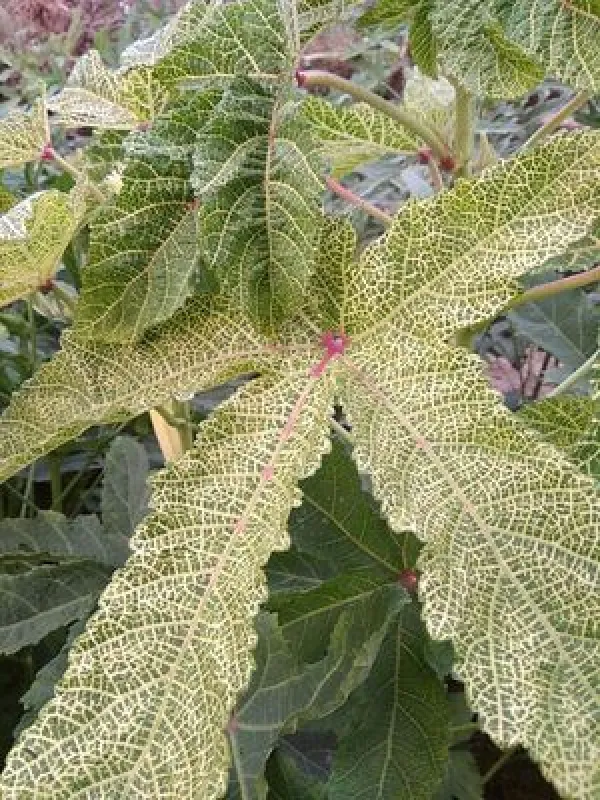
Description
Symptoms
The first and most noticeable symptom is the yellowing of leaf veins, which gradually spreads across the entire leaf blade, creating a characteristic net-like or mosaic pattern.
As the disease progresses, leaves become pale and chlorotic, their size decreases significantly, and their shape may become distorted or curled.
Plants infected at early growth stages show severe stunted growth, appearing dwarfed and producing minimal side shoots.
Fruits on infected plants often change color, becoming pale yellow and deformed, losing their commercial value and overall quality.
In severe cases, flowering almost ceases, and buds may drop before opening, which critically reduces total crop yield.
Pathogen
The causative agent of this disease is the Okra yellow vein mosaic virus (OYVMV), which belongs to the family Geminiviridae.
This pathogen is a single-stranded DNA virus that is transmitted by a specific vector, the whitefly (Bemisia tabaci).
The virus affects not only okra (Abelmoschus esculentus) but also a wide range of related plants in the Malvaceae family, including hibiscus and cotton.
Transmission occurs during the feeding of both adults and nymphs of the whitefly, which transfer viral particles from infected plants to healthy tissues.
Mechanical transmission via gardening tools or plant sap during standard pruning is extremely rare for this type of virus.
Conditions for development
The development of the disease is favored by warm and humid weather, which provides an ideal environment for the rapid population growth of the vector, the whitefly.
High temperatures during the growing season accelerate the development cycle of both the virus within the plant and the insect pests on its surface.
The presence of weed reservoirs near fields creates a constant source of infection from which whiteflies migrate to okra crops.
Dense planting facilitates the creation of a microclimate with high humidity, making it easier for insects to move between neighboring plants.
The lack of crop rotation and the cultivation of okra in the same location for several consecutive years contribute to the accumulation of the virus in the soil and crop debris.
Why it matters
Yellow vein mosaic is considered one of the most destructive diseases of okra, capable of causing up to 80-90% yield loss under conditions of heavy infestation.
Early-stage infection leads to a complete loss of marketability, as the fruits become small, discolored, and unsuitable for consumption.
Systemic infection disrupts photosynthetic processes, which weakens the plant's immunity and makes it susceptible to secondary fungal infections.
The economic impact stems not only from the direct loss of fruit but also from the costs associated with frequent chemical applications to control the vector.
Infected plants serve as a constant source of viral spread to neighboring plots, complicating the cultivation of other susceptible crops in the vicinity.
Protection
The main management strategy involves strict control of the whitefly population using systemic and contact-acting insecticides.
It is recommended to use resistant okra hybrids, which have been specifically bred for cultivation in regions with a high risk of viral outbreaks.
Regular weeding is essential to eliminate host plants that can serve as reservoirs for both the virus and insect pests during the off-season.
The use of cultural practices, such as yellow sticky traps, allows for the effective monitoring and reduction of whitefly populations.
- Rogueing and destruction of infected plants immediately upon symptom detection.
- Maintaining spatial isolation between new and old planting sites.
- Timely treatment of field borders with effective insecticides.
- Use of floating row covers to protect young seedlings from early colonization.
Discussion
No discussions yet — be the first.