
European fruit tree canker
Nectria ditissima
Description
Symptoms
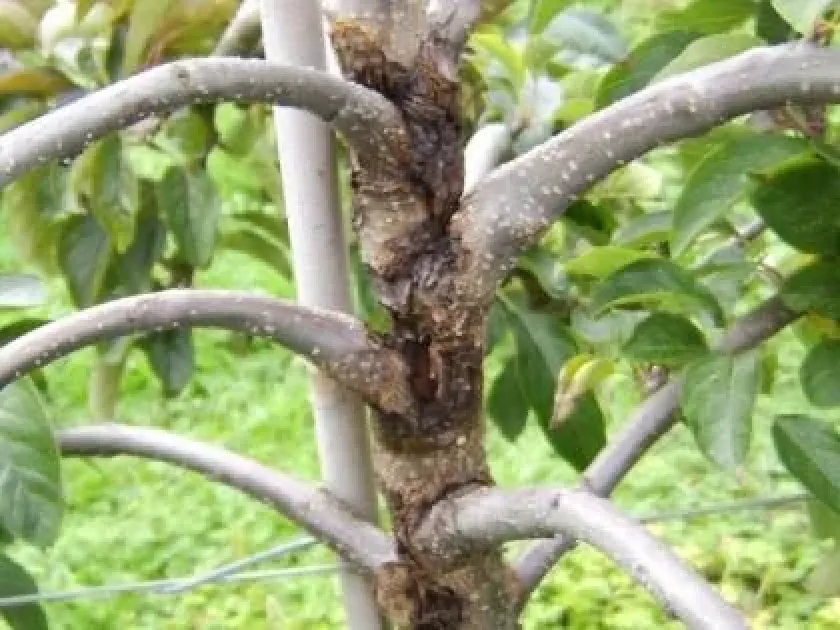
Initial symptoms are often seen as small, sunken, or discolored spots on the bark, which later develop into distinct cankers.
Open cankers are characterized by exposed wood surrounded by callus rolls, while closed cankers show irregular, swollen bark growth.
During humid conditions, small white, cream, or bright red fruiting bodies (perithecia) become visible on the surface of the canker.
Leaves on infected branches often show signs of chlorosis or wilting because the pathogen blocks the water transport within the branch.
Branches weakened by the canker frequently break during high winds, often revealing the characteristic internal rot of the wood.
Pathogen
The disease is caused by the fungus Nectria ditissima (anamorph Cylindrocarpon heteronema), which is a serious pathogen of woody plants.
The fungus invades the host through various wounds, such as pruning cuts, leaf scars, frost cracks, or mechanical damage caused by insects.
The life cycle involves the production of both asexual conidia and sexual ascospores, which are spread by wind and rain splash throughout the season.
Once established, the pathogen colonizes the bark and cambium, eventually growing into the woody tissue and disrupting vascular functions.
It is a perennial disease, meaning the fungal mycelium remains active within the host tissue for many years, producing new spores each season.
Conditions for development
Moderate temperatures and high humidity are the primary drivers for the development and spread of Nectria ditissima.
Wet weather during leaf fall or early spring facilitates the infection process as spores germinate on the newly exposed leaf scars.
Orchards located in low-lying areas with poor air circulation and high morning dew frequency are at a much higher risk of infection.
Trees stressed by drought, poor soil management, or excessive nitrogen fertilization show higher susceptibility to the disease.
Overcrowded orchards with dense canopies retain moisture longer, creating a perfect microclimate for fungal proliferation.
Why it matters
European fruit tree canker causes significant economic losses by reducing fruit yield and shortening the productive lifespan of the orchard.
The disease can kill young trees by girdling the main stem, whereas in mature trees, it often leads to the loss of large, productive scaffolds.
Fruit infection, known as "eye rot," can occur, making the produce unsalable and reducing overall quality at harvest.
Infected trees act as reservoirs for spores, spreading the pathogen to adjacent healthy plants and complicating orchard management.
Continuous surgical interventions and intensive chemical management required to keep the disease in check add substantial costs for growers.
Protection
Integrated management includes prompt pruning and removal of all cankered wood, ensuring that cuts are made well into healthy tissue.
All pruning wounds should be protected with appropriate wound sealants or fungicidal pastes to prevent new infections.
Applying copper-based fungicides during leaf fall and early spring is essential to reduce the inoculum load in the orchard.
Improving air drainage and ensuring proper soil health helps the trees maintain their natural defenses against fungal invasion.
- Strict sanitation protocols, including the disinfection of tools between trees.
- Selecting resistant varieties or less susceptible rootstocks for new orchard planting.
- Monitoring the orchard closely for early symptoms and treating them before they spread to the main trunk.
Discussion
No discussions yet — be the first.