
Nanovirus necropumiliviciae
Nanovirus necropumiliviciae
Description
Symptoms
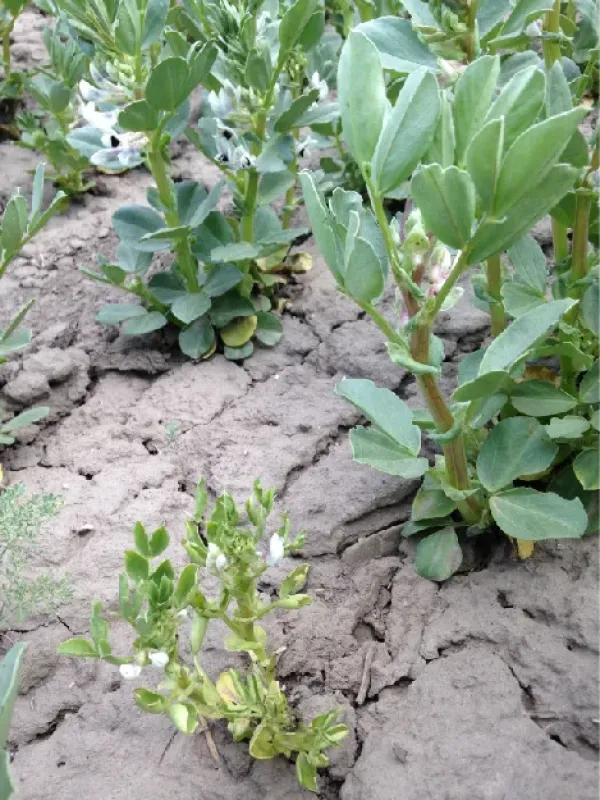
The most prominent symptom of infection is severe stunting, which is caused by the shortening of internodes. Plants fail to reach their full size and appear significantly smaller compared to healthy specimens.
Leaves exhibit chlorosis, which eventually progresses into necrotic spots. These lesions often follow the leaf venation pattern, eventually leading to tissue death, leaf curl, and premature senescence of the foliage.
Plants affected by this virus show reduced vigor and often wilt even when soil moisture levels are adequate. The root system also undergoes significant degradation, becoming poorly developed and less efficient at nutrient uptake.
In many legume species, the infection leads to the thickening of leaflets and significant morphological deformations. Flowering is either severely delayed or does not occur at all, resulting in a total failure to produce pods or seeds.
Field symptoms often appear in localized patches, indicating the paths taken by migratory aphids. Identifying these patches early is essential, as they often represent the epicenters of further field-wide contamination.
Pathogen
The causal agent of this disease is Nanovirus necropumiliviciae, a member of the Nanoviridae family. This virus contains a single-stranded DNA genome and is characterized by extremely small virions that effectively colonize the phloem tissues of host plants.
The pathogen is highly specialized, causing systemic infections that hinder the translocation of nutrients. By interfering with the plant's vascular system, the virus creates a physiological imbalance that leads to stunted growth and reduced metabolic efficiency.
Transmission occurs exclusively through persistent vectors, primarily specific aphid species. Once the insect acquires the virus during feeding, it remains infectious for the rest of its life, facilitating widespread transmission across crop fields.
The virus is not transmitted mechanically via tools or direct plant-to-plant contact. This means that the main focus of containment must be the management of insect populations that act as biological bridges for the infection.
The genetic adaptability of this nanovirus allows it to persist in various environmental conditions. Its ability to maintain infectivity within the vector population ensures that the virus survives between growing seasons, posing a constant threat to new crops.
Why it matters
The damage caused by this nanovirus is primarily manifested through massive yield losses. In cases of severe infection, entire fields may become non-productive, resulting in near-total harvest failure.
Economic losses go beyond the reduction in quantity; the quality of any produce harvested from surviving plants is significantly degraded, making it unmarketable and unsuitable for further use as seed material.
The virus acts as a stress factor, making the host plant highly susceptible to secondary infections by bacteria and fungi. This synergistic effect often accelerates the destruction of the crop and complicates diagnostic efforts.
The wide distribution of the virus necessitates strict phytosanitary measures in affected regions. Authorities may impose quarantine restrictions to prevent the movement of contaminated materials, further impacting trade and local agricultural operations.
Chronic infection in seed stocks is a major long-term danger. If contaminated seeds are planted in subsequent seasons, the virus can quickly re-establish itself, leading to a persistent cycle of disease that is difficult to break without replacing all plant material.
Protection
Management primarily focuses on the control of aphid vectors. The timely application of systemic insecticides is vital to break the transmission chain, especially during the early stages of crop growth when plants are most vulnerable.
The use of virus-free seeds is the most effective preventative strategy. Rigorous testing protocols, including molecular diagnostics, should be implemented to ensure that planting material is completely free from the pathogen.
Maintaining spatial isolation between susceptible crops and potential reservoirs of the virus—such as wild legume species—is a key practice to prevent aphids from introducing the pathogen into the field.
Integrated pest management (IPM) practices, such as removing weeds that host aphids and monitoring for the first signs of the virus, allow for early intervention, which can significantly mitigate the spread of the disease.
Developing resistant varieties remains the gold standard for long-term control. Breeding programs targeting genetic resistance to the nanovirus help farmers achieve stable yields while reducing the need for intensive chemical applications.
Discussion
No discussions yet — be the first.