
Description
Symptoms
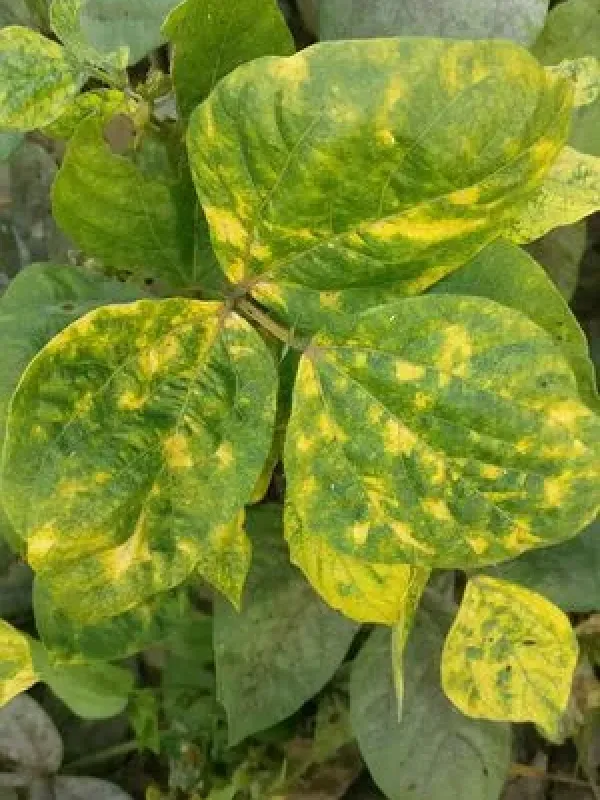
Symptoms typically begin as scattered yellow or chlorotic spots on young leaves. As the infection progresses, these spots expand and coalesce, resulting in a distinct mosaic pattern of yellow and green tissues across the foliage.
In severe cases, the leaves turn completely yellow, and the plant experiences stunted growth. The affected leaves are often smaller than normal, curled, and distorted, which limits the plant's capacity for photosynthesis and energy production.
In soybeans, the disease manifests as severe leaf yellowing or bronzing. The systemic nature of the virus ensures that all new growth is affected, leading to a significant reduction in the plant's height and vigor compared to healthy specimens.
Infected plants produce fewer flowers and pods. The pods that do develop are usually smaller, malformed, and contain shriveled, poorly developed seeds, which reduces both the yield and the quality of the harvested crop.
- Chlorotic yellow mosaic patterns on leaves.
- Stunting and dwarfing of the entire plant.
- Leaf distortion and marginal curling.
- Reduction in flower and pod set.
Pathogen
The causative agent of this disease is the Mungbean yellow mosaic virus (MYMV), which belongs to the Begomovirus genus in the Geminiviridae family. It is a single-stranded DNA virus known for its high genetic diversity and rapid evolution.
The virus is exclusively transmitted by the whitefly, Bemisia tabaci. Transmission through seeds or mechanical contact is rare, making the movement of these insect vectors the primary pathway for the virus to enter and spread within agricultural fields.
MYMV has a broad host range, impacting various pulse crops significantly. Besides mungbean (Vigna radiata), the virus affects soybeans (Glycine max), common beans, black gram, and several species of wild leguminous plants that act as viral reservoirs.
The virus particles are geminate (twinned) in shape, a hallmark of the Geminiviridae family. Upon infection, the virus invades the host's phloem tissue, effectively disrupting the plant's metabolic functions and overall growth cycle.
The disease is most prevalent in tropical and subtropical regions where environmental conditions support large, year-round whitefly populations, often exacerbated by the presence of alternative host plants.
Conditions for development
The spread of the disease is strictly dependent on the density of the whitefly population, Bemisia tabaci. High temperatures (above 25°C) and moderate humidity levels create the perfect environment for whiteflies to breed rapidly.
Weeds growing around the fields act as alternative hosts, keeping the virus active even when the primary crop is not present. These reservoirs are essential for the survival of the virus throughout the off-season.
Early-season planting in hot regions often leads to higher infection rates, as young seedlings are highly vulnerable. During periods of drought, whiteflies migrate extensively in search of green foliage, accelerating the transmission of the virus.
Lack of adequate spatial separation between fields with different pulse crops allows for the efficient movement of insects carrying the virus, facilitating rapid disease spread across larger farming areas.
Poor agricultural practices, such as failing to clear field margins of weeds or utilizing susceptible varieties in high-risk areas, significantly increase the likelihood of a major disease outbreak.
Why it matters
The economic impact of Mungbean yellow mosaic disease can be severe, potentially causing near-total crop failure. The virus stunts development so effectively that infected plants often fail to reach maturity or produce a viable harvest.
Quality degradation is a major issue, as infected seeds possess lower protein content and poor germination rates. This creates significant problems for both seed producers and commercial growers looking to sell high-quality produce.
The systemic nature of the infection makes the plants more susceptible to secondary stressors, such as water scarcity or secondary fungal infections, further diminishing the potential yield.
For soybean production, yield losses can range from 30% to 80%, depending on the variety's resistance and the stage at which the infection occurs during the growing season.
Since the disease cannot be cured once symptoms appear, the primary economic loss comes from the wasted labor, inputs, and land usage dedicated to the crop that fails to provide a return on investment.
Protection
The most effective strategy for managing the disease is the development and adoption of resistant or tolerant crop varieties. Breeding programs focused on MYMV resistance are essential for sustainable pulse production.
Effective management of the whitefly population is a critical component of disease control. The application of systemic insecticides at the early stages of crop development helps reduce the number of insect vectors and slows the viral spread.
Rigorous sanitation measures, such as the removal of host weeds from field perimeters and nearby areas, are vital to eliminate viral reservoirs. Controlling the whitefly population at the source prevents it from moving into the crops.
Implementing spatial isolation and optimizing planting dates to avoid peak whitefly activity are highly recommended. These measures help protect the crop during its most sensitive growth stages.
Continuous monitoring using yellow sticky traps allows farmers to track whitefly density and decide on the timing of insecticide applications, ensuring that management efforts are both efficient and timely.
Pathogens and affected parts
Affects crops · 1
Discussion
No discussions yet — be the first.