
Downy mildew of melon
Melon leaf curl begomovirus
Description
Symptoms
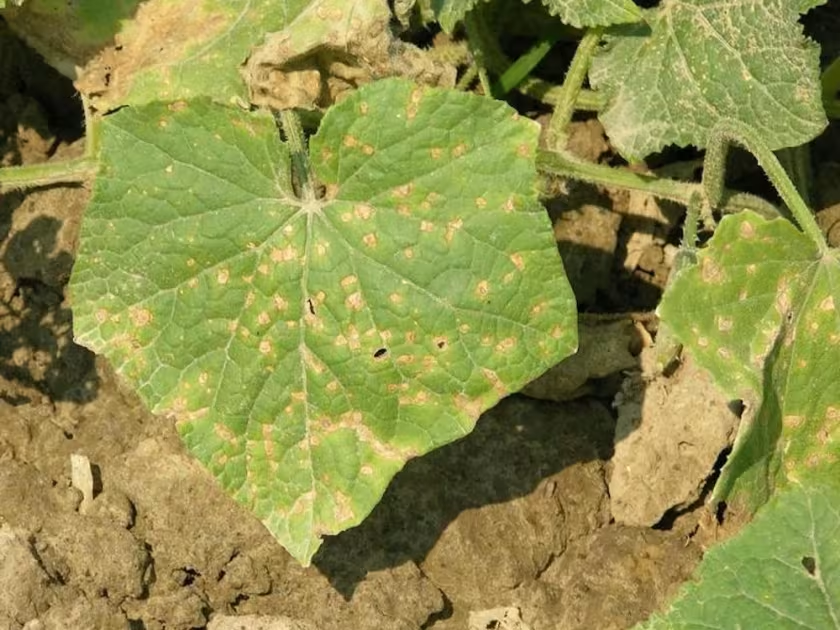
Symptoms initially appear as small, yellow, angular-shaped spots on the upper leaf surface, limited by the leaf veins.
Under conditions of high humidity, a characteristic gray or violet-gray fungal growth develops on the underside of these yellow spots.
As the disease progresses, these spots expand, turn brown or necrotic, and eventually merge, leading to the collapse of the entire leaf.
Severe infections result in premature defoliation, which exposes the fruits to sunscald and stops the fruit development process.
Infected fruits fail to reach maturity, exhibit poor flavor, and have significantly reduced market value due to their stunted growth.
Pathogen
The causative agent of downy mildew in melons is the oomycete Pseudoperonospora cubensis, which is a highly specialized plant pathogen.
It is an obligate parasite, meaning it requires living host tissue to complete its life cycle and cannot survive for long on dead matter.
The pathogen reproduces by forming sporangia that are easily dispersed by wind and splashing water, allowing it to spread across fields rapidly.
It can survive in the soil in the form of oospores, which are resistant structures that allow the pathogen to persist through unfavorable seasons.
The rapid multiplication rate of the pathogen leads to frequent epidemics in melon fields during periods of wet and warm weather.
Conditions for development
High relative humidity (above 80-90%) is the most critical environmental factor that triggers the development and spread of downy mildew.
The presence of free moisture (dew or rain) on the leaves is essential for the germination of spores and subsequent penetration into the tissue.
Temperatures ranging from 15°C to 22°C are optimal for the pathogen, making spring and early autumn particularly risky periods for infection.
Poor ventilation within greenhouses and high plant density in fields create a microclimate that remains humid for longer periods, favoring the disease.
Cloudy weather with frequent light showers creates the perfect conditions for the continued production of inoculum throughout the growing season.
Why it matters
Downy mildew is one of the most destructive diseases in melon production, potentially causing total crop loss if left unmanaged.
The loss of foliage leads to a reduction in photosynthesis, which directly impacts the sugar content and size of the developing melon fruits.
Plants affected by this disease are weakened, making them more vulnerable to secondary infections and damage by various insect pests.
The economic impact is substantial due to the costs of frequent fungicide applications and the loss of marketable yield due to low quality.
Failure to control the disease early in the season often leads to an early end to the harvest, significantly reducing the overall profitability.
Protection
Implementing a strict crop rotation cycle of at least 3 to 4 years is essential to break the survival cycle of the soil-borne inoculum.
Sanitation practices, such as the removal and destruction of crop residues, significantly reduce the initial level of infection in the next season.
Using drip irrigation instead of overhead sprinklers keeps the foliage dry, which is a key strategy in preventing spore germination.
The application of both preventative and curative fungicides is necessary to protect plants during periods of high environmental risk.
- Choose resistant or tolerant melon varieties.
- Maintain proper spacing between plants for airflow.
- Regularly monitor the undersides of leaves for symptoms.
- Improve greenhouse ventilation systems.
Discussion
No discussions yet — be the first.