
Melanconis birch canker
Melanconis stilbostoma
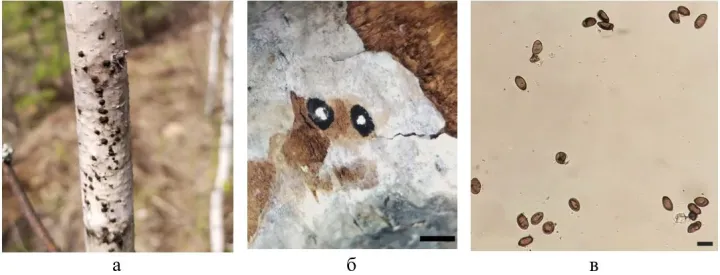
Description
Symptoms
The most visible symptom is the appearance of numerous small, black, wart-like fruiting bodies scattered across the affected bark surface.
As the infection progresses, the bark becomes discolored, necrotic, and brittle, often splitting open to reveal the decayed wood underneath.
Early signs include the wilting and premature yellowing of leaves on specific branches, which eventually dry out and die completely.
When the bark is carefully peeled away, dark, stained wood is often visible, indicating that the fungus has successfully disrupted the tree's vascular transport system.
Advanced stages of the disease lead to crown dieback, where the tree starts losing its upper branches, eventually affecting the main trunk and killing the tree.
Pathogen
The disease is caused by the fungus Melanconis stilbostoma (anamorph Melanconium betulinum), which belongs to the order Diaporthales. It is an aggressive parasite that specifically targets the bark of birch trees.
The fungus reproduces by forming black, erumpent stroma (fruiting bodies) under the outer layer of the bark. Once mature, these structures erupt through the bark, releasing large amounts of spores.
This pathogen acts primarily on stressed or weakened trees. After the host tissue dies, the fungus remains active as a saprophyte, surviving in dead branches and stumps for a long time.
Dispersal of the fungus occurs through rain splash, wind, and insect vectors that bore into the bark, facilitating the entry of the mycelium into the nutrient-rich cambium layer.
The biology of the pathogen is closely tied to the host's physiological state; when a tree’s defense mechanisms are lowered, the fungus rapidly colonizes the inner bark layers.
Conditions for development
Environmental stress is a key driver for disease outbreaks. Prolonged drought weakens the tree's natural resistance, making it vulnerable to fungal entry.
Mechanical damage to the trunk, caused by lawn equipment, weather events (like frost cracks), or animal activity, creates entry points for fungal spores.
Overcrowded forest stands or garden plantings limit air circulation, leading to high humidity levels that favor the germination of fungal spores in the bark.
Abrupt seasonal temperature changes can lead to bark sunscald, which is a major factor predisposing trees to colonisation by Melanconis stilbostoma.
Increased populations of wood-boring insects often coincide with disease outbreaks, as these insects act as efficient carriers for the fungal spores.
Why it matters
Melanconis canker is a highly damaging pathogen that causes progressive necrosis of the bark and cambium, leading to the gradual decline of birch trees.
The destruction of vascular tissues results in the slow starvation of limbs, which causes significant loss of aesthetic value and structural integrity.
Once a tree is heavily infested, it becomes a secondary host for more pests, further weakening its structure and creating a high risk of falling branches.
In woodland settings, this disease can lead to significant forest depletion, impacting biodiversity and reducing the survival rate of young birch populations.
The infection is often fatal if not caught early, particularly in urban environments where trees are already prone to stress from pollution and soil compaction.
Protection
Management strategy centers on strict sanitation: the prompt pruning and removal of all diseased wood is essential to reduce the local spore load.
Pruning cuts must be made into healthy wood and treated with an appropriate fungicide or wound sealer to prevent re-infection through the open wound.
Promoting tree vigor through adequate watering during dry spells and proper fertilization helps the tree build natural defenses against fungal attack.
Monitoring and controlling populations of bark-boring insects is a critical component of integrated pest management to limit spore distribution.
- Regular site inspections to identify black stroma on bark.
- Sanitary pruning of all dead and dying branches back to the branch collar.
- Destruction of infected material by burning or burying far from host trees.
- Painting the trunk with white latex-based paint to prevent sunscald.
- Use of systemic fungicides if recommended by local agricultural extension services.
Discussion
No discussions yet — be the first.