
Millet streak virus
Mastrevirus sporoboprimi
Description
Symptoms
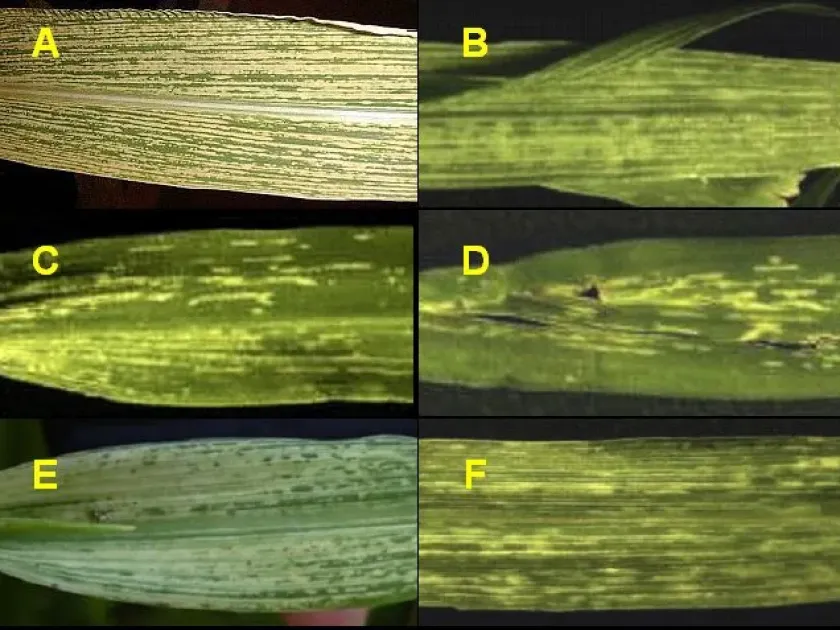
The primary symptom is the development of yellow or chlorotic streaks running parallel to the leaf veins. These streaks are characteristic of Mastrevirus infections and can cause a patchy appearance across the field.
Infected millet plants exhibit stunted growth compared to healthy individuals. Stunting is often severe, leading to a significant reduction in the overall height and biomass of the affected crop.
As the infection advances, leaves may show increased chlorosis, becoming pale and brittle. In severe cases, tissues may exhibit necrosis or premature senescence, resulting in a loss of photosynthetic capacity.
Reproductive organs are often severely impacted. Infected plants may fail to produce fully developed panicles, or the panicles may remain trapped within the leaf sheath, causing reduced fertility.
A general lack of vigor and uneven plant development are typical signs of an infected millet population. The chlorotic patterns often become more pronounced as the plant enters its generative phase.
Pathogen
The causal agent of the disease is the Mastrevirus sporoboprimi, which belongs to the Mastrevirus genus within the Geminiviridae family. The virus consists of a circular single-stranded DNA genome enclosed in twin particles.
Transmission of the virus occurs exclusively through insect vectors, primarily leafhoppers. The virus circulates within the insect's body, maintaining a persistent infection that allows the vector to transmit the pathogen throughout its life.
Mechanical transmission via plant sap or seed-borne transmission is not typical for this virus. Its spread is strictly dependent on the movement and feeding habits of its specific insect vectors.
The virus survives in perennial wild grasses, which act as primary reservoirs. These host plants provide a bridge for the pathogen to persist during the off-season and re-infect new crop fields.
Once inside the plant, the virus replicates in the phloem tissue, leading to systemic infection and long-term disruption of the plant's metabolic pathways.
Conditions for development
The incidence of the disease is heavily dictated by the population dynamics of the leafhopper vectors. Warm, dry weather conditions favor rapid reproduction and increased mobility of these insects.
The most vulnerable stage for infection is the seedling and tillering phase. Early infection during these stages leads to the most significant physiological damage and yield reduction.
Proximity to wild grass reservoirs significantly increases the risk of infection. Weeds at field margins serve as breeding grounds for vectors and a source of viral inoculum.
Agricultural practices that promote high weed pressure near millet fields contribute to the spread of the virus. Maintaining clean field borders is crucial for minimizing vector pressure.
Regional variations in climate influence the seasonal timing of vector migration, which dictates when growers must be most vigilant for potential outbreaks.
Why it matters
Millet streak virus causes considerable economic loss by directly reducing grain yield. Stunted plants and poor panicle development lead to lower yields per hectare.
Grain quality is negatively affected, with infected plants often producing shriveled and lightweight seeds. This reduces the marketability and milling quality of the harvested millet.
Infected crops are more susceptible to secondary stresses, including water deficit and other opportunistic pathogens, which further compounds the loss in plant health.
The disease can lead to significant thinning of stands, as severely infected seedlings may die prematurely. This results in poor crop density and reduced efficiency of land use.
In regions where the virus is endemic, it acts as a limiting factor for cultivation, necessitating intensive management programs to maintain productivity.
Protection
Effective management requires the control of insect vectors through targeted insecticide applications. Timing is critical, with treatments focused on the early stages of crop development.
Weed control is a fundamental preventive measure. By eliminating wild grass reservoirs around the fields, the primary sources of both the virus and the vectors are removed.
Spatial isolation between millet fields and perennial grass areas helps reduce the migration of leafhoppers. Strategic planting planning can significantly lower the infection pressure.
The use of resistant or tolerant cultivars, where available, remains the most sustainable approach to managing the disease. Breeding programs continue to prioritize viral resistance traits.
Regular monitoring of vector population density in the fields allows for data-driven decisions regarding control measures, ensuring timely intervention before widespread infection occurs.
Discussion
No discussions yet — be the first.