
Aster yellows
Maryland aster yellows phytoplasma
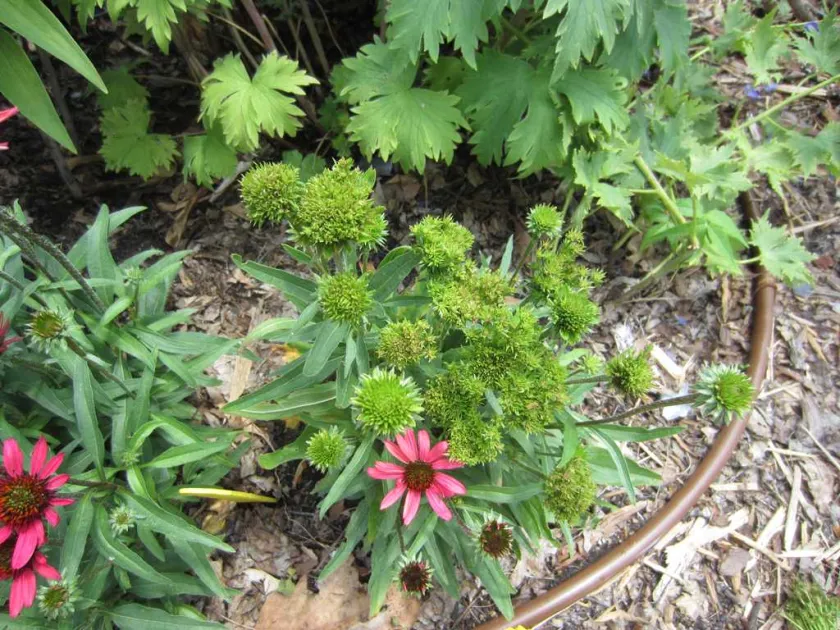
Description
Symptoms
Early symptoms of aster yellows include a characteristic yellowing or chlorosis of the younger leaves. The foliage may appear stunted, twisted, or distorted, and in many species, the stems exhibit excessive branching or a bushy, rosette-like appearance.
A hallmark of this disease is virescence, where the floral parts lose their normal pigment and develop into leaf-like structures. Flowers often become sterile, fail to produce seeds, or show abnormal growth, making them aesthetically and commercially worthless.
Plants affected by the pathogen show significant growth inhibition, resulting in a stunted architecture. The roots may also be compromised, often producing an excess of fine, hair-like lateral roots, which is particularly common in infected carrot crops.
In addition to morphological changes, the physiological state of the plant declines rapidly. The plant loses its natural vigor, becomes less responsive to environmental cues, and may exhibit early senescence as the vascular system becomes increasingly clogged by the pathogen.
The progression of symptoms is irreversible. As the season continues, the plant becomes increasingly weakened, leading to premature death. In field settings, infected individuals often stand out due to their abnormal color and stunted size compared to healthy neighbors.
Pathogen
Aster yellows is caused by a specialized group of wall-less bacteria known as phytoplasmas. These obligate parasites colonize the phloem tissues of plants, where they rely entirely on the host's metabolic processes for their survival and reproduction.
The transmission of the pathogen is mediated exclusively by insect vectors, primarily leafhoppers of the species Macrosteles quadrilineatus. The insect acquires the phytoplasma while feeding on an infected plant and transmits it to healthy plants after an incubation period.
Once inside the plant, the phytoplasma moves systemically through the phloem. This movement is rapid, allowing the pathogen to reach the roots, shoots, and leaves, effectively altering the host's hormonal balance and developmental trajectory.
Phytoplasmas cannot be cultured in artificial media, which makes them difficult to isolate for scientific research. Their presence is usually confirmed through molecular techniques like PCR, which detect the specific DNA sequences of the pathogen in the plant's phloem sap.
Because the infection is systemic and colonizes the vascular system, there is no chemical cure for an infected plant. Consequently, disease management focuses entirely on breaking the cycle of transmission by controlling the vector population and removing infected sources.
Conditions for development
The spread of aster yellows is heavily dictated by the life cycle of its leafhopper vector. Warm, dry weather conditions are ideal for leafhopper breeding, leading to population explosions that can quickly spread the pathogen across large agricultural landscapes.
The presence of perennial weeds serves as a crucial reservoir for the pathogen during the winter months. Plants such as dandelion, plantain, and thistles act as overwintering sites, allowing the phytoplasma to persist even when no susceptible crops are present.
Environmental stress, such as drought or nutritional imbalances, can make plants more susceptible to feeding by insects. When crops are stressed, they are often less capable of mounting a defense, which increases the likelihood of successful phytoplasma transmission.
The geographical distribution of the disease is closely tied to the migration patterns of leafhoppers. Long-distance movement of vectors on wind currents can bring the disease to new regions, even when local populations were previously low or absent.
Agricultural practices that promote high plant density or continuous cropping can facilitate the spread. In intensive systems, the proximity of host plants allows vectors to move easily between plants, ensuring a rapid increase in the incidence of the disease.
Why it matters
Aster yellows causes devastating losses in the cut flower industry, as infected stems lose their decorative value. The loss of product quality often results in significant financial losses, forcing growers to discard entire batches of flowers.
In vegetable production, the disease renders root crops like carrots and celery unmarketable due to their woody texture and poor taste. This loss of yield and quality directly impacts the economic viability of the affected agricultural operations.
The systemic nature of the disease makes it a persistent threat throughout the growing season. Since even a low percentage of infection can escalate quickly through vector transmission, the entire field population is at constant risk.
Furthermore, the disease predisposes plants to other secondary infections, such as soft rot or other bacterial diseases. This makes the management of infected fields more complex, as multiple pathologies may be present at the same time.
The costs of disease control, including regular insecticide applications and field sanitation, significantly increase production expenses. These costs, combined with the loss of potential revenue, highlight the economic challenge posed by aster yellows.
Protection
Management begins with the systematic control of leafhopper populations using appropriately timed insecticide applications. Reducing the number of vectors is the most effective way to prevent the initial infection of healthy crop plants.
Field sanitation is critical; regular weeding of perennial hosts around the farm perimeter can significantly reduce the reservoir of the phytoplasma. By eliminating these host sources, the risk of disease transmission into the main crop is minimized.
Choosing resistant cultivars or certified disease-free planting stock is a vital strategy. Growers should prioritize sourcing their material from reputable nurseries that implement strict testing and quarantine procedures for their mother blocks.
In greenhouse or protected environments, the use of fine-mesh screening can physically exclude leafhoppers. This creates an environment where the risk of transmission is significantly lowered, protecting high-value crops from potential outbreaks.
Immediate removal and destruction of symptomatic plants are mandatory to slow the spread of the disease within the field. Plants should be pulled out by the roots and burned, as they continue to serve as a source of the pathogen as long as they remain in the field.
Discussion
No discussions yet — be the first.