
Description
Symptoms
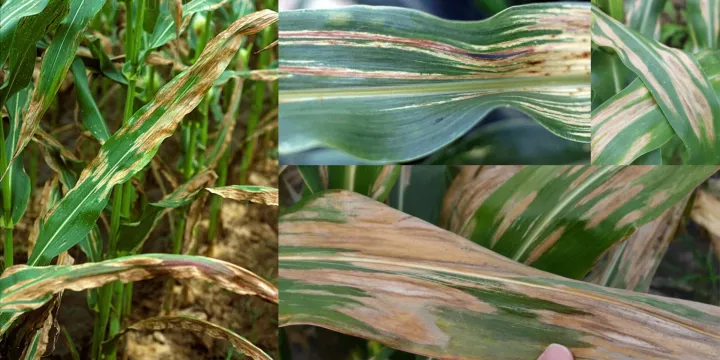
Initial symptoms are usually observed on young seedlings as chlorotic spots appearing shortly after emergence.
These spots rapidly evolve into narrow, elongated necrotic streaks that develop along the leaf veins.
As the infection progresses, streaks can coalesce, resulting in patches of withered tissue and overall leaf necrosis.
Infected corn plants often exhibit stunted growth and an overall decrease in vigor compared to healthy counterparts.
In severe cases, the leaf architecture becomes distorted, and the photosynthetic capacity of the plant is significantly impaired.
Pathogen
The disease is caused by the Maize necrotic streak virus (MNeSV), which belongs to the Aureusvirus genus of the Tombusviridae family.
MNeSV is a soil-borne virus that relies on a specific biological vector for transmission within the field environment.
The virus is transmitted by the soil-borne plasmodiophorid Olpidium bornovanus, which releases zoospores carrying the virus to plant roots.
It exclusively infects maize (Zea mays) and has a limited range of natural hosts, focusing heavily on corn production areas.
Unlike some other viruses, it does not spread through seeds or mechanical contact, making root-zone soil management crucial for control.
Conditions for development
The spread of the virus is strictly linked to the environmental requirements of its vector, Olpidium bornovanus.
High soil moisture levels provide the necessary medium for zoospores to swim and locate root systems for infection.
Cooler to moderate temperatures are generally favorable for the pathogen's activity and successful transmission within the rhizosphere.
Continuous maize cropping systems facilitate the build-up of viral inoculum and vector populations in the soil over time.
Soil texture that promotes water retention and lack of proper drainage often exacerbate the severity of outbreaks in affected fields.
Why it matters
The harmful impact of Maize necrotic streak is primarily measured by reduced biomass and lower grain production.
Early-season infection can lead to seedling mortality, resulting in poor stand establishment and uneven crop growth.
Photosynthetic limitation caused by necrotic streaks prevents the plant from accumulating sufficient nutrients, affecting grain filling.
Even if plants survive, the resulting yield loss in grain weight and quality makes the disease a significant economic concern.
The impact is often localized but can be devastating in areas with high soil inoculum pressure and conducive moisture levels.
Protection
Crop rotation is the most effective cultural practice to reduce the population density of the soil-borne vector over time.
Improving field drainage is vital, as it reduces the ability of Olpidium zoospores to transmit the virus through the soil.
Utilizing resistant or tolerant corn hybrids remains the primary and most reliable strategy for managing the disease in high-risk areas.
Weed management should be prioritized to ensure that no potential alternate hosts harbor the virus or the vector.
Field sanitation and careful monitoring of irrigation practices can significantly mitigate the risk of pathogen dispersion.
Pathogens and affected parts
Affects crops · 1
Discussion
No discussions yet — be the first.