
Barley yellow dwarf
Luteovirus sociomali
Description
Symptoms
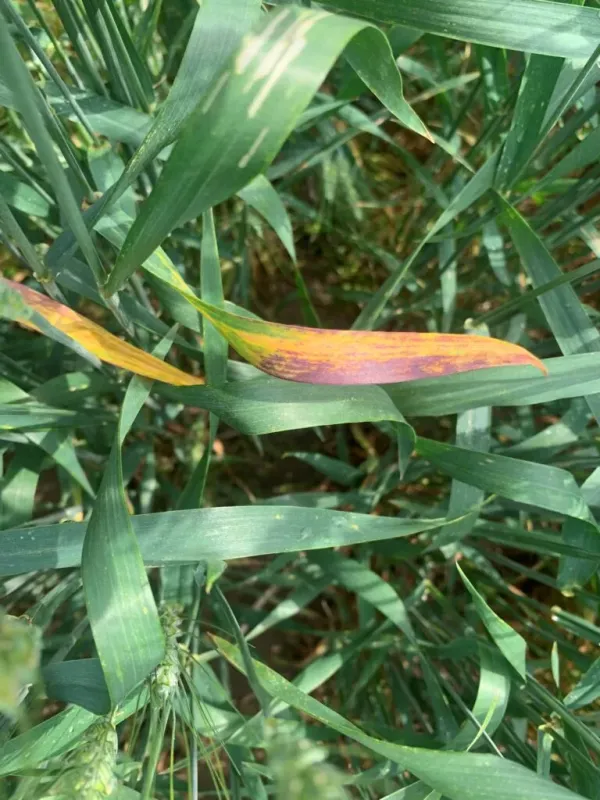
Initial visual symptoms appear as chlorosis of the leaf tips, which gradually spreads across the entire leaf blade.
A characteristic sign is the discoloration of leaves: barley leaves often turn yellow or golden, while oat leaves may exhibit a reddish-orange hue.
Infected plants show significant growth retardation, resulting in stunted height and abnormal tillering.
The root system of infected plants develops poorly, making them more susceptible to environmental stressors, including drought.
Heads in infected plants are often underdeveloped, small, or fail to emerge from the leaf sheath, leading to severe yield loss.
Pathogen
The disease is caused by the Barley yellow dwarf virus (BYDV), which belongs to the Luteoviridae family.
It is an obligate parasite that is not transmitted mechanically, through soil, or seeds, but spreads exclusively via specific insect vectors.
The primary vectors of the infection are various species of cereal aphids, such as the bird cherry-oat aphid and the English grain aphid.
The virus localizes in the phloem of the infected plant, where it replicates, disrupting the transport of photosynthates to the root system.
There are several strains of the virus, which differ in their virulence and host specificity toward different cereal grain crops.
Conditions for development
The development of epidemics depends directly on the population density of aphid vectors in the agroecosystem during critical growth stages.
The most dangerous infection period is the seedling and tillering stage, when young plants are most susceptible to the virus.
A warm and prolonged autumn promotes active aphid reproduction and early infection of winter crops, which increases the severity of the disease.
Infected weeds and perennial grasses serve as primary reservoirs for the infection, from which aphids transfer the virus to commercial fields.
A decrease in the activity of natural predators that feed on aphids can also trigger disease outbreaks in cereal crops.
Why it matters
The damage caused by Barley yellow dwarf includes a significant reduction in crop productivity, sometimes resulting in total plant death.
Mass infection leads to a sharp reduction in the number of productive tillers and a decrease in the thousand-kernel weight.
Crop quality deteriorates significantly, as grain becomes shriveled, loses mass, and fails to meet industrial processing standards.
Virus-infected crops exhibit reduced winter hardiness, leading to sparse stands and the potential need for spring reseeding.
Economic losses for farms can range from 20% to 80% of the projected harvest, depending on the intensity of the infection.
Protection
The primary management strategy involves adhering to optimal sowing dates: not too early for winter crops, and as early as possible for spring crops.
An effective practice is the elimination of weeds at field margins, which serve as reservoirs for both the virus and aphids.
The application of insecticides during the early stages of vegetation helps suppress aphid populations and prevent widespread infection.
Using varieties that are resistant or tolerant to the virus is the most economically sound method for protecting the crop.
- Monitoring aphid populations using yellow sticky traps.
- Spatial isolation of new plantings from older fields.
- Crop rotation to exclude highly susceptible predecessors.
Discussion
No discussions yet — be the first.