
Barley yellow dwarf
Luteovirus kertrihordei
Description
Symptoms
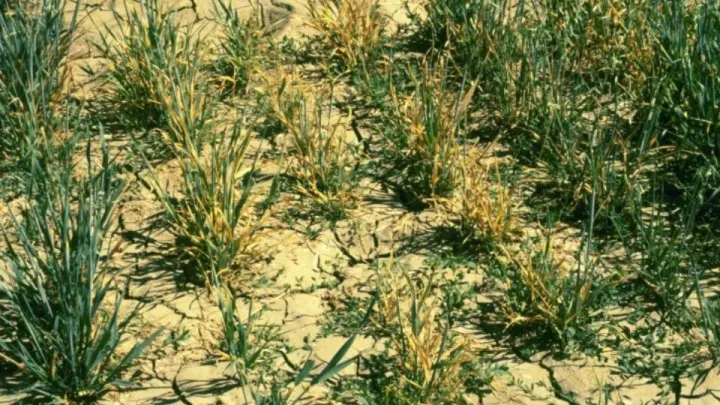
Symptoms typically begin with yellowing or reddening of leaf tips, which progress down the leaf blade. Stunting is the most characteristic sign, giving the plant a dwarfed appearance.
Infected plants often show increased tillering, but these tillers are usually stunted and produce little or no grain. The color of the foliage varies by species: barley often turns golden-yellow, while wheat and oats often show reddish or purple hues.
In the field, infected areas often appear as patches of stunted, discolored plants. The root system of affected plants is usually underdeveloped, making them more susceptible to drought stress.
At later stages, heads may remain small or fail to emerge properly, leading to significant yield reduction. In severe cases, the entire plant may die before maturity.
The presence of aphid colonies on the leaves is a key indicator that the virus may be introduced, as the aphids act as the primary delivery mechanism for the pathogen.
Pathogen
The causal agent of this disease is the Barley yellow dwarf virus (BYDV), a member of the Luteovirus genus. This virus is an obligate parasite transmitted exclusively by several aphid species in a persistent, circulative manner.
BYDV infects only the phloem tissues of plants, where it multiplies and interferes with the translocation of photoassimilates. There are various strains of the virus, which differ in their severity and their specific aphid vectors.
The virus cannot be transmitted mechanically or through seeds. It survives in perennial grasses, winter cereal crops, and volunteer plants, serving as a reservoir for infection during the off-season.
Aphids acquire the virus by feeding on infected phloem and retain it for the remainder of their lives, making them efficient long-distance vectors of the disease.
This pathogen is considered one of the most widely distributed and economically damaging virus diseases affecting cereal crops globally, especially in temperate regions.
Conditions for development
Disease prevalence is heavily dependent on the migration patterns and population density of aphid vectors. Mild and prolonged autumn weather creates ideal conditions for aphid colonization of early-sown winter cereals.
Early sowing increases the window of exposure for young seedlings to aphids during their peak migration periods. Consequently, late-sown crops are often less affected by primary infections.
The presence of volunteer grain and grassy weeds around fields provides a "green bridge" that allows the virus and its vectors to survive through the summer and migrate into new autumn crops.
Warm winters enable aphids to survive on crops, leading to potential secondary spread in the spring. High nitrogen fertilization can stimulate lush vegetative growth, which is highly attractive to aphids.
Climatic factors, such as wind patterns, also influence the distance aphids travel, spreading the virus over wide geographic areas from initial infection hotspots.
Why it matters
The economic impact of Barley yellow dwarf is profound, with yield losses reaching up to 80% in heavily infested fields. The severity of the loss depends on the timing of infection; younger plants are significantly more damaged.
In addition to yield volume, the quality of the grain is compromised, with lower test weights and reduced starch content. This often leads to downgrading of the harvested crop.
Infected plants are inherently weaker and more susceptible to secondary root rot pathogens and environmental stress, which complicates field recovery.
The cost of insecticide applications and the loss of crop value create a dual economic burden for farmers, making management decisions critical to profitability.
In many cases, the damage is irreversible once the plant is systemically infected, as there are no curative treatments available for plants already carrying the virus.
Protection
Integrated Pest Management (IPM) is the best approach to control BYDV, focusing primarily on minimizing aphid populations and reducing viral reservoirs.
Adjusting sowing dates is a key agronomic practice; delaying winter planting until after the peak aphid migration window can significantly reduce the risk of early-season infection.
The use of insecticidal seed treatments provides a crucial protective window for young seedlings, reducing the likelihood of successful viral transmission during the most vulnerable growth stages.
Effective weed management, especially the elimination of volunteer cereals and grasses, is essential to remove the "green bridge" and break the disease cycle.
- Selecting virus-resistant or tolerant crop varieties
- Monitoring aphid populations with yellow sticky traps
- Timely application of systemic insecticides if threshold levels are met
- Practicing crop rotation to disrupt virus survival
- Avoiding over-fertilization that attracts aphid vectors
Discussion
No discussions yet — be the first.