
Barley yellow dwarf
Luteovirus avii
Description
Symptoms
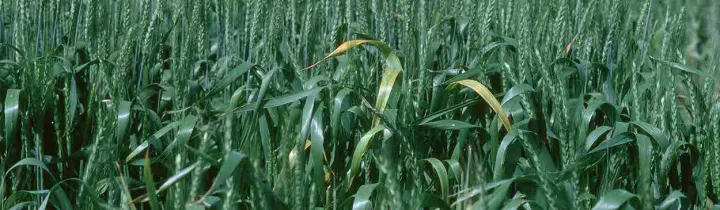
The primary symptom is leaf discoloration, typically starting from the tips and progressing towards the base, appearing as yellowing in barley or reddish-purple in wheat and oats.
Stunted growth is a hallmark of the disease, resulting in plants that appear shorter than healthy ones, giving the field a distinctively uneven and stunted look.
Infected plants often exhibit increased tillering, but these tillers are usually stunted, unproductive, and may fail to produce a grain-bearing head.
Root system development is significantly inhibited, making the plants more susceptible to drought, nutritional deficiencies, and other environmental stresses.
Since these symptoms can be easily confused with nutrient deficiencies or environmental stress, visual field diagnosis should always be supported by identifying aphid activity.
Pathogen
Barley yellow dwarf virus (BYDV) is a widespread viral disease that affects various species of grasses and cereal crops, belonging to the Luteoviridae family.
The virus is not transmitted by seed, mechanical contact, or soil-borne processes; it is exclusively transmitted by several species of cereal aphids.
Once injected into the plant by an aphid vector, the virus circulates within the phloem tissue, obstructing the transport of nutrients and sugars throughout the plant.
Multiple strains of BYDV exist, characterized by differences in host range and the specific efficiency with which certain aphid species transmit each strain.
The pathogen has a very wide host range, including barley, wheat, oats, rye, triticale, corn, and many wild grass species that act as a reservoir for the virus.
Conditions for development
The spread of BYDV is tightly linked to the population dynamics and migration patterns of cereal aphids, which move between fields seeking new hosts.
Warm, dry autumns are particularly conducive to the disease, as they favor early aphid colonization of newly emerged winter cereal crops.
Mild winters allow aphids to survive on winter cereals or volunteer plants, providing a continuous source of infection for the upcoming spring season.
Strong winds can transport winged aphids over long distances, facilitating the rapid spread of the virus across vast agricultural landscapes.
The presence of wild grass reservoirs near crop fields ensures that there is always a source of the virus available for aphids to pick up and spread.
Why it matters
Barley yellow dwarf is considered one of the most economically devastating viral diseases of cereals globally, causing significant yield losses in affected regions.
The severity of the yield loss is heavily dependent on the stage of plant development at the time of infection; earlier infections cause the most severe damage.
Infected plants suffer from poor grain filling, which results in smaller, shriveled kernels and significantly reduced test weights of the harvested grain.
Beyond quantity, the infection lowers the overall physiological vigor of the crop, making it more prone to secondary infections and winterkill.
Economic damage can range from minor yield reductions in resistant varieties to near-total crop loss in susceptible fields during high-pressure aphid years.
Protection
Integrated management is essential, focusing primarily on controlling the aphid population through the timely application of systemic insecticides.
Planting resistant or tolerant cereal varieties is the most effective long-term strategy to mitigate the impact of BYDV on farm productivity.
Cultural practices include managing volunteer cereals and weeds that harbor the virus and adjusting planting dates to avoid peak aphid migration periods.
Regular field scouting for aphid infestations is crucial for making informed decisions regarding chemical control interventions before the virus spreads.
Seed treatments with systemic insecticides are a highly effective method for protecting seedlings from early autumn infections in winter cereals.
Discussion
No discussions yet — be the first.