
Loofah witches broom
Loofah witches
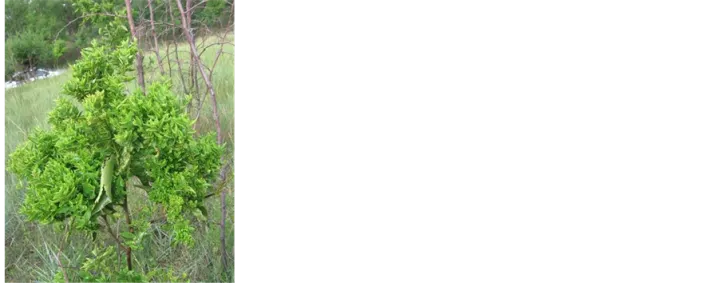
Description
Symptoms
The most prominent sign is the abnormal proliferation of shoots, causing the tops and lateral parts of the plant to form dense clusters or "brooms," which gives the disease its name.
Leaves on infected areas become significantly smaller, show signs of chlorosis, and often exhibit curling, crinkling, and severe deformation.
Internodes become drastically shortened, resulting in a stunted or dwarf-like growth habit, with numerous weak secondary shoots developing from the axillary buds.
Flowers on infected plants undergo virescence, transforming into green leaf-like structures, which renders them incapable of pollination or normal fruit formation.
In cases of early infection, the loofah plant stops growing, and fruits either fail to develop or form as small, twisted, and unmarketable structures.
Pathogen
The agent of the "loofah witches broom" disease is phytoplasma, a highly specialized intracellular parasite that infects the phloem of plants. Phytoplasmas are wall-less prokaryotes, which makes them extremely sensitive to environmental conditions and difficult to culture in laboratory settings.
Transmission occurs primarily through insect vectors, mainly leafhoppers, which acquire the pathogen while feeding on infected sap. After an incubation period within the insect, it becomes a vector capable of transmitting the disease throughout its lifespan.
This disease affects a wide range of plants in the Cucurbitaceae family, including loofah. Phytoplasma disrupts the plant's hormonal balance by blocking the synthesis of auxins and cytokinins, leading to severe metabolic shifts.
Once inside the sieve tubes of the phloem, the pathogen multiplies, clogging the vessels and preventing the transport of essential nutrients from the leaves to the roots and fruits.
Because the infection is systemic, it spreads throughout the entire plant, making it virtually impossible to treat infected specimens with conventional systemic fungicides.
Conditions for development
The development and spread of the disease are directly correlated with the population density of insect vectors, which are most active during hot and dry weather.
High temperatures favor the metabolism of leafhoppers, increasing their feeding rate and the efficiency of phytoplasma transmission to healthy host plants.
Weedy areas surrounding loofah fields serve as essential reservoirs, allowing the phytoplasma and its insect vectors to survive and persist between cropping seasons.
Poor ventilation within the crop canopy and excessive nitrogen fertilization, which promotes dense vegetative growth, attract vectors and accelerate the spread of the pathogen.
Continuous monoculture of cucurbits in the same location contributes to the accumulation of the pathogen in the soil and plant debris, establishing persistent infection hotspots.
Why it matters
The primary economic damage is the total loss of marketable yield, as the plant redirects its metabolic resources toward the production of defective vegetative growth.
The disease causes premature tissue necrosis and weakening of the root system, ultimately leading to the decline and death of the entire plant within a single season.
Due to the systemic nature of the infection, seeds collected from plants that appear healthy in an infected field may carry the pathogen, posing a risk to future harvests.
Additional costs arise from the necessary implementation of intensive vector control programs and the labor-intensive removal of infected plant residues.
Rapid spread of the disease within a field can lead to the necessity of destroying the entire loofah plantation to prevent further outbreaks in the vicinity.
Protection
The primary strategy for management is prevention, which includes using certified, disease-free seeds and maintaining spatial isolation from potential infection sources.
Strict sanitation practices must be followed, including the systematic removal of weeds that act as alternative hosts for both the phytoplasma and insect vectors.
- Regular application of insecticides to control leafhopper and other sucking insect populations.
- Immediate rogueing and burning of all plants exhibiting initial symptoms of witches broom.
- Crop rotation with non-cucurbit species for a minimum of 3-4 years to break the infection cycle.
- Monitoring the field edges for early signs of vector activity.
Effective control relies heavily on managing the insect vectors during the critical stages of loofah development to minimize the risk of pathogen transmission.
Discussion
No discussions yet — be the first.