
Description
Symptoms
Symptoms often manifest as reduced height growth, chlorosis of needles, and thinning crowns, which indicate an compromised root system and impaired nutrient uptake.
A definitive sign is the presence of laminated decay, where the wood separates along the annual rings. Small, dark reddish-brown mycelial mats are frequently found on root surfaces.
Upon removing the bark, one can observe the wood breaking into thin, flexible sheets. This structural degradation often leads to tree instability and potential windfall.
Trees often die in expanding patches or centers, with trees at the edge of these centers frequently showing the most active signs of infection.
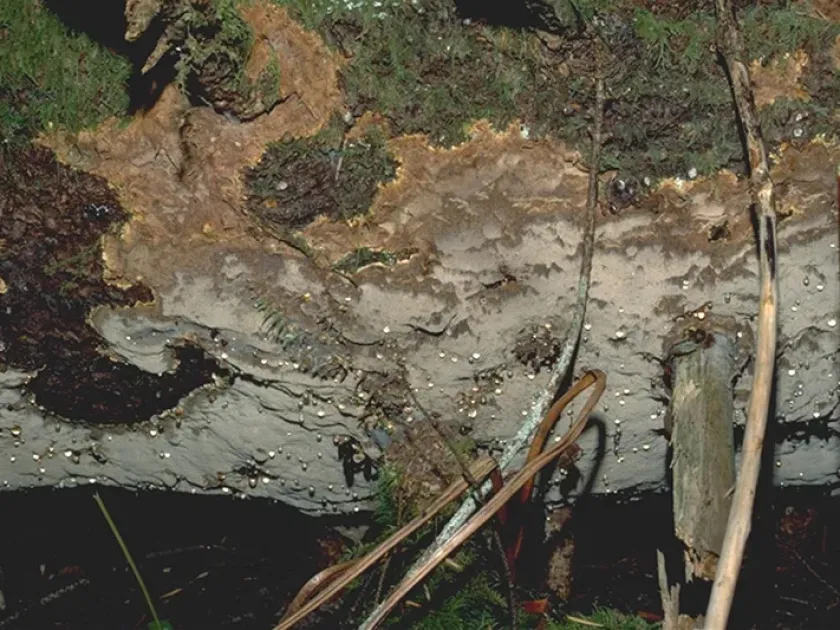
The presence of resupinate, brown sporocarps near the base of the tree is a late-stage sign, indicating significant colonization of the host plant.
Pathogen
The causal agent of this disease is the fungus Phellinus weirii, a basidiomycete responsible for severe root decay in various conifer species.
This pathogen functions by colonizing the root system and the lower bole, where it breaks down lignin and cellulose, leading to a characteristic rot.
The fungus is long-lived in the soil, persisting within infected stumps and root segments for several decades, making it a persistent threat to forest health.
Transmission occurs primarily through root-to-root contact, allowing the fungus to spread from infected trees to adjacent healthy hosts in the stand.
Phellinus weirii is known for its ability to form thick, leathery mats of mycelium on the surface of roots, which are diagnostic for identification in the field.
Conditions for development
The disease thrives in dense forest stands where the proximity of roots facilitates easy transmission of the mycelium between individual trees.
Douglas-fir is highly susceptible to Phellinus weirii, making it the primary target and economic victim of the pathogen in many regions.
Favorable soil moisture and moderate temperatures provide optimal conditions for the fungus to expand its mycelial network within the forest floor.
High-density planting regimes or lack of thinning operations increase the connectivity of root systems, creating a perfect environment for the pathogen to spread.
In mature stands, the weakened vigor of trees often makes them more vulnerable to the progression of root decay over time.
Why it matters
The primary impact is the loss of tree biomass and the formation of gaps in the forest canopy, which leads to significant timber volume reduction.
For susceptible species like Douglas-fir, the wood quality is severely compromised, rendering it unsuitable for high-value structural lumber purposes.
Wind-throw becomes a frequent occurrence due to the destruction of lateral roots, creating safety hazards and complicating the salvage of timber.
Long-term harm includes the contamination of the site, preventing successful regeneration with the same species for many years after the initial harvest.
The ecological disruption of the forest ecosystem is significant, as the disease alters the successional patterns and biodiversity within the affected areas.
Protection
Effective management focuses on removing infected stumps and root systems during harvest to eliminate the primary sources of inoculum.
Strategic planting of resistant or non-susceptible tree species on sites with a history of laminated root rot can significantly reduce future losses.
Early detection through systematic forest health surveys helps in isolating infected centers and preventing the further spread of the fungus.
In some cases, trenching around infected zones is used to physically break root contact and prevent the migration of the pathogen to neighboring trees.
Silvicultural strategies that promote species diversity and proper spacing are essential for minimizing the risk of outbreaks in vulnerable forest stands.
Pathogens and affected parts
Affects crops · 1
Discussion
No discussions yet — be the first.