
Description
Symptoms
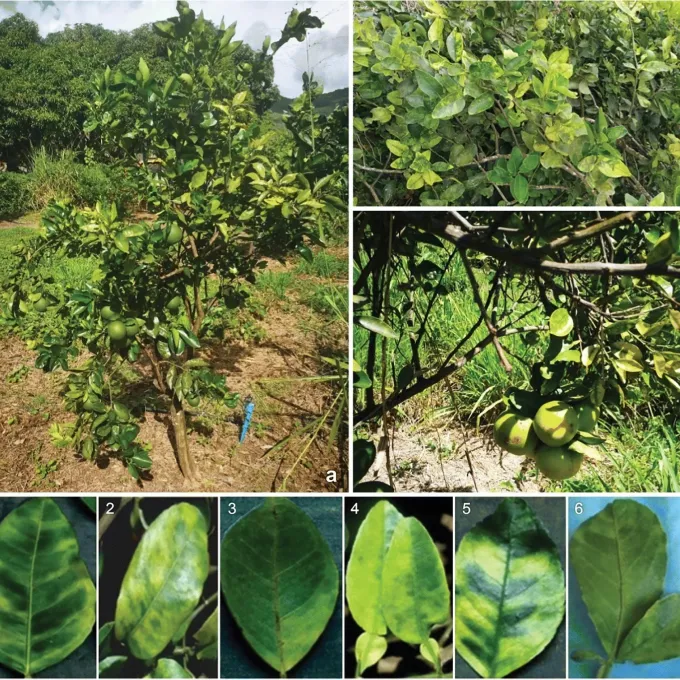
The most distinctive symptom is a blotchy mottle pattern on the leaves, which frequently crosses the midrib, unlike nutrient-deficient yellowing.
Affected fruit are typically small, misshapen, and often exhibit a distinct green color at the stem end even when fully mature, hence the name greening.
Fruit juice quality is severely degraded, characterized by a bitter or metallic taste, making the yield commercially worthless for fresh or processing markets.
Trees show progressive decline, including extensive twig dieback, sparse canopy, and a lack of new, healthy flush growth.
- Blotchy mottle leaf chlorosis.
- Small, asymmetrical, green-tinted fruits.
- Bitter fruit flavor.
- Premature fruit drop.
- Dieback of twigs and branches.
Pathogen
Citrus Huanglongbing, often called citrus greening, is associated with the gram-negative bacterium Candidatus Liberibacter and phytoplasma-like organisms.
These pathogens inhabit the phloem tissue of citrus plants, disrupting the tree's ability to transport nutrients and sugars from leaves to roots.
The disease is transmitted primarily by sap-sucking insects, most notably the Asian citrus psyllid (Diaphorina citri) or the African citrus psyllid.
Once inside the plant, the pathogen colonizes the phloem, causing systemic infection that prevents the recovery of the tree's vascular system.
The transmission process is rapid: once a psyllid feeds on an infected tree, it retains the bacteria for the remainder of its life, effectively acting as a vector.
Conditions for development
The spread of the disease is highly dependent on the climate, which dictates the population dynamics of the citrus psyllid vector.
Warm, humid conditions facilitate year-round breeding cycles for psyllids, significantly increasing the risk of pathogen transmission in tropical regions.
Orchards with improper spacing or neglected canopy management provide sheltered environments for psyllid populations to build up rapidly.
Long-distance spread of the disease is predominantly human-mediated, primarily through the movement of infected, asymptomatic nursery stock.
The latent period, where trees are infected but show no symptoms, makes it difficult to detect the disease before it has already spread to neighboring trees.
Why it matters
Huanglongbing is considered the most devastating disease for the global citrus industry, as there is currently no cure for infected trees.
It causes significant yield losses within a few years, eventually leading to the complete abandonment of commercial citrus groves.
Root systems suffer severe degradation, resulting in a tree that cannot maintain its vegetative health regardless of water or fertilizer inputs.
The economic impact involves not just the loss of annual crops, but the catastrophic investment loss of the entire orchard infrastructure.
Entire regions have seen their citrus production plummet or completely collapse due to the inability to contain the spread of the pathogen.
Protection
Integrated management is essential, starting with the use of clean, pathogen-free nursery stock certified through rigorous laboratory testing.
Aggressive vector control through well-timed insecticide applications is the primary method to keep psyllid populations below the economic threshold.
Prompt identification and removal (roguing) of infected trees is necessary to eliminate sources of inoculum, though this is often difficult in high-prevalence areas.
Biological control methods, such as the release of parasitoid wasps (Tamarixia radiata), are used to reduce the psyllid population in a sustainable way.
Regional coordination among growers is critical for success, as unmanaged neighboring orchards serve as constant sources of new infections.
Pathogens and affected parts
Affects crops · 1
Discussion
No discussions yet — be the first.