
Description
Symptoms
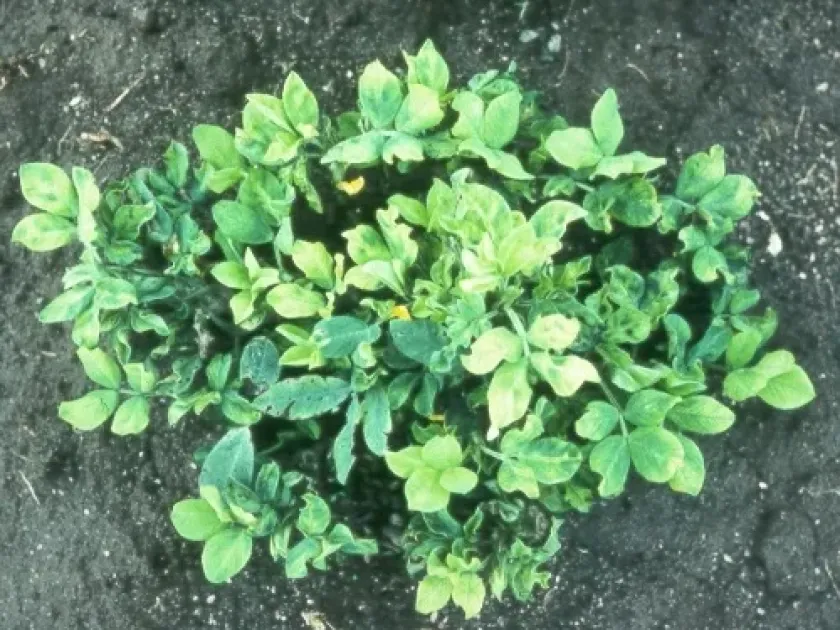
The primary symptom of the disease is a pronounced deformation of the leaf blades. Leaves become crinkled, and their margins curl upwards or downwards, giving the plant a characteristic curly appearance.
A significant reduction in leaf size and shortening of internodes are observed. The plants look stunted, lag in growth, and have an unnaturally bushy form due to excessive branching of lateral shoots.
Chlorotic mosaic or spotting often appears on the surface of infected leaves. Leaf tissues may thicken and become brittle, while the venation acquires an atypical pale color.
In severe cases, infected plants produce almost no generative organs. Flowers may be deformed, and ovaries fail to develop or die off at early stages of formation.
The root system of infected specimens also undergoes changes: the development of nitrogen-fixing nodules is slowed, which further suppresses the overall condition of the peanut crop.
Pathogen
The disease is caused by viruses primarily transmitted by insect vectors. The most common vector is the aphid, which transfers viral particles while feeding on the sap of healthy plants.
The peanut leaf curl virus belongs to a group of pathogens capable of persisting in the vector's body for a long time. Mechanical transmission through field tools occurs less frequently.
In addition to aphids, thrips or leafhoppers may participate in the spread of the infection. The exact virus species depends on the region, but the pathophysiological mechanism of tissue damage remains similar for most isolates.
The infection spreads rapidly within the field if the vector population reaches threshold levels. The virus localizes in the phloem, disrupting the normal transport of nutrients.
Weeds from the legume or solanaceous families often serve as reservoirs of infection during the off-season, where the virus persists until new peanut sprouts appear.
Conditions for development
Disease development is closely linked to the number of insect vectors. During dry and hot periods, aphid populations grow more actively, which contributes to mass infection of crops.
Optimal conditions for spread occur when there are primary infection sources near the fields. The more reservoir weeds are nearby, the higher the risk of an epidemic outbreak.
Densely planted fields create a microclimate favorable for insect movement and protection from adverse effects. Poor agrotechnical practices contribute to rapid area coverage.
The temperature regime significantly affects the incubation period. In hot periods, the virus develops faster inside the plant, accelerating the appearance of symptoms.
Inadequate agrocenosis management, including untimely weeding, creates ideal conditions for maintaining an infectious background throughout the growing season.
Why it matters
The main danger lies in a critical reduction in yield. Infected plants form almost no pods, or the peanuts turn out to be underdeveloped and empty.
The quality of commercial products deteriorates sharply: peanut seeds become small, lose their nutritional value, and become unsuitable for further processing or storage.
The disease causes a disruption of physiological processes, including photosynthesis and respiration. This makes peanuts more vulnerable to secondary fungal and bacterial infections.
Economic damage is associated not only with direct crop losses but also with the costs of protective measures, which are often ineffective against viral etiology.
In large areas, leaf curl is capable of destroying up to 50–80% of the potential harvest if early infection occurs, making cultivation on such plots unprofitable.
Protection
The primary control method is managing insect vector populations. The application of systemic insecticides at early growth stages reduces the risk of initial infection.
An important preventive step is the destruction of weeds that serve as virus reservoirs. Regular weeding of fields and surrounding areas significantly lowers the infection background.
It is recommended to use peanut varieties resistant to viral diseases. Breeding efforts are focused on creating genetically protected forms capable of resisting infection.
Maintaining spatial isolation between new and old peanut fields helps prevent the transfer of infection by insects from one field to another.
Applying agrotechnical practices, such as optimal planting dates and balanced fertilization, strengthens plant immunity and makes them less susceptible to the pathogen.
Pathogens and affected parts
Affects crops · 1
Discussion
No discussions yet — be the first.