
Grapevine summer disease
Grapevine summer mottle agent
Description
Symptoms
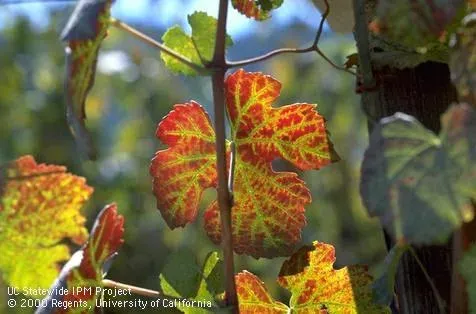
The first external signs appear in early summer. Leaves on infected vines show characteristic chlorosis, turning yellow on white-berry varieties or reddish-purple on dark-berry varieties, often accompanied by downward rolling of the leaf margins.
As the disease progresses, the leaves become brittle and rigid. The shoots fail to lignify properly, remaining green and herbaceous until late autumn, which leaves the vine highly susceptible to winter frost damage.
Flower clusters and berries often undergo necrosis and drop prematurely. Any fruit that does reach maturity is typically stunted, flavorless, and essentially useless for wine production.
Internal symptoms include the discoloration of the phloem tissue. The plant growth habit changes as well, with shortened internodes giving the vine a stunted, bushy, or broom-like appearance.
The lack of proper wood maturation is a hallmark sign. In late autumn, while healthy vines turn brown and harden, infected canes remain soft and green, indicating a complete failure of the plant's natural defense mechanisms.
Pathogen
Grapevine summer disease, scientifically known as Flavescence dorée, is caused by phytoplasmas. These are cell wall-less bacteria that inhabit the phloem tissue of the host plant, effectively hijacking its vascular transport system.
The primary vector for the transmission of this disease is the American grapevine leafhopper, Scaphoideus titanus. This insect acquires the phytoplasma while feeding on infected vines and transmits it to healthy plants during subsequent feeding sessions.
Once inside the plant, the phytoplasma colonizes the sieve tubes of the phloem. This disrupts the flow of photoassimilates, leading to severe metabolic stress and systemic illness within the entire grapevine structure.
The pathogen is highly contagious within the vineyard through the movement of the leafhopper population. Because it is a systemic infection, the disease persists in the woody parts of the vine, making the entire plant a permanent reservoir of the pathogen.
Long-distance spread of the disease is primarily facilitated by the transport of infected planting material. Cuttings taken from asymptomatic but infected vines can introduce the disease into new regions, leading to severe outbreaks.
Conditions for development
The development of Flavescence dorée is intrinsically linked to the life cycle of Scaphoideus titanus. Warm and humid conditions in late spring are ideal for the emergence of leafhopper nymphs from overwintering eggs.
High temperatures accelerate the acquisition and incubation period of the phytoplasma within the insect vector. Consequently, regions with warmer climates experience more intense and rapid spread of the disease.
Neglected vineyards with high weed pressure act as hubs for the disease. Weeds provide alternative food sources and shelter for the leafhoppers, maintaining high pest density even when the vines are not the primary focus.
Proximity to abandoned or poorly managed vineyards significantly increases the risk of infection. The mobility of the adult leafhopper allows the pathogen to jump across vineyard boundaries quite easily.
Overwintering conditions play a role in the long-term survival of the vector population. Mild winters allow more eggs to survive on the vine bark, leading to larger infestations the following season.
Why it matters
The primary economic impact is the total loss of yield quality and quantity. Infected vines are effectively rendered unproductive, and the produce is unfit for vinification purposes.
The disease significantly decreases the vine's hardiness. Winter mortality rates in infected vineyards are extremely high, often leading to the total collapse of entire blocks of vines after a harsh winter.
Significant financial burden is incurred by the necessity of total vineyard removal and replanting. The loss of established, high-yielding vines represents a major investment loss for growers.
The spread of the disease can cause severe regional instability in viticulture. Due to its impact, many countries have implemented strict mandatory quarantine and eradication programs to manage the disease.
Because the disease can remain latent in the plant for months or years, an infestation can be well-established before symptoms become visible, complicating early detection and management efforts.
Protection
The cornerstone of control is managing the Scaphoideus titanus population. Strategic application of insecticides during the nymphal stages is essential to break the cycle of disease transmission.
Strict adherence to phytosanitary protocols is mandatory. Growers must ensure that all new vine material is certified free of phytoplasma by reputable, government-regulated nurseries.
Regular visual monitoring of the vineyard is crucial for the early identification of symptomatic plants. Once a vine is identified as infected, it should be promptly removed, including the root system, to eliminate the infection source.
Cultivation practices that reduce weed cover help minimize the habitat available for the leafhopper vector. Maintaining a clean and well-tended environment decreases the overall pest pressure.
- Use of yellow sticky traps to monitor adult leafhopper flight activity.
- Implementation of buffer zones between infected and healthy vineyard blocks.
- Disinfection of pruning tools to prevent mechanical spreading of sap.
- Selecting cultivars or rootstocks that exhibit lower susceptibility to the disease.
Discussion
No discussions yet — be the first.