
Exserohilum prolatum
Exserohilum prolatum
Description
Symptoms
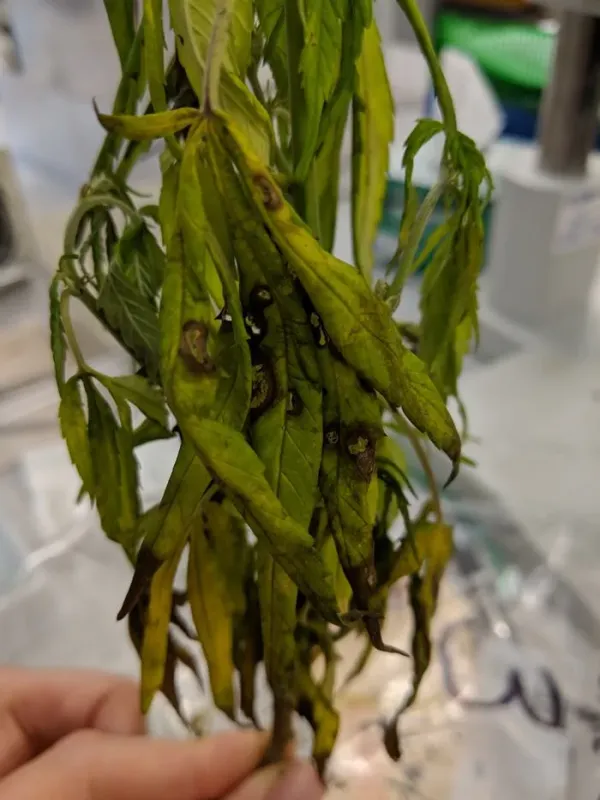
The primary manifestation of the disease is the development of distinct spots on the leaves of affected plants. These spots often exhibit an elongated or oval shape, which reflects the species name of the fungus, and gradually transition into a brown or dark-colored necrotic tissue.
Surrounding the necrotic areas, a light chlorotic halo often forms, which indicates the pathogen's ability to release toxins that compromise the plant's health. As the infection progresses, these individual lesions can coalesce, eventually covering large portions of the leaf surface.
Under conditions of high humidity, an olive-black or grey velvety mold appears on the spots. This represents the sporulation of the fungus, consisting of conidiophores and conidia that are easily dispersed by wind currents to neighboring healthy plants.
Infection may also affect leaf sheaths and stems, leading to the premature drying and senescence of these organs. This leads to a general weakening of the plant, inhibited growth, and a significant reduction in photosynthetic efficiency.
For definitive diagnosis, a microscopic examination of the conidia is required. The characteristic protruding hilum at the base of the spore is a vital morphological trait that distinguishes Exserohilum prolatum from other leaf-spotting fungi such as Bipolaris or Helminthosporium species.
Pathogen
The causative agent of the disease is the microscopic fungus Exserohilum prolatum, classified within the Ascomycota division. It is a facultative parasite that thrives both as a pathogen on living tissue and as a saprotroph on dead plant debris.
The fungus reproduces via conidia formed on conidiophores. A distinct morphological characteristic of the Exserohilum genus is the prominent hilum, which serves as a critical identification marker for plant pathologists and researchers.
The pathogen survives the winter season as mycelium embedded in crop residues remaining on the soil surface. Furthermore, the fungus can persist via spores (conidia) residing on the surface of seeds, providing a pathway for transmission in subsequent seasons.
The life cycle initiates when spores land on the leaf surface and, provided there is sufficient moisture, germinate to penetrate the plant tissue via stomata or direct epidermal breach. The pathogen's virulence is linked to its ability to secrete specific metabolic enzymes that degrade plant cell walls.
The genetic adaptability of this fungus allows it to thrive in diverse environments, posing significant challenges for breeding programs aiming to develop resistant crop varieties.
Conditions for development
Disease development is most intense during warm and humid weather conditions. The optimal temperature range for spore germination typically falls between 20 and 28 degrees Celsius, provided the relative humidity remains consistently high.
Dew, fog, and frequent rainfall are critical environmental drivers for the rapid spread of conidia. Liquid water on the foliage is an essential requirement for the successful penetration of the fungus into the plant's internal tissues.
Dense crop canopies, which restrict airflow and maintain humidity, create the perfect microclimate for the infection to propagate. Poor aeration within the field significantly accelerates the transmission of the fungus between plants.
Poor crop rotation practices, where host crops are planted in the same field too frequently, lead to an accumulation of inoculum in the soil. Large amounts of undecomposed plant material serve as the primary source of initial infection.
Plants under stress—due to nutrient deficiencies, drought, or pest pressure—are significantly more susceptible to Exserohilum prolatum. Weakened defense mechanisms allow the fungus to colonize the tissue much more rapidly than it would in healthy, thriving plants.
Why it matters
The economic impact of the disease stems from a substantial reduction in the functional leaf area, which severely limits the plant's capacity for photosynthesis. This reduction is particularly detrimental during the grain-filling stage.
Premature leaf senescence caused by the infection results in shriveled grains and a decrease in thousand-kernel weight. This negatively affects both the total crop yield and the overall quality of the harvest, leading to significant financial losses for farmers.
Infected plants exhibit reduced vigor and increased susceptibility to secondary pathogens and abiotic stressors. Depending on the intensity of the outbreak, field yield losses can range from 15% to 30% or even higher under severe epidemic conditions.
Seed transmission is a major concern, as grain harvested from infected fields can carry the fungus, thereby spreading the disease to new locations and compromising the seed bank for future planting seasons.
In extreme cases of epidemic spread, the disease can lead to widespread necrosis, essentially killing the foliage and resulting in the complete failure of the crop if no protective actions are taken in time.
Protection
The primary preventive strategy involves rigorous crop rotation, substituting susceptible hosts with resistant or non-host crops to interrupt the pathogen's life cycle. Ensuring spatial isolation from previous year’s infected fields further reduces the risk of primary inoculation.
Effective tillage practices, such as deep plowing to bury crop residues, speed up the decomposition process and destroy the pathogen's overwintering sites. The use of stubble decomposers can also help reduce the inoculum load in the soil.
The application of high-quality, fungicide-treated seeds is crucial. Seed treatment provides an essential barrier against early-stage infections and ensures a healthy, protected stand of seedlings.
During the growing season, if initial symptoms are identified, the application of systemic fungicides is necessary. Formulations based on triazoles and strobilurins are highly effective in managing the disease by preventing further spread and protecting healthy tissue.
Balanced fertilization, especially the adequate provision of potassium, helps strengthen cell walls and enhances the plant's natural systemic resistance, making it more difficult for the pathogen to penetrate and establish an infection.
Discussion
No discussions yet — be the first.