
European Stone Fruit Yellows
European stonefruit yellows phytoplasma
Description
Symptoms
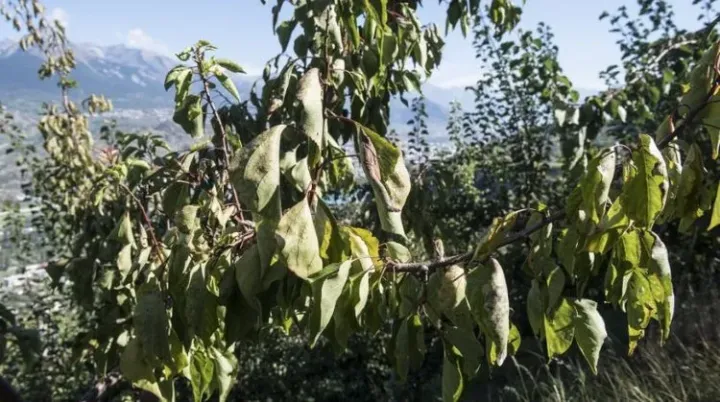
Early spring symptoms include premature bud burst and the development of chlorotic, stunted leaves. Affected leaves often exhibit yellowing, reddening, or leaf curling at the margins.
During the summer months, trees often develop "witches' broom" formations, characterized by proliferation of thin, weak shoots with very short internodes.
The root system is significantly compromised, showing decay and necrosis of small feeder roots, which hinders the tree's ability to absorb nutrients and water effectively.
Fruit quality is severely impacted; fruits remain underdeveloped, show abnormal deformation, and often drop prematurely before reaching maturity.
Necrotic lesions frequently appear on the trunk and at the branching points of limbs. Peeling back the bark often reveals dark brown, necrotic tissue, indicating deep-seated metabolic damage.
Pathogen
European Stone Fruit Yellows (ESFY) is caused by the phytoplasma Candidatus Phytoplasma prunorum. This pathogen is a specialized microorganism that survives and multiplies within the phloem tissues of host trees.
The pathogen lacks a cell wall, making it highly sensitive to external conditions, so it relies entirely on the host plant or specific insect vectors for survival and transmission.
Propagation of the disease primarily occurs through the movement of infected nursery stock, such as rootstocks or scions, which can carry the phytoplasma in a latent state for years.
The primary natural vector for ESFY is the psyllid Cacopsylla pruni. These insects ingest the phytoplasma while feeding on the phloem of infected trees and subsequently transmit it to healthy hosts.
Detection is often difficult because the pathogen can remain in a latent phase, showing no symptoms while actively spreading throughout the orchard's vascular system.
Conditions for development
The spread of ESFY is strictly correlated with the migration cycles of the psyllid Cacopsylla pruni. Outbreaks are most common in years with warm, dry spring weather, which promotes vector activity.
High summer temperatures facilitate the multiplication of the phytoplasma within the host tree, causing symptoms to manifest more rapidly and aggressively.
Orchards located near wild blackthorn (Prunus spinosa) thickets are at a higher risk, as these wild hosts serve as natural reservoirs for both the pathogen and the vector.
Poor orchard management, such as neglecting pruning or failing to control insect populations, allows the infection to build up and spread unchecked throughout the entire plantation.
High humidity within dense, poorly ventilated tree canopies provides an ideal microclimate for the colonization and movement of insect vectors between trees.
Why it matters
ESFY is considered one of the most destructive diseases in stone fruit production, as infected trees generally cannot be cured and eventually die.
The disease drastically reduces the tree's winter hardiness, leaving infected orchards highly susceptible to cold injury even during relatively mild winters.
Economic losses are severe, involving the costs of tree removal, loss of productive canopy, and the inability to produce marketable yields for several years.
Presence of the disease often triggers mandatory quarantine measures, severely restricting the movement and sale of nursery stock and impacting the farm's export potential.
The gradual decline of an infected tree forces a cycle of replanting, which disrupts orchard management and results in a long-term loss of profitability for the grower.
Protection
The primary control measure is the exclusive use of high-quality, certified nursery stock that has been rigorously tested using PCR methods to ensure freedom from phytoplasma infection.
Strategic management of Cacopsylla pruni populations is essential. Insecticide applications during the green-tip stage are effective in reducing the vector population before widespread transmission occurs.
Any tree displaying symptoms of ESFY must be immediately rogued and destroyed, including the root system, to eliminate the infection source from the orchard.
Growers should maintain a buffer zone by removing wild Prunus species from the vicinity of the orchard, as these act as a constant source of infection.
Strict hygiene protocols, including the disinfection of pruning tools with alcohol or appropriate sterilizing agents between trees, are mandatory to prevent mechanical transmission of the pathogen.
Discussion
No discussions yet — be the first.