
Dothideomycetes
Dothideomycetes
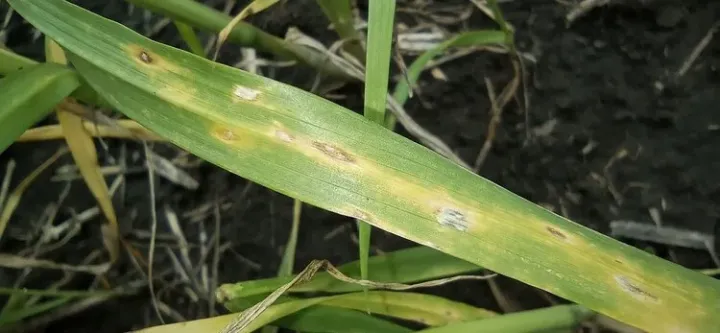
Description
Symptoms
The primary symptoms of Dothideomycetes infection manifest as chlorotic spots that eventually turn into necrotic lesions of various shapes and colors. Affected areas are often surrounded by a dark border, a common characteristic for many types of cereal leaf spots.
Small black dots, known as pycnidia or pseudothecia, are frequently visible on the surface of necrotic tissues. This is a key diagnostic feature, allowing for the visual confirmation of fungal disease during field scouting.
Intensive infection leads to premature yellowing and leaf abscission, which critically reduces the photosynthetic activity of the plant. Ultimately, this results in significant yield losses and lower quality characteristics for grain or produce.
Stems and flower stalks of infected plants can become deformed or dry out prematurely. Under high humidity, a characteristic coating consisting of the fungus's conidial sporulation may form around infection sites, which is easily spread by wind to adjacent areas.
Root necks and fruits can also be affected, resulting in dark, sunken spots or rots. Such symptoms are often confused with bacterial infections, necessitating phytopathological laboratory analysis for accurate identification.
Pathogen
Dothideomycetes is the largest and most diverse class of ascomycete fungi, encompassing thousands of species, many of which are destructive plant pathogens. These fungi possess complex life cycles and have the ability to infect both wild plants and crucial agricultural crops.
Pathogens of this group are characterized by the development of ascostromata—specialized fruiting bodies embedded within the host plant tissues or developing on the surface. Inside these structures, asci containing ascospores are formed, which serve as the primary source of infection during the growing season.
Among the most notable members of this class are pathogens causing septoria leaf spot, black spot, various types of powdery mildew (in the narrow sense), and scab. Their mycelium often grows intercellularly, gradually destroying the structure of leaf, stem, or fruit tissues.
Many Dothideomycetes are capable of surviving as saprotrophs on plant debris, which allows them to successfully overwinter in the soil or on crop stubble. This makes disease management extremely difficult, as the inoculum remains in the field even after deep tillage.
The genetic plasticity of fungi in this class allows them to rapidly adapt to fungicide treatments, frequently leading to the emergence of resistant strains. Agronomists must consistently rotate products from different chemical groups to effectively suppress epiphytotics.
Conditions for development
The development of Dothideomycetes is promoted by prolonged periods of high humidity and moderate temperatures ranging from 18 to 25 degrees Celsius. Raindrops and dew are the primary vectors for spore dispersal within a field.
Dense crop stands and poor air circulation create a microclimate that is ideal for conidia germination and tissue penetration. This is why disease outbreaks are often widespread during seasons with frequent rainfall.
The presence of plant debris on the soil surface plays a crucial role, as the fungus maintains viability there for several years. Minimum tillage practices often facilitate the accumulation of infectious potential in the top layer of the substrate.
Violation of crop rotation schedules, where host plants return to the field too quickly, significantly increases the risk of epiphytotics. Poor agronomic practices create a favorable base for the accumulation of spore material, which activates under favorable conditions.
Stress factors, such as imbalanced nitrogen fertilization, weaken plant immunity and make them more susceptible to fungal attacks. Robust and healthy plants possess more effective barrier mechanisms against the penetration of fungal hyphae.
Why it matters
The primary damage caused by Dothideomycetes is mass leaf tissue destruction, which deprives the plant of the ability to produce energy and develop generative organs. This leads to shriveled grain and a loss of marketability for the produce.
In crop production, yield losses from leaf spots caused by this fungal class can reach 30-50% in epidemic years. Reduced thousand-kernel weight is a direct consequence of disrupted metabolic processes in the affected tissues.
Beyond yield quantity, significant deterioration in quality is observed. Mycotoxins, which can be produced by certain species, may render the harvest unsuitable for food processing or animal feed.
Infection of crops leads to increased operational costs for unplanned fungicide applications. This significantly lowers the profitability of cultivation, making production sensitive to any weather anomalies.
The long-term persistence of pathogens in the soil forces farmers to abandon the cultivation of more profitable crops in favor of less profitable but more resistant varieties. This negatively impacts crop rotation structures and overall farm economics in the long run.
Protection
The protection system against Dothideomycetes is based on the use of fungicides with both preventive and curative action. Applications of triazole and strobilurin-based products effectively suppress disease development during early growth stages.
A mandatory element of control is adherence to proper crop rotations with spatial field isolation. Rotating crops allows the fungal development cycle to be broken, denying the pathogen access to its host plant during critical periods.
Thorough incorporation of plant residues into the soil via deep plowing or the use of stubble decomposers helps reduce the primary infection load. This is a fundamental measure that must be carried out in the autumn after harvest.
Using seeds treated with broad-spectrum fungicides protects seedlings from early infection. Quality seed material is the first line of defense against a wide range of pathogens, including many Dothideomycetes species.
Breeding and introducing resistant crop varieties and hybrids is the most reliable and environmentally friendly method of control. Modern breeding programs focus on developing plants with genetically encoded immunity to major leaf spot diseases.
Discussion
No discussions yet — be the first.