
Disciseda
Disciseda
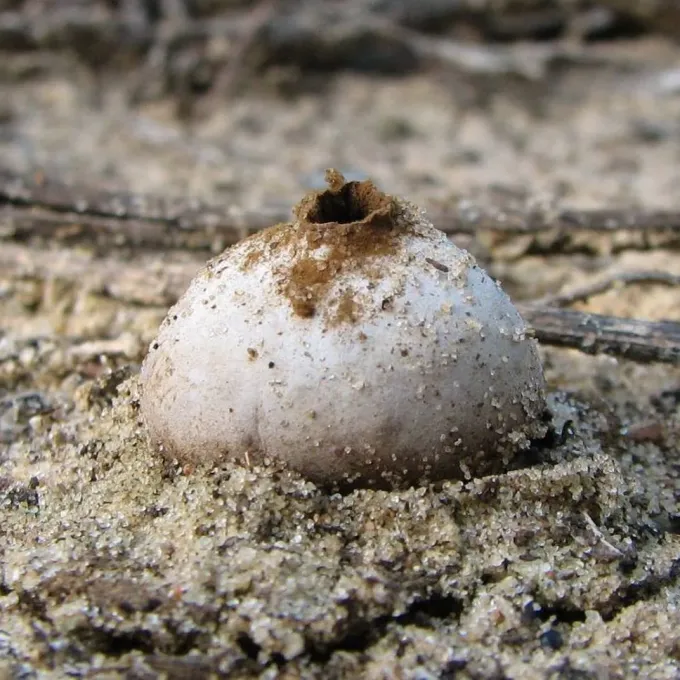
Description
Pathogen
The genus Disciseda belongs to the family Agaricaceae and represents a group of puffball fungi adapted to specific terrestrial environments.
These fungi act as saprotrophs, meaning they obtain nutrients from decaying organic matter rather than attacking living plant tissues.
They do not function as phytopathogens, and there is no record of them causing diseases in commercial crops or agricultural plants.
The fungus structure usually develops partially underground, revealing itself mainly during the spore dispersal phase of its life cycle.
From a biological standpoint, their role is essential for nutrient cycling in semi-arid and sandy soil habitats.
Conditions for development
Disciseda species are typically found in open areas, favoring sandy or rocky soils that are exposed to direct sunlight.
They show a remarkable ability to survive in environments with high diurnal temperature fluctuations and low humidity.
The development of the fruiting body is primarily triggered by the accumulation of soil moisture following seasonal rainfall.
These fungi thrive in nutrient-poor conditions where they efficiently decompose complex organic debris into simpler forms.
They are well-adapted to habitats where water availability is the primary limiting factor for most other fungal life forms.
Why it matters
There is no evidence or agricultural report indicating that Disciseda poses any threat to crop production or yield quality.
As obligate saprotrophs, they lack the enzymatic mechanisms required to invade or damage the living tissues of cultivated plants.
Their presence in a field is purely ecological, as they facilitate the natural decomposition of soil organic matter.
No protective measures, chemical controls, or fungicide applications are necessary, as they are not harmful to agricultural ecosystems.
Farmers and agronomists do not consider these fungi as pests, confirming their harmless status regarding plant pathology.
Discussion
No discussions yet — be the first.