
Description
Symptoms
The primary symptom is a progressive root rot that leads to stunted growth, yellowing (chlorosis), and wilting of the foliage, eventually causing total plant collapse.
On leaves, the disease manifests as distinct spots, ranging from small reddish-brown specks to large necrotic lesions, often resulting in premature leaf drop.
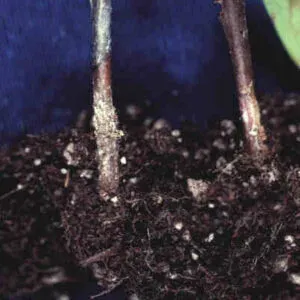
Stem cankers may appear at the crown area, showing sunken, dark-colored lesions that girdle the stem and restrict nutrient and water uptake.
In seedling nurseries, particularly with Liquidambar, the disease often causes damping-off, where stems soften and collapse near the soil line under high humidity.
- Darkening and decay of root systems
- Yellowing and chlorotic patches on leaves
- Sunken stem cankers near the soil line
- Rapid wilting and death of young seedlings
Pathogen
The disease is caused by the fungus Calonectria kyotensis (anamorph Cylindrocladium kyotense). This soil-borne pathogen survives in organic matter and debris as mycelium or sclerotia.
It has a very broad host range, infecting various nursery crops, including hardwoods like Liquidambar styraciflua, as well as azaleas and conifers.
The fungus produces conidia that are easily dispersed by splashing water, irrigation droplets, contaminated tools, and movement of infected planting stock.
In the life cycle of this pathogen, microconidia play a significant role in spreading the infection rapidly throughout dense greenhouse environments.
The pathogen thrives in the rhizosphere of host plants, where it colonizes root tissue, causing necrosis and disrupting the water-conducting vessels of the plant.
Conditions for development
The development of Calonectria kyotensis is strongly favored by high relative humidity (above 90%) and saturated, poorly drained soil conditions.
Warm temperatures, specifically within the range of +20°C to +28°C, are optimal for the rapid germination of fungal spores and infection of host roots.
Poor ventilation in greenhouse structures allows moisture to accumulate on leaf surfaces and in the soil, creating perfect conditions for the pathogen's spread.
Mechanical injuries to the root system during repotting or transplanting provide easy entry points for the fungal hyphae to colonize the plant tissue.
Contaminated media and recycled nursery containers serve as the primary sources of inoculum, facilitating the introduction of the fungus into clean batches.
Why it matters
This disease poses a severe threat to nursery profitability, as it can cause high mortality rates among seedling crops within a short timeframe.
Infected plants that survive often remain stunted and unmarketable due to persistent leaf spotting, stem lesions, and weak structural development.
The long-term persistence of the pathogen in soil and substrate makes it difficult to reuse nursery beds without extensive and costly sterilization efforts.
The disease limits the diversity of plant species that can be grown in affected facilities, creating significant management and logistical challenges.
Severe infestations on specimen plants like Liquidambar can lead to the loss of expensive stock and require complete removal of all surrounding plants in the area.
Protection
Effective management requires strict sanitation: discarding infected plants, sterilizing containers, and using only high-quality, disease-free growing media.
Implementing proper irrigation practices that avoid overhead splashing and ensuring optimal drainage in containers are crucial to inhibiting spore dispersal.
Regular fungicide applications, targeting both the foliage and the root zone, can help suppress the disease, particularly in high-risk nursery settings.
It is essential to maintain good airflow and reduce plant density in greenhouses to lower the humidity levels around the foliage and stems.
Early identification through periodic monitoring of roots and leaves allows for quick isolation of the pathogen and prevents mass contamination of the nursery stock.
Pathogens and affected parts
Affects crops · 1
Discussion
No discussions yet — be the first.