
Description
Symptoms
Initial symptoms are often seen as yellowing and chlorosis of the foliage, followed by sudden wilting of the entire plant as the root system fails.
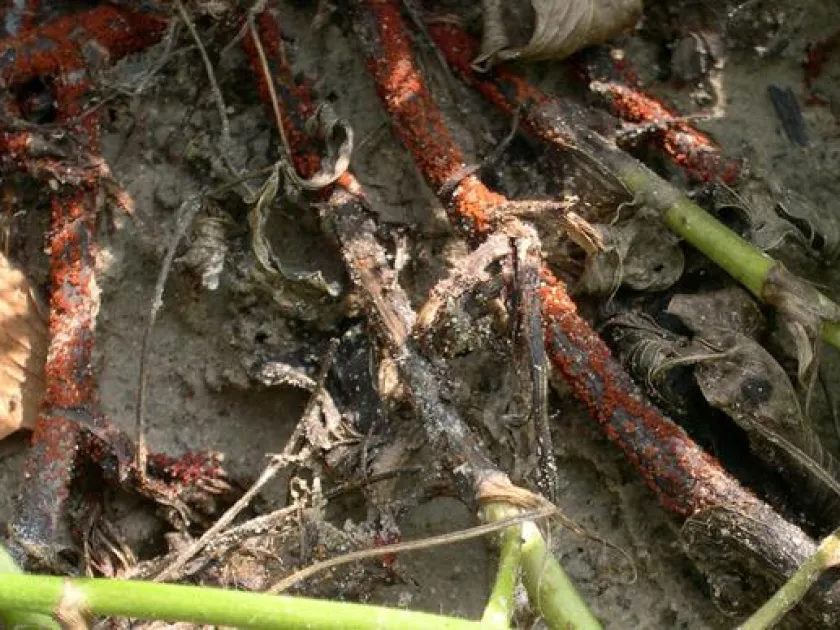
Root system examination reveals dark, necrotic lesions that can girdle the taproot. The decaying roots often appear black, which is characteristic of the infection.
Under humid conditions, a reddish-brown or dark mycelial growth and sporulation may be visible at the base of the stem near the soil line.
Pod decay is common, with mature pods becoming blackened and brittle, often rotting completely in the soil before harvest time.
- Chlorosis and yellowing of the leaves.
- Black, necrotic lesions on the taproot and lateral roots.
- Stunting of plant growth.
- Sudden wilting and plant death.
- Decayed and blackened peanut pods.
Pathogen
The disease is caused by the soil-borne fungus Cylindrocladium crotalariae (teleomorph Calonectria ilicicola). It is a persistent pathogen capable of producing resilient microsclerotia.
The fungus primarily infects the roots and lower stems of susceptible plants. Peanut (groundnut) is the most significant commercial crop affected by this pathogen globally.
Cylindrocladium crotalariae thrives in moist soil environments, where it can survive as sclerotia for many years in the absence of a host plant.
Biological activity of the pathogen involves the colonization of the vascular system of the host, leading to rapid decay of the root tissues and systemic failure.
Dispersal is primarily through contaminated soil, irrigation water, and the movement of infected plant debris by farming equipment across agricultural fields.
Conditions for development
High soil moisture is the most critical factor for disease development. Excessive rainfall or improper irrigation management significantly promotes the infection.
The fungus prefers warm temperatures, typically between 20°C and 25°C, for optimal growth and proliferation of its spores.
Poorly drained, heavy clay soils are particularly susceptible to this disease due to their ability to hold water, creating a perfect habitat for the fungus.
Field equipment is a primary vector for spreading the pathogen between fields; cleaning machinery is essential to prevent the spread of contaminated soil.
Continuous monocropping of peanuts significantly increases the inoculum density in the soil, making subsequent crops more vulnerable to severe outbreaks.
Why it matters
Cylindrocladium black rot can lead to massive economic losses due to stand reduction and low yields in infected peanut fields.
Affected crops produce poor-quality pods, making them unsuitable for food processing and decreasing the overall market value of the harvest.
The pathogen causes irreversible damage to the root system, meaning plants cannot recover once the infection reaches an advanced stage.
The long-term persistence of the fungus in the soil complicates land management and limits the options for rotating profitable crops on infested acreage.
High levels of infection may necessitate the abandonment of certain fields for peanut production for extended periods, impacting overall farm profitability.
Protection
Implementing long-term crop rotation (3–5 years) with non-host crops is the most effective management strategy to decrease soil-borne inoculum levels.
Improving field drainage and leveling the land to avoid water accumulation are vital cultural practices to discourage the growth of the pathogen.
Selection of resistant or tolerant peanut varieties is the cornerstone of an integrated pest management program against this disease.
Sanitation practices, including the deep plowing of crop residues, help to accelerate the decomposition of infected tissues and reduce survival of the fungus.
Seed treatment with registered fungicides provides early-season protection to seedlings, though it may not be sufficient for severe infestations later in the season.
Pathogens and affected parts
Affects crops · 1
Discussion
No discussions yet — be the first.