
Cucurbit yellow stunting disorder
Cucurbit yellow vine agent
Description
Symptoms
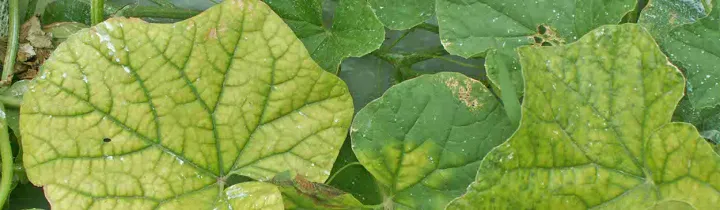
The primary symptoms appear as interveinal chlorosis on older leaves, which gradually spreads throughout the entire plant canopy over time.
While the leaf tissue between the veins turns yellow, the veins themselves remain distinctively green, creating a sharp contrast that is characteristic of this disorder.
Infected plants exhibit severe stunting and reduced internode length, resulting in a dwarf-like appearance that significantly limits the overall biomass.
Fruit set is drastically reduced, and the fruits that do develop are often deformed, small, and lack the characteristic color and quality of healthy specimens.
The leaves eventually become brittle and develop a leathery texture, while leaf margins may curl upward or downward as the plant reaches an advanced stage of infection.
Pathogen
The causative agent of this disease is the Cucurbit yellow stunting disorder virus (CYSDV), a member of the Crinivirus genus within the Closteroviridae family.
This virus has a single-stranded RNA genome and is strictly phloem-limited, meaning it restricts its colonization to the plant's nutrient-transporting tissues.
The primary vector for the transmission of CYSDV is the sweetpotato whitefly, Bemisia tabaci. The virus is transmitted in a semi-persistent manner, where the whitefly acquires the virus after feeding on an infected plant and remains infectious for several days.
Weed species from the Cucurbitaceae, Convolvulaceae, and Amaranthaceae families serve as reservoirs, allowing the virus to overwinter and persist in the environment.
Unlike many other plant viruses, mechanical transmission via pruning tools or sap contact is not considered a significant route for this specific pathogen.
Conditions for development
The development and spread of CYSDV are highly dependent on the population dynamics of its whitefly vector, which thrives in warm and dry environmental conditions.
High temperatures accelerate the life cycle of Bemisia tabaci, leading to rapid population explosions that facilitate the widespread dissemination of the virus.
The presence of nearby weed hosts or abandoned crop fields provides a continuous source of inoculum, fueling new outbreaks during the growing season.
In greenhouse settings, the virus can spread year-round if the facility remains planted without an adequate break, allowing for continuous vector reproduction.
Proper field hygiene and the reduction of nearby host plant density are critical to slowing down the progression of the disease within the cultivation area.
Why it matters
This disease is economically devastating, capable of reducing total yields by 30 to 80 percent, depending on the timing of infection and plant maturity.
The quality of the produce is severely compromised, with fruit sugar content significantly reduced and marketability dropping due to deformation.
Infected plants show increased susceptibility to secondary pathogens, including various fungi and bacteria, which can hasten the death of the crop.
Increased expenditure on aggressive whitefly control programs significantly raises production costs, reducing the overall profit margin for the grower.
In regions where the virus has become endemic, the cultivation of highly susceptible cucurbit varieties often becomes unsustainable without extreme control measures.
Protection
The most effective strategy for managing CYSDV is an integrated pest management (IPM) approach that focuses on intensive whitefly population control.
Growers should monitor whitefly populations using yellow sticky traps and apply systemic insecticides as soon as the threshold levels are exceeded.
- Implement a mandatory fallow period in greenhouses to break the life cycle of the vector and the virus.
- Utilize physical barriers, such as fine-mesh insect screens or row covers, to protect young plants during the most vulnerable growth stages.
- Eliminate alternative weed hosts in and around the planting area to remove the virus reservoir.
- Prioritize the use of resistant or tolerant cultivars that have been bred to withstand the impacts of the virus.
Maintaining a strict field sanitation protocol, including the prompt removal and destruction of symptomatic plants, helps to reduce the inoculum potential in the field.
Discussion
No discussions yet — be the first.