
Description
Symptoms
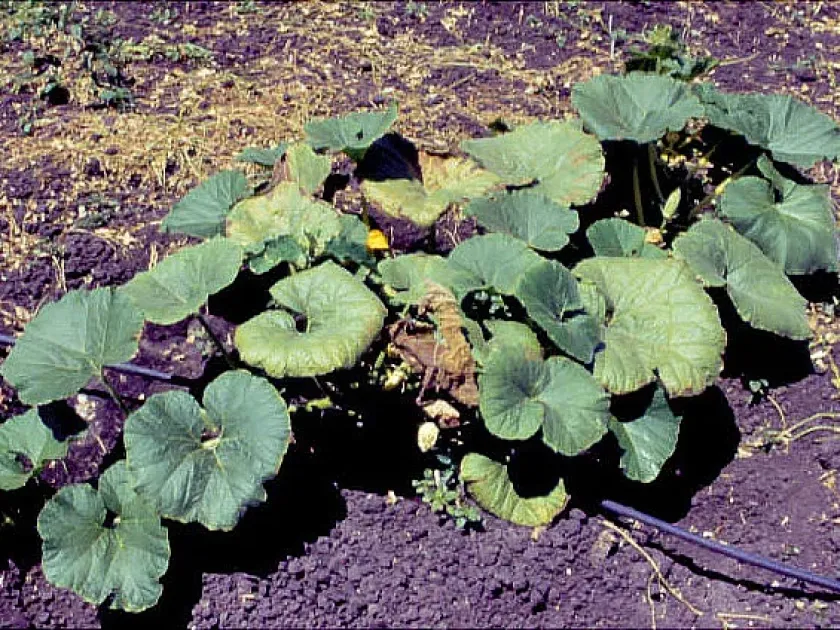
The main symptom is a pronounced interveinal chlorosis on the leaves of the middle and lower plant layers. The yellowing gradually progresses across the leaf blade, while the veins remain green, giving the plant a mottled appearance.
Unlike many other viral diseases, Cucurbit chlorotic yellows is not typically associated with severe leaf deformation or curling. Plants often appear less stunted in the early stages compared to other viral infections.
As the disease progresses, shoot growth slows down, and there is a general weakening of the plant's vegetative mass. In some cases, lower leaves may become brittle and drop prematurely, negatively affecting photosynthetic activity.
Visual symptoms can mimic magnesium or nitrogen deficiency, making diagnostic accuracy via visual observation difficult. Laboratory testing using PCR or ELISA is required to confirm the presence of the virus.
The infection can manifest in patches within a field or greenhouse, gradually spreading to neighboring plants, which is characteristic of vector-borne virus spread.
Pathogen
The pathogen is the Cucurbit chlorotic yellows virus (CCYV), a member of the genus Crinivirus within the family Closteroviridae.
The virus consists of filamentous particles containing single-stranded RNA. It is an obligate parasite that cannot reproduce outside of the host plant's cells.
Transmission in nature occurs exclusively in a semi-persistent manner via insect vectors. The primary vector is the whitefly, particularly the tobacco whitefly (Bemisia tabaci).
The virus circulates within the insect for a certain period after feeding on an infected plant, but it is not passed transstadially through the eggs of the vector.
The limited host range of the virus includes mainly members of the Cucurbitaceae family, such as watermelon, melon, cucumber, zucchini, and pumpkin.
Conditions for development
The development of an epidemic depends directly on the population density of whiteflies in the crops. Optimal conditions for the pest's reproduction include high temperatures (above 25-28 degrees Celsius) and high humidity.
Disease spread accelerates when weeds are present in the field or near greenhouses, as they serve as natural reservoirs for the virus during the off-season.
Dense planting and poor ventilation in greenhouse environments create an ideal microclimate for the rapid buildup of vector colonies, triggering widespread infection.
Agricultural equipment used for field maintenance can facilitate the movement of whiteflies between neighboring plots, thereby accelerating the spread of the disease.
Using poor-quality or pest-infested planting material is a critical risk factor for the introduction and rapid distribution of the viral infection.
Why it matters
The main danger of the virus lies in a sharp reduction in the commercial quality and volume of cucurbit yields. Fruits formed on diseased plants are often small and lose their flavor characteristics.
In watermelons and melons, sugar accumulation is significantly reduced, rendering the fruits unmarketable. The virus suppresses physiological processes necessary for proper ripening.
Early infection can lead to significant yield losses, potentially resulting in a total loss of commercial value. Plants also become more susceptible to secondary fungal and bacterial infections due to a compromised immune system.
The disease causes economic losses for producers, as infected plantations require additional investments in expensive vector control measures and often necessitate the removal of symptomatic plants.
- Reduced sugar content in fruits
- Premature senescence of the foliage
- Decreased commercial fruit size
- Loss of marketability
- Reduced duration of the fruiting period
Protection
The most effective management strategy is an integrated approach focused on controlling the disease vector — the whitefly. Managing pest populations allows growers to break the virus transmission cycle.
It is essential to conduct regular weeding both inside greenhouses and along the perimeter of fields, as weeds act as reservoirs for the infection.
Using spatial isolation when planting new batches of seedlings from older, potentially infected crops significantly lowers the risk of secondary infection.
The use of yellow sticky traps helps monitor whitefly population dynamics, allowing for timely application of protective measures before mass infestation occurs.
Strict crop rotation and mandatory disinfection of greenhouse facilities after each production cycle are necessary to eliminate all stages of the vector's development.
Pathogens and affected parts
Affects crops · 1
Discussion
No discussions yet — be the first.