
Western gall rust
Cronartium harknessii
Description
Symptoms
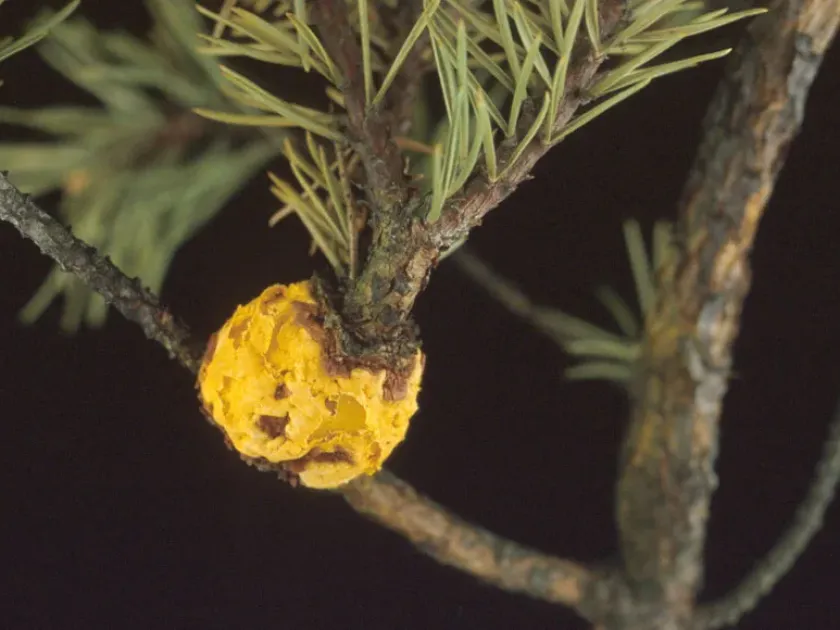
The primary diagnostic sign of the infection is the formation of spherical or oval-shaped galls on the stems and branches of pine trees. These galls are essentially hypertrophied wood tissues induced by the fungal parasite.
In spring, bright orange or yellow aeciospores become visible on the surface of these galls. They appear as dusty masses erupting through cracks in the bark once the fungus has completed its maturation cycle.
In infected areas, the bark typically becomes rough, cracked, and significantly darkened. Prolonged infection often leads to the death of the branch or stem section, causing permanent deformation of the crown.
Young trees infected on the main leader often develop distorted growth or form dense clusters of branches known as witches' brooms. Frequently, the top section of the tree above the gall turns yellow and dies due to impaired nutrient transport.
Monitoring is most effective during the sporulation period when the vibrant orange masses are easily detectable from a distance. During the rest of the year, identification relies on recognizing these abnormal woody swellings.
Pathogen
The causal agent of this disease is the rust fungus Cronartium harknessii. This is a specialized pathogen classified as an autoecious rust fungus, capable of completing its life cycle without an alternate host, attacking only various pine species.
The fungus invades the plant tissues through tender, young shoots, where it initiates the development of its mycelium. Unlike many other rust diseases, this pathogen does not require a secondary host, which significantly facilitates its spread within coniferous stands.
Throughout its life cycle, the fungus stimulates abnormal cell division in the tree's vascular tissues, resulting in the formation of characteristic galls. Reproduction occurs via aeciospores, which are dispersed by wind currents during the spring and early summer months.
These aeciospores remain viable even in relatively dry conditions, allowing the fungus to quickly colonize new areas of the forest. The pathogen can persist within the tree's tissues for many years, gradually depleting the resources of the affected plant section.
The biology of the pathogen is highly adapted to temperate climates with high humidity levels, where spore production and germination are most intense. The persistent presence of active mycelium makes infected trees long-term sources of inoculum.
Conditions for development
Conditions favoring infection include high relative humidity during the period of pine bud break. This specific timing allows aeciospores to germinate effectively on the surfaces of young, non-lignified shoots.
Temperatures ranging from 15 to 20 degrees Celsius are optimal for the rapid development of the pathogen. Cool and rainy weather patterns in late spring create an ideal environment for the widespread dispersal of the fungus.
The presence of existing infected trees in the vicinity creates a permanent source of inoculum. In densely planted stands where air circulation is restricted, the disease spreads far more aggressively between neighboring trees.
Light intensity also plays a role in the infection process; however, high humidity remains the primary driver. In dense plantations, the high frequency of host contact allows the fungus to jump easily from one branch to another.
Overall tree stress, caused by insect attacks or unfavorable soil conditions, can exacerbate the visual symptoms of the disease. Healthy, vigorously growing trees show better resilience, though they are not immune to heavy inoculum pressure.
Why it matters
The primary harm involves a substantial reduction in wood growth due to the obstruction of vascular tissues within the galls. These infected areas act as metabolic sinks, diverting vital nutrients and weakening the rest of the tree.
Affected stems lose their commercial timber value as the wood becomes deformed and susceptible to secondary decay. Eventually, these trees become structurally weak and prone to wind breakage during storms.
In nurseries, young seedlings often succumb to the infection within a few seasons. If the pathogen affects the root collar or the primary leader, the seedling's death is almost certain, leading to significant economic losses for growers.
The disease facilitates secondary infestations by wood-boring insects, which exploit the weakened bark around the galls. This combination further accelerates the decline and eventual mortality of the affected limbs or the entire tree.
At a forestry scale, the prevalence of this rust requires costly sanitation activities, including the removal of infected trees. Severely damaged stands often require complete clear-cutting and replanting, which represents a massive operational expense.
Protection
The primary preventative measure is the use of rust-resistant stock sourced from certified forest nurseries. It is crucial to inspect seedlings carefully during purchase, rejecting any plants that show early signs of stem swelling or gall formation.
Sanitation logging, which involves the removal and destruction of infected trees, is a standard practice in forest management. All infected materials must be removed from the site and destroyed by burning to prevent further spore dispersal.
In nursery environments, chemical control using fungicides during peak sporulation periods can be effective. Treatments with copper-based or systemic fungicides help reduce the infection load during the early stages of plant development.
Maintaining optimal stand density is essential to ensure adequate air circulation and reduce micro-humidity around the trees. Regular thinning operations significantly decrease the likelihood of widespread infection in younger pine forests.
Continuous monitoring of forest stands allows for the early detection of disease hotspots. Prompt intervention and the removal of initial infection sources are the most effective ways to prevent a large-scale epidemic in young forest plantations.
Discussion
No discussions yet — be the first.