
Pine stem rust
Cronartium asclepiadeum
Description
Symptoms
Early symptoms appear as chlorotic needles on affected branches, followed by the development of characteristic swelling on the stems or branches of the trees.
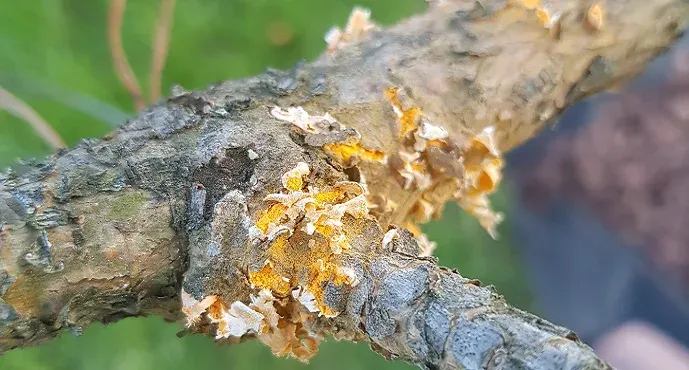
The most diagnostic sign is the appearance of aecia — blister-like swellings on the bark that rupture to reveal a mass of bright orange or yellow powder-like spores.
Infection sites often develop open cankers or deep wounds associated with heavy resin flow, which is a defensive response of the pine tree to the fungal attack.
Young trees are particularly vulnerable; if the infection reaches the main trunk, it often results in severe deformation, stunted growth, or the death of the entire tree.
On intermediate hosts, the disease manifests as small brown spots or pustules on the underside of the leaves, which serve as an active inoculum source for the next season.
Pathogen
The disease is caused by the heteroecious rust fungus Cronartium asclepiadeum (synonym Cronartium flaccidum). This pathogen has a complex life cycle involving an alternation between pine trees and various herbaceous hosts.
The fungus infects pines through the needles or young shoots and colonizes the cambium and bark. As a perennial parasite, it forms long-lived mycelium that persists in the host tissues for many years.
The life cycle includes the production of aeciospores in the spring, which are wind-dispersed to infect healthy pines. These spores are highly mobile and can travel significant distances under favorable wind conditions.
Intermediate hosts, such as Vincetoxicum and other plants, are essential for the fungus to complete its sexual reproduction stage, producing urediniospores and teliospores during the summer.
The biological success of this fungus depends on its ability to synchronize its sporulation periods with the vulnerability of the host plants, ensuring its survival across different environmental conditions.
Conditions for development
The development of the disease is heavily favored by high relative humidity and mild temperatures during the spring, which are optimal for spore germination and infection.
Dense plantations with poor air circulation create a microclimate that traps moisture, leading to an increased risk of severe fungal outbreaks within the stand.
The proximity of intermediate host plants significantly increases the infection pressure on pines, making plantations located near such vegetation highly susceptible.
Trees that are already stressed by drought, poor soil quality, or mechanical injuries are more prone to infection compared to vigorous, healthy individuals.
Prolonged wet spells during the period of aeciospore dispersal dramatically increase the incidence of the disease, often leading to rapid colonization of new young shoots.
Why it matters
Pine stem rust is a devastating disease in forestry, causing substantial mortality in young plantations and reducing the quality of timber in older stands.
The infection disrupts the vascular system of the tree, leading to crown dieback, reduced growth rates, and an overall decline in tree health and resilience.
Cankers caused by the fungus decrease the commercial value of the wood and make the trees susceptible to secondary attacks by wood-boring insects, like bark beetles.
In ornamental and landscape settings, the disease causes permanent disfigurement, forcing the removal of high-value trees that can no longer recover.
The economic impact is exacerbated by the long-term nature of the disease, as it remains latent in the trees for years before causing visible decline or mortality.
Protection
The primary control strategy involves site selection, ensuring that new pine plantations are established at a safe distance from areas where intermediate hosts are abundant.
Sanitation practices, including the systematic removal and destruction of infected trees or branches, are essential to reduce the local inoculum density.
Chemical control via fungicide application can be effective in nursery settings during the critical spring period to prevent primary infections of young seedlings.
- Regular monitoring of plantations for early signs of swelling or resin flow.
- Removing and eliminating intermediate hosts from the vicinity of the pines.
- Maintaining optimal planting density to promote airflow and dry conditions.
- Selecting resistant varieties or species that are less prone to rust infections.
Good silvicultural management, including adequate fertilization and thinning, improves overall tree health and strengthens their natural defenses against pathogen attacks.
Discussion
No discussions yet — be the first.