
Corynespora leaf spot
Corynesporasca
Description
Symptoms
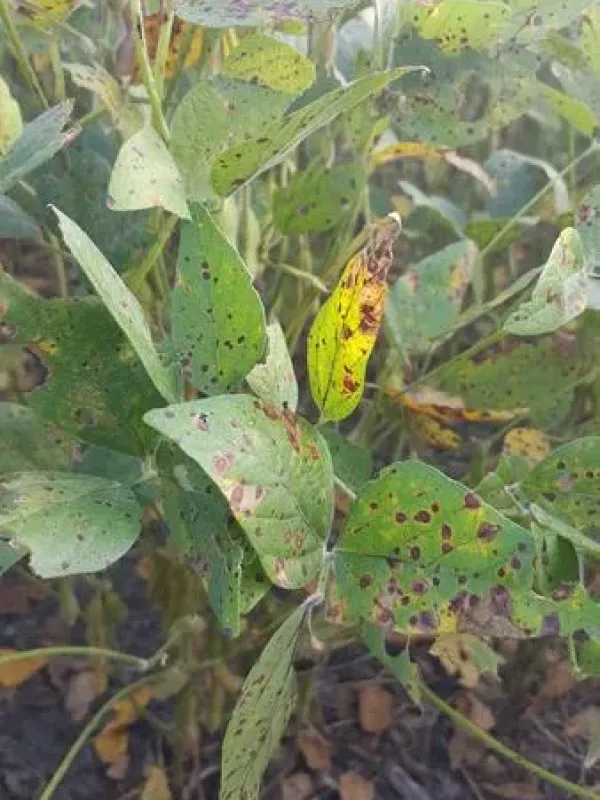
Initial symptoms typically appear as small, chlorotic to reddish-brown spots on the lower leaves. As the infection progresses, these spots expand into larger, irregular or angular lesions, often bounded by leaf veins.
A distinctive feature of the disease is the development of concentric rings within the lesions, giving them a 'target-spot' appearance. In humid conditions, a grey to olive-colored velvety growth may be visible on the undersides of the leaves.
Infections on stems and petioles appear as elongated, dark brown lesions or streaks. Severe stem infection can result in wilting, lodging, and premature death of the plant due to the disruption of water and nutrient transport.
Fruit symptoms include sunken, necrotic spots that can lead to fruit rot or deformation. In crops like soybean, the spots may show a reddish-brown margin and can merge to cover large areas of the foliage, leading to premature defoliation.
Because symptoms can easily be confused with other leaf spot diseases such as Cercospora or Septoria, accurate identification often requires laboratory examination of the conidia morphology.
Pathogen
The disease is caused by the fungus Corynespora cassiicola. It is a facultative parasite known for its extremely broad host range, affecting hundreds of plant species including soybeans, cucumbers, tomatoes, and various ornamentals.
This pathogen survives in soil, on crop debris, and within infected seeds. It is characterized by its ability to produce the phytotoxin cassiicolin, which plays a crucial role in the infection process by inducing cell death in host tissue.
The fungus produces conidia, which are disseminated primarily by wind, splashing rain, and agricultural machinery. These spores can persist for extended periods, allowing the pathogen to remain viable in the field across several seasons.
Corynespora cassiicola is known for its high genetic diversity, with numerous physiological races exhibiting varying levels of virulence. This variability poses a significant challenge for breeders aiming to develop resistant crop varieties.
Under favorable conditions, the pathogen colonizes the intercellular spaces of leaves and stems. Its rapid colonization rate and efficient sporulation make it a major threat to crop productivity in humid regions.
Conditions for development
The development of Corynespora leaf spot is strongly favored by warm and humid weather conditions. Optimal temperatures for fungal growth and sporulation range between +25°C and +30°C.
High relative humidity (above 80%) and persistent dew are essential for spore germination and successful penetration of the host tissue. Prolonged rain events significantly accelerate the spread of the disease within the crop canopy.
Dense planting patterns that limit airflow and trap moisture around the base of the plant create an ideal microclimate for the fungus to thrive and build up inoculum pressure.
High nitrogen fertilization rates can exacerbate the disease by promoting lush, succulent growth that is more susceptible to pathogen entry. Such plants often lack the necessary structural defenses to withstand fungal toxin activity.
The presence of alternative weed hosts acts as a reservoir for the fungus throughout the year. Infected plant residues remaining on the soil surface serve as the primary source of initial inoculum for subsequent crops.
Why it matters
The primary impact of the disease is the reduction of the functional leaf area, which severely limits the plant's photosynthetic capacity. This directly translates into lower biomass accumulation and reduced grain or fruit yield.
Severe infection leads to early senescence and defoliation, cutting short the critical period for seed filling. This results in smaller, shriveled seeds with poor quality and low germination potential.
In highly susceptible varieties, the disease can cause significant economic losses, sometimes exceeding 50% under extreme epidemic conditions. This necessitates costly intervention measures and impacts farm profitability.
The damage to stem integrity increases the risk of lodging, which complicates harvesting operations and further lowers the harvestable yield. Moreover, infected plants are often more susceptible to secondary pathogens.
Managing the disease requires significant investments in fungicides, which increases the cost of production. Furthermore, the development of fungicide resistance in the pathogen remains a growing concern for modern agriculture.
Protection
Integrated pest management (IPM) is the most effective approach. Crop rotation with non-host species is essential to break the life cycle of the pathogen and reduce the soil-borne inoculum reservoir.
Deep plowing and residue management are recommended to bury infested plant debris, promoting decomposition and reducing the survival rate of the fungal structures.
- Selection of resistant or tolerant cultivars as a primary defense.
- Use of high-quality, fungicide-treated seeds.
- Strict weed control to eliminate alternative hosts.
- Adjustment of planting density to improve air circulation within the crop.
- Application of protective and systemic fungicides (e.g., strobilurins, triazoles).
Fungicide applications should be timed based on scouting and environmental monitoring, particularly during the early stages of disease development, to prevent the pathogen from reaching epidemic levels.
Biological control agents, such as Trichoderma species or specific strains of Bacillus, are increasingly used to suppress fungal growth in the soil and on the phyllosphere, providing an eco-friendly supplement to chemical control.
Discussion
No discussions yet — be the first.