
Description
Symptoms
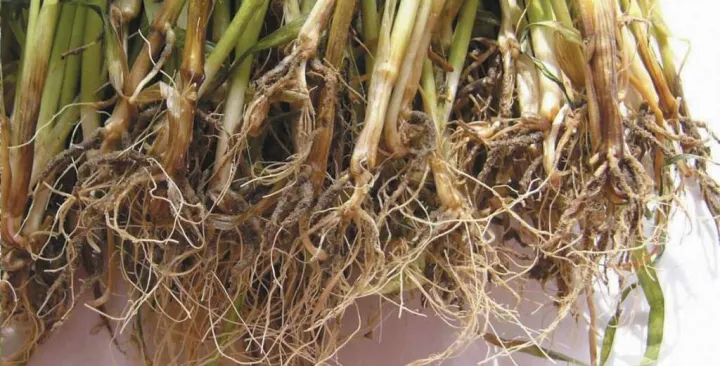
Initial symptoms are characterized by browning and softening of the roots and the stem base. As the infection progresses, these tissues turn dark brown or black, showing signs of severe cell death and decay.
Affected plants exhibit stunted growth, reduced tillering, and general chlorosis of the foliage. In severe cases, the entire plant may wilt and die during the seedling or early vegetative growth stages.
High humidity promotes the emergence of a pink or white mycelial mat at the crown of the plant. This characteristic fungal growth is a diagnostic feature of the disease during periods of active moisture.
The root system becomes brittle and rots, making it extremely easy to pull the plant from the soil. This lack of root integrity prevents the plant from securing nutrients, leading to rapid yellowing and death of the lower leaves.
At the heading stage, infected barley may display "whiteheads," where the heads become sterile and fail to fill. This is a direct consequence of the fungus blocking the vascular bundles at the base of the stem.
Pathogen
The causal agent of Fusarium root rot is the fungus Gibberella zeae (also known as Fusarium graminearum in its asexual state). It is a persistent soil-borne pathogen capable of surviving in soil, crop residues, and infected seeds for extended periods.
This fungus exhibits a broad host range, infecting various cereals, including wheat, barley, and maize. By invading the root and crown tissues, the pathogen disrupts the plant's vascular system, hindering the uptake of water and vital minerals.
The fungus is highly virulent and produces mycotoxins, such as deoxynivalenol, which act as virulence factors. These toxins not only weaken the host plant but also pose significant safety risks when grain is harvested and processed.
Transmission occurs through airborne spores and contaminated soil particles. Once the pathogen colonizes the root zone, it utilizes saprophytic survival strategies to remain in the field even after the host crop has been harvested.
The genetic diversity of Gibberella zeae makes it highly adaptable to different environmental conditions. Its ability to switch between sexual and asexual reproductive stages provides a high survival potential in agricultural landscapes.
Conditions for development
The development of Fusarium root rot is favored by warm and moist conditions, with temperatures ranging between 15°C and 25°C. Excessive soil moisture is the primary trigger for the rapid germination of fungal spores.
Continuous monocropping, particularly of cereals, leads to a buildup of inoculum in the soil. The presence of crop stubble provides a perfect substrate for the fungus to persist from one season to the next.
Dense planting patterns and high nitrogen application levels often result in a microclimate characterized by reduced airflow and higher humidity. Such conditions are conducive to fungal invasion and rapid disease spread.
Feeding damage by soil-dwelling pests like wireworms provides physical pathways for the fungus to enter the plant. Weakened roots are significantly more susceptible to these fungal opportunistic infections.
Environmental stresses, including cold winter injuries or erratic spring temperature shifts, suppress the plant’s natural defense mechanisms. During these periods of weakness, the fungus can easily overwhelm the host's defenses.
Why it matters
The primary economic impact is the reduction of plant stand density due to seedling mortality. Fewer plants mean lower potential yield, which cannot be compensated for later in the growing season.
Infected plants have limited water and nutrient uptake, leading to grain shriveling and reduced test weights. This decrease in grain quality limits its commercial value and suitability for milling.
The accumulation of mycotoxins in the grain makes it unsafe for human consumption or animal feed. This often leads to grain rejection at elevators and significant financial losses for the grower.
Severe infestations can lead to widespread lodging, making mechanical harvesting inefficient and labor-intensive. Total yield losses can range from 10% to 50% depending on the severity of the infection.
The persistence of the fungus in the field creates a long-term burden, necessitating expensive chemical interventions in future cropping cycles. This shifts the farm's operational costs toward repeated disease management.
Protection
Crop rotation is the most effective cultural practice for managing Fusarium root rot. Integrating non-host crops like legumes or oilseeds into the rotation helps to reduce the primary inoculum load in the soil.
Seed treatment with professional-grade systemic fungicides is critical for early-season protection. This practice ensures that the emerging roots and shoots are shielded from initial soil-borne inoculum.
Agronomic strategies such as incorporating crop residues into the soil help accelerate the decomposition process and reduce the survival of the fungus. Maintaining good soil drainage is also essential for limiting excess moisture.
- Utilizing resistant or tolerant cultivars when available.
- Balanced fertilization to improve overall plant health and stem strength.
- Incorporating bio-fungicides containing beneficial fungi like Trichoderma.
In-season foliar applications of fungicides, specifically triazoles, can be used to suppress the disease in localized hotspots. Timely intervention is crucial, as late-stage applications are often ineffective against established root rot.
Pathogens and affected parts
Affects crops · 1
Discussion
No discussions yet — be the first.