
Citrus tatter leaf
Citrus tatter leaf virus
Description
Symptoms
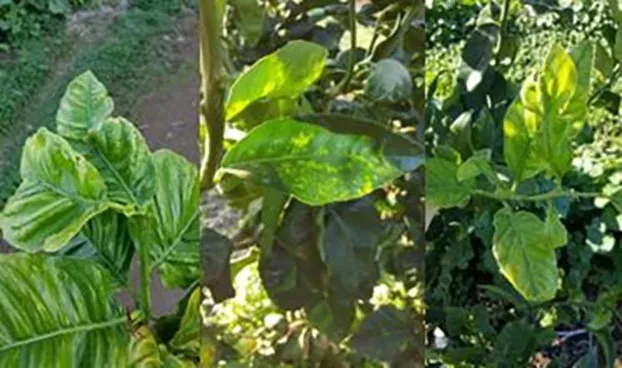
The hallmark symptom is the development of chlorotic spots, streaks, and irregular patches on young leaves, giving them a tattered or shredded appearance as the leaf tissue fails to expand properly.
Leaf deformation is common, with affected leaves often appearing wrinkled or asymmetrical. Growth is stunted, and in severe cases, premature leaf drop can weaken the overall structure of the canopy.
The most dramatic symptom appears at the bud union of sensitive rootstocks. Graft incompatibility leads to swelling, tissue necrosis, and eventual constriction, which can result in the sudden decline or death of the tree.
Symptoms are most visible during periods of flush growth. While hot summer temperatures may temporarily mask these signs, the virus remains active within the internal conductive tissues of the plant.
In older trees, the symptoms may become milder or even disappear entirely, making the tree a carrier that can accidentally be used as a source of scion wood for new propagations.
Pathogen
The Citrus tatter leaf virus (CTLV) is a systemic plant pathogen with filamentous particles. It primarily spreads through contaminated grafting tools or the use of infected budwood during the propagation process.
The virus has a wide host range within the Citrus genus, but its most severe effects are observed in trees grafted onto Poncirus trifoliata rootstocks, which exhibit a clear graft incompatibility with the virus.
The pathogen colonizes the phloem tissues, spreading throughout the tree and ensuring that every vegetative part becomes a potential source of the virus for further transmission.
Because there are no effective insect vectors identified for this specific virus in most regions, the primary risk is human-mediated transmission during routine maintenance such as pruning and grafting.
As the virus persists in the tree for its entire life, infected trees remain silent reservoirs of the disease, posing a constant risk to surrounding healthy plants if maintenance protocols are not strictly followed.
Why it matters
Economic damage is primarily driven by reduced fruit yield and quality. Trees infected with CTLV struggle to maintain the vigor required for consistent production, leading to smaller, less marketable fruits.
The incompatibility caused by the virus forces growers to remove entire sections of their orchards prematurely. This creates significant financial losses due to the cost of replanting and the loss of years of productivity.
CTLV severely limits the choice of scion-rootstock combinations. Growers cannot utilize certain high-performing pairings because they are genetically susceptible to this specific viral infection.
The latent nature of the virus makes it a hidden threat in nursery stocks. Distributing infected saplings can lead to large-scale outbreaks, impacting the reputation and profitability of commercial citrus nurseries.
Over time, the cumulative stress of the viral infection reduces the lifespan of the citrus trees, leading to long-term decline and increased susceptibility to secondary environmental stressors.
Protection
The most effective strategy for managing Citrus tatter leaf is the implementation of a clean-stock program. Only trees certified as virus-free should be used for planting new orchard blocks.
Strict tool sanitation is mandatory. After every use, pruners, saws, and grafting knives must be disinfected using effective chemical solutions to prevent the mechanical transmission of the virus between trees.
Prompt rogueing (removal) of symptomatic trees is essential to manage the spread of the disease. Since no cure exists, preventing the virus from reaching a permanent status in the orchard is the only logical solution.
Nurseries should employ regular diagnostic testing, such as ELISA or PCR, to screen mother trees for the presence of the virus before collecting budwood for propagation.
International and domestic quarantine measures are crucial to prevent the accidental introduction of CTLV into regions where it is not yet established. Proper identification and testing at borders protect local agricultural integrity.
Discussion
No discussions yet — be the first.